A 5-year fixed buy-to-let rate of 3.49% sits at the top of the London market right now, available at 65% LTV through a handful of specialist lenders including TMW and Barclays. That headline figure gets quoted frequently. What gets quoted less often is the arrangement fee sitting alongside it: typically £1,999 to £3,999 on the products carrying those lead rates.
What the Numbers Show
Work through the actual rate sheet and the picture gets more granular quickly. At 75% LTV — where the majority of London landlords sit, given average property prices in Greater London running above £520,000 — the best 5-year fixes land between 3.89% and 4.35%, depending on lender and whether you're paying a flat fee or a percentage-based product fee. On a £400,000 loan, a 1.5% product fee is £6,000. That changes the effective cost considerably when you run it against a 3.99% fee-free alternative over 60 months.
Two-year fixes tell a different story. The sharpest 2-year rates in London currently sit around 4.65% at 75% LTV, with fees of £999 to £1,999. The spread between 2-year and 5-year fixes has narrowed to roughly 80 basis points, which narrows the argument for short-term products if you're betting on rates falling materially within 24 months. In late 2023, that spread was closer to 150 basis points.
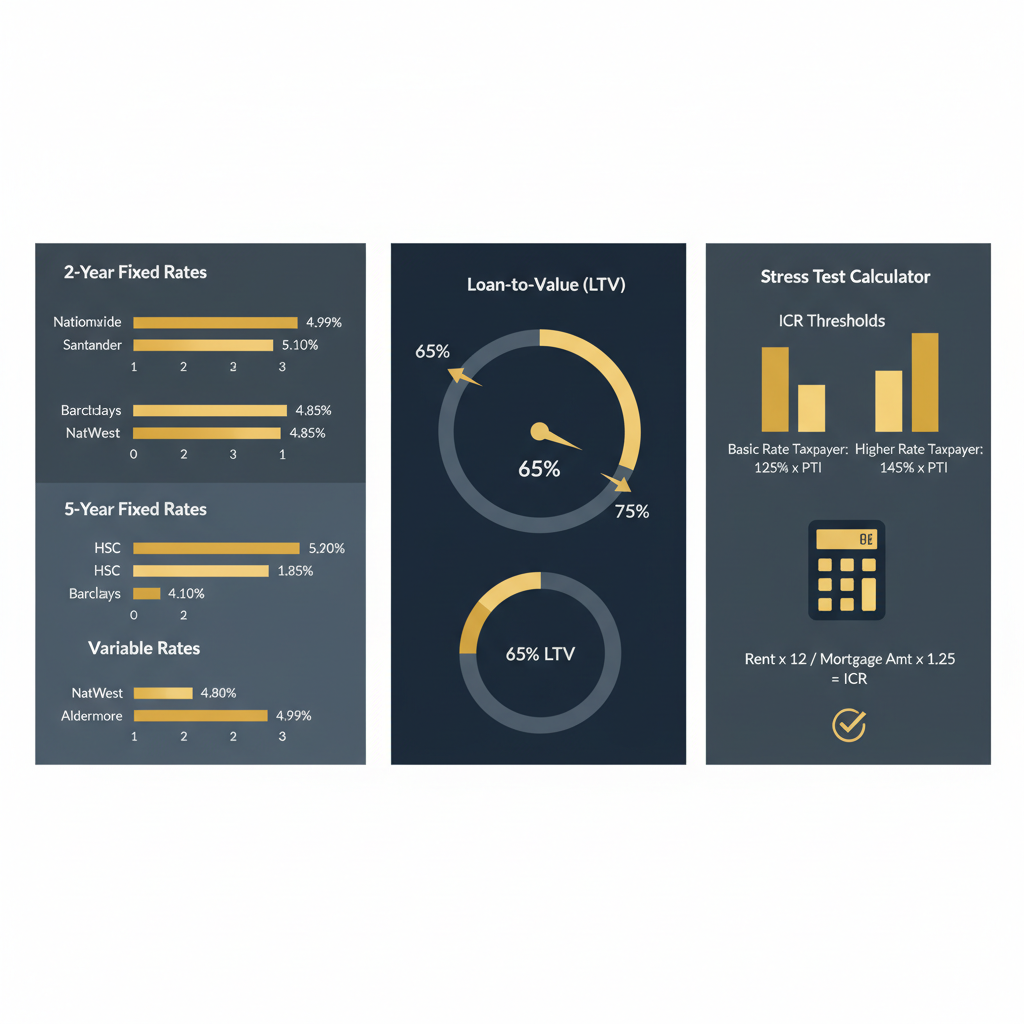
The stress test is where London landlords hit the real obstacle. Most lenders applying the Prudential Regulation Authority's 2017 underwriting standards stress at 5.5% across the product term, requiring rental income to cover 125% to 145% of that stressed payment. At 145% — the figure applied to higher-rate taxpayers and portfolio landlords — a £400,000 mortgage at 5.5% requires monthly rent of roughly £2,686. In Zone 3 or 4 London that's achievable on a 3-bedroom house. On a 1-bedroom flat in SE1 valued at £450,000 generating £1,900 per month, you won't pass that calculation at 75% LTV. You'll need to come down to 65% LTV or restructure the deal.
Lenders are treating this differently right now. Fleet Mortgages and Paragon currently apply 125% ICR for basic-rate taxpayers at 5.5% stress. Foundation Home Loans and Precise apply 145% ICR for higher-rate taxpayers. The difference in maximum loan size between those two positions on a £1,900 per month rental property can be as much as £40,000.
Portfolio landlords — defined as owning 4 or more mortgaged properties under PRA rules — face an additional layer. Lenders want a full portfolio schedule, recent mortgage statements, void period history and in some cases 3 months' business bank statements if properties are held in an SPV. Nationwide currently applies a 70% LTV cap across the whole portfolio for portfolio lending. Barclays will go to 75% but flags any property with a pre-existing charge from another lender. Processing time for a portfolio case at most high-street lenders runs 3 to 5 weeks longer than a standard single application.
Limited company applications have dominated London BTL submissions since the Section 24 mortgage interest relief restriction phased in fully by April 2020. Right now, the rate premium for borrowing through an SPV versus personal name sits between 0.3% and 0.7% depending on lender. That gap has closed since 2022, when it was closer to 1%. Lenders including Landbay, Aldermore and The Mortgage Works now offer SPV rates that are genuinely competitive with personal-name products, particularly on 5-year terms.
What This Means for Landlords
If you're holding a London property in personal name on a tracker that's running at Bank Rate plus 1.5% — currently 6.75% — the maths for remortgaging to a 5-year fix at 4.1% is straightforward. That's a 265 basis point saving. On a £350,000 interest-only loan, that's approximately £771 per month.
The product fee question is material at London loan sizes. At £500,000, a 1% arrangement fee is £5,000. Over a 5-year term that adds 0.10% to your effective annual rate. Run it against a comparable fee-free product at 4.45% and a 1% fee product at 4.05%, and the break-even point sits at around month 38. If you're likely to exit or remortgage before that, take the fee-free option.
ERCs on current London BTL fixes are structured in three main ways: declining from 5% to 1% over 5 years, flat at 3% for years 1 and 2 then 2% for years 3 to 5, or front-loaded at 5% declining 1% per year. On a £400,000 loan in year 1, the difference between a 5% ERC structure and a 3% structure is £8,000. Check the ERC structure, not just the headline rate.
New purchase activity in London has slowed materially since Q1 2024, with SDLT changes bringing the additional-rate threshold for BTL purchases back to 5% above standard residential rates from October 2024. On a £600,000 London acquisition, the additional SDLT bill alone is £30,000. That changes gross yield calculations significantly on properties yielding 4.5% or below — which covers a large share of inner London stock.
For accidental landlords or those holding legacy London property with sub-3% rates now expiring, the options have narrowed. The spread between best available rates and product minimum yield thresholds — most lenders need gross yield of at least 5% to pass ICR at 75% LTV — means some inner London properties with current valuations simply don't support remortgaging at the same LTV. A property bought in 2017 for £350,000 now valued at £480,000 might have improved equity position, but if the rent is £1,750 per month, the ICR calculation at 145% still caps borrowing at around £273,000 at 5.5% stress.
That's the number that matters most on the current London BTL rate sheet: not the 3.49% headline, but whether your rental income can satisfy 145% ICR at 5.5% on the loan you actually need.