A 2% arrangement fee on a £200,000 Manchester buy-to-let mortgage adds £4,000 to your borrowing costs before you have even made a single monthly payment. That number matters, and it is one many landlords overlook when they compare headline rates on comparison sites. So does the rental coverage calculation sitting beneath it.
Here is what a close read of current lender rate sheets actually shows for Manchester landlords right now.
What the Numbers Show
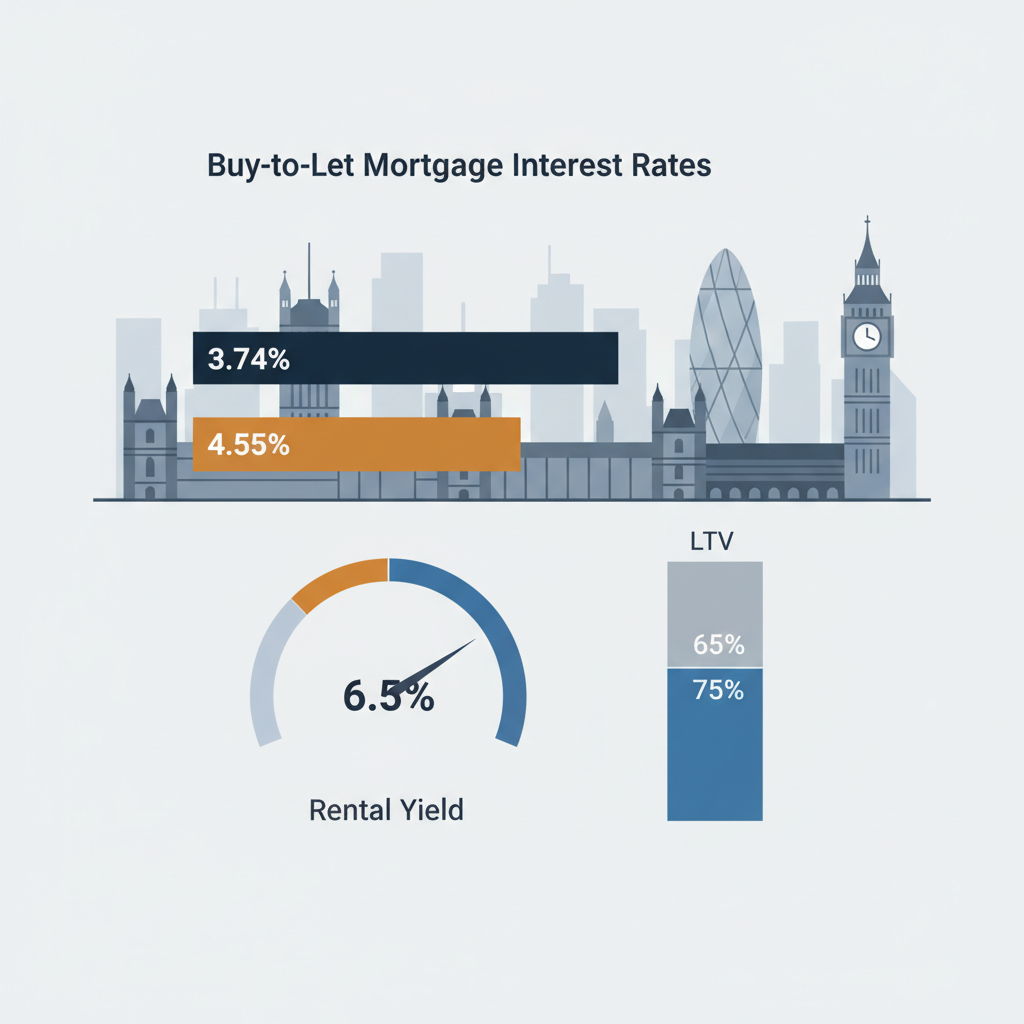
On a standard 75% loan-to-value 5-year fixed product, rates for Manchester buy-to-let borrowers currently sit between 3.89% and 4.74%, depending on lender and fee structure. The 3.89% product — available through lenders including The Mortgage Works and Paragon — carries that 2% arrangement fee. A fee-free equivalent from the same tier of lenders starts closer to 4.49%. On a £180,000 mortgage over 25 years on an interest-only basis, that difference is roughly £108 per month in interest charges. The fee-free route costs more monthly but saves the upfront £3,600. Your break-even point on taking the lower rate is approximately 33 months.
At 65% LTV — where Manchester landlords with equity in existing portfolios often land — rates drop further. The Mortgage Works currently shows a 65% LTV 5-year fix at 3.74%, again with a 2% fee. Skipton Building Society's portfolio range sits at 3.99% at the same tier with a flat £1,995 fee, which makes it comparatively cheaper on larger loan sizes above £200,000.
Two-year fixes tell a different story. A 75% LTV 2-year fix from TMW is currently priced at 4.19%, and Virgin Money's equivalent sits at 4.34%. Given that swap rates have been volatile in 2024 and have nudged slightly upward since September, the gap between 2-year and 5-year products has compressed to roughly 30 basis points at 75% LTV. Six months ago that spread was closer to 55 basis points. Locking in a 5-year fix is now a closer call than it was.
For Manchester properties above £500,000 — a category that includes period conversions in Didsbury and Chorlton, as well as HMO freeholds in Fallowfield — standard residential BTL rates no longer apply. Lenders including Fleet Mortgages and Landbay price these above a £750,000 threshold on their specialist range, and arrangement fees on those products commonly run to 2.5%.
Rental coverage is the other variable that directly affects what rate you actually qualify for. Most high-street BTL lenders apply a stress test of 145% rental coverage at a notional rate of 5.5%. On a £175,000 loan at interest-only, that means a minimum monthly rent of approximately £1,163 to meet coverage. Manchester's average private sector rent — £1,350 per month across the city according to recent Rightmove rental tracker data — means most single-let properties in M1 through M21 postcode areas satisfy this threshold without difficulty. HMOs, however, are stress tested differently at some lenders. Paragon uses a 125% coverage ratio on HMOs, which frequently makes it the more practical choice for Fallowfield and Rusholme HMO operators.
What This Means for Landlords
If you hold a Manchester BTL portfolio that was fixed in 2019 or early 2020, your previous rate was likely between 1.49% and 2.39%. Rolling onto a current 5-year fix at 3.89% on a £180,000 mortgage increases monthly interest by roughly £225. That is not a minor adjustment. For a property yielding 6.5% gross — the current average gross yield across South Manchester according to PropCast's Q3 figures — the net yield impact after that rate increase is significant enough to affect tax planning decisions, particularly for landlords holding properties in personal names and paying 40% income tax.
Section 24 remains the context for all of this. Mortgage interest is no longer a fully deductible expense for landlords in personal names, replaced by a 20% basic rate tax credit. A landlord in the 40% tax bracket on a £180,000 mortgage at 3.89% pays £7,002 per year in interest but can only claim relief on £1,400.40 of that. The after-tax cost of borrowing is materially higher than the headline rate implies. Limited company structures sidestep this, and it is telling that approximately 80% of new BTL purchase applications processed through brokers in Q3 2024 were made through limited companies — a figure that has risen from 47% in 2019.
Lenders serving limited company applicants in Manchester include Fleet Mortgages, Landbay, Foundation Home Loans, and Paragon. Foundation's limited company 5-year fix at 75% LTV currently sits at 4.29% with a 2% fee. Landbay's equivalent is 4.19% with a £999 flat fee — meaningfully cheaper on loan sizes below £150,000.
For first-time landlords — a category that covers a meaningful share of Manchester purchasers given the city's BTL investment appeal — product choice narrows considerably. Several lenders including BM Solutions impose a 0.25% loading on applications from borrowers without an existing BTL mortgage. That takes a headline rate of 4.19% to an effective rate of 4.44%. Precise Mortgages and Kensington do not apply that loading, which is worth knowing.
On EPC grounds, it also matters that Manchester City Council has enforced selective licensing across large parts of the city since 2015, with a renewal and expansion in 2022 covering 12 designated areas. The licence fee is currently £750 per property for a 5-year licence. Some lenders — including Nationwide's specialist BTL arm TMW — now ask for EPC ratings at application. Properties with an EPC rating of E or below will face additional capital expenditure requirements ahead of the proposed 2030 minimum C rating target under current government consultation.
A Manchester landlord with 3 properties, all mortgaged at 75% LTV on a current-cycle 5-year fix, might be paying between £850 and £1,100 per month across the portfolio in mortgage interest. Against gross rental income of £4,050 per month at a 6.5% yield on average £185,000 assets, the headline numbers still work. But the margin is narrower than it was at any point between 2015 and 2022, and fee structure, product type and legal ownership vehicle now each carry real financial weight.
The rate you see advertised is rarely the rate that actually costs you the most or the least.