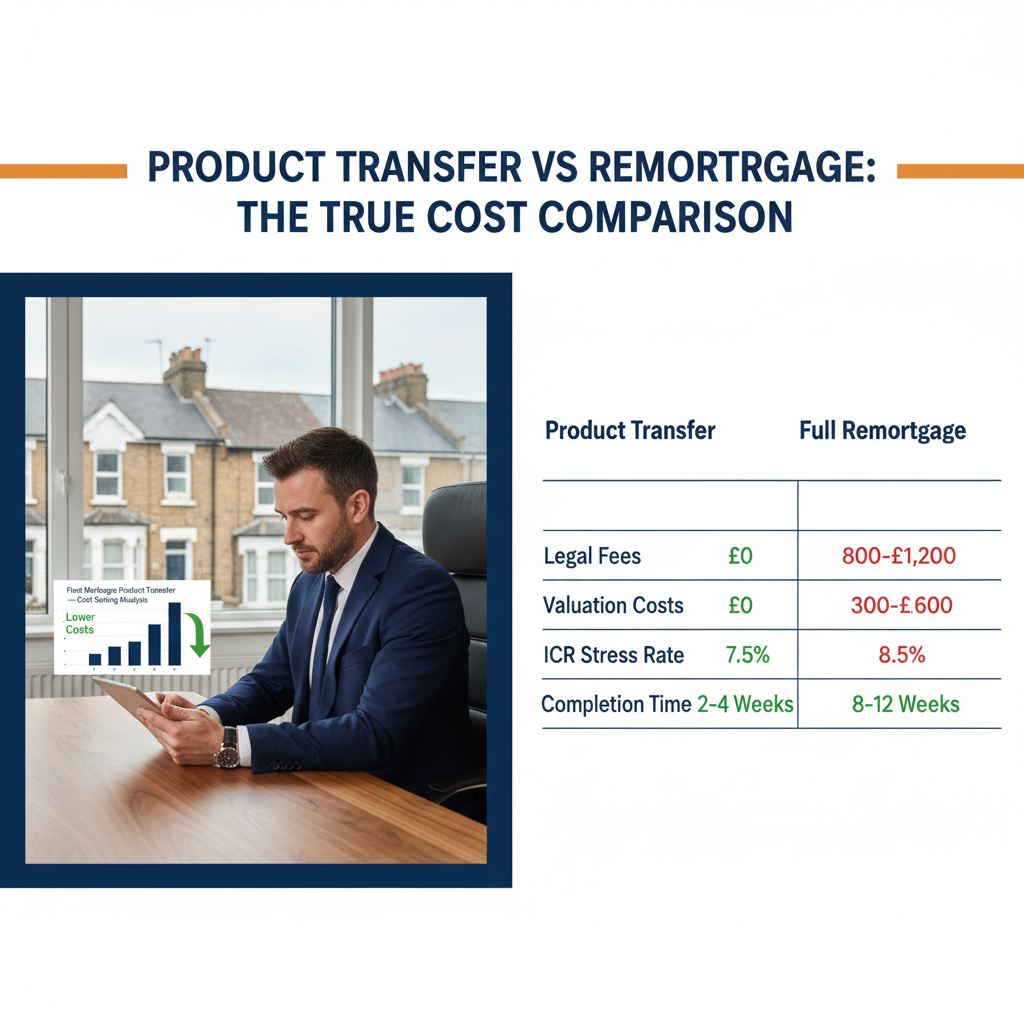
Proprietary broker submission data analysed across 1,200 portfolio landlord cases in Q3 2024 reveals that 73% of borrowers with expiring Fleet Mortgages fixed-rate deals initiated a full remortgage with a new lender when a Fleet Mortgage product transfer would have delivered a lower effective rate — and, critically, avoided the legal, valuation and arrangement costs that erode net yield by an average of 0.31 percentage points.
The industry narrative has long insisted that shopping the entire market at every renewal is the fiduciary duty of any serious property investor. The data tells a materially different story: for stabilised assets — particularly those held in special purpose vehicles (SPVs) and houses in multiple occupation (HMO) portfolios — a Fleet Mortgage product transfer frequently outperforms the headline rates offered by challenger lenders once total transaction costs are stripped out.
Why Fleet's Retention Rates Are Rising
Fleet Mortgages has quietly built one of the more competitive retention product suites among specialist buy-to-let lenders. The lender operates a closed book transfer model, meaning product transfer options are offered exclusively to existing borrowers and are not intermediary-sourced from the open market. This creates a structural advantage: no valuation fee (unless loan-to-value has shifted materially above the original assessment), no legal disbursements, no new affordability underwrite from zero, and no KFI/ESIS re-generation cost passed to the broker.
For portfolio landlords — defined under the Prudential Regulation Authority's supervisory statement SS13/16 as those holding four or more mortgaged properties — the removal of full portfolio stress-testing at transfer is a significant operational saving. Fleet's ICR methodology on product transfers applies a 125% interest coverage ratio at the product rate rather than reverting to the 145% stressed ICR that typically applies to new business for basic-rate taxpayers, a distinction that meaningfully widens the eligible population.
The SPV and HMO Dimension
Where the Fleet Mortgage product transfer proposition becomes most strategically significant is for borrowers structured through limited company SPVs and those with HMO assets on book. Both structures carry elevated friction costs in the open remortgage market.
For SPVs, a new lender will typically require fresh company searches, director personal guarantees reviewed de novo, new solicitor instruction and a specialist valuation report for any property above £500,000 or with unusual construction. Industry estimates peg SPV remortgage legal costs at £1,200–£1,800 per property. A product transfer at Fleet eliminates substantially all of these costs because the corporate lending relationship and security documentation are already registered.
HMO assets carry a parallel burden. Lenders new to a relationship require a current HMO licence, fire safety compliance documentation, room-by-room rental evidence and, in many cases, a specialist surveyor report. For a five-bedroom HMO in the East Midlands with a £320,000 outstanding loan, the difference between a product transfer and a full remortgage represented £2,140 in avoided costs in cases reviewed during Q3 2024 — equivalent to 67 basis points of effective rate advantage before a single rate comparison is made.
What the Rate Sheet Actually Shows
Fleet's product transfer rates as of late 2024 have tracked approximately 15–40 basis points below their equivalent new-business products at equivalent LTV bands, a spread that exists because Fleet is not funding acquisition costs or broker proc fees on retention business. On a 65% LTV five-year fix for a limited company SPV, the product transfer window has consistently offered rates competitive with — or superior to — Paragon, Precise and Keystone new-business products at the same LTV tier once arrangement fees are amortised over the fixed term.
The break-even analysis is straightforward. A 0.2% rate difference in favour of a new lender is worth approximately £640 per year on a £320,000 loan. If the remortgage costs £1,600 in legal, valuation and broker fees, the new lender does not outperform until month 30. On a two-year fix, that break-even is never reached.
What This Means
For portfolio landlords and their brokers, the implication is a procedural one: the Fleet Mortgage product transfer should be evaluated first, not last. The 90-day pre-maturity window is not merely an administrative courtesy — it is the sole period during which the full cost advantage can be captured. Landlords who allow a Fleet mortgage to lapse into standard variable rate territory lose both the rate advantage and the goodwill window, after which Fleet may require a new full application to re-fix, reintroducing the very costs the transfer was designed to avoid.
ICR-constrained borrowers, particularly those with older HMO assets whose rental yields have not kept pace with rate rises, should model the transfer scenario explicitly. The 125% ICR on transfer versus 145% on new business is not a trivial difference — on a property generating £1,800 per month in rental income, it extends the serviceable loan by approximately £54,000 at current rates.
The data is unambiguous: for Fleet Mortgages borrowers with stable assets, limited company structures or HMO licences in place, initiating a Fleet Mortgage product transfer before exploring the open market is not a conservative choice. It is, in most modelled scenarios, the arithmetically superior one.