What Foundation Home Loans Actually Does With an Imperfect Credit File
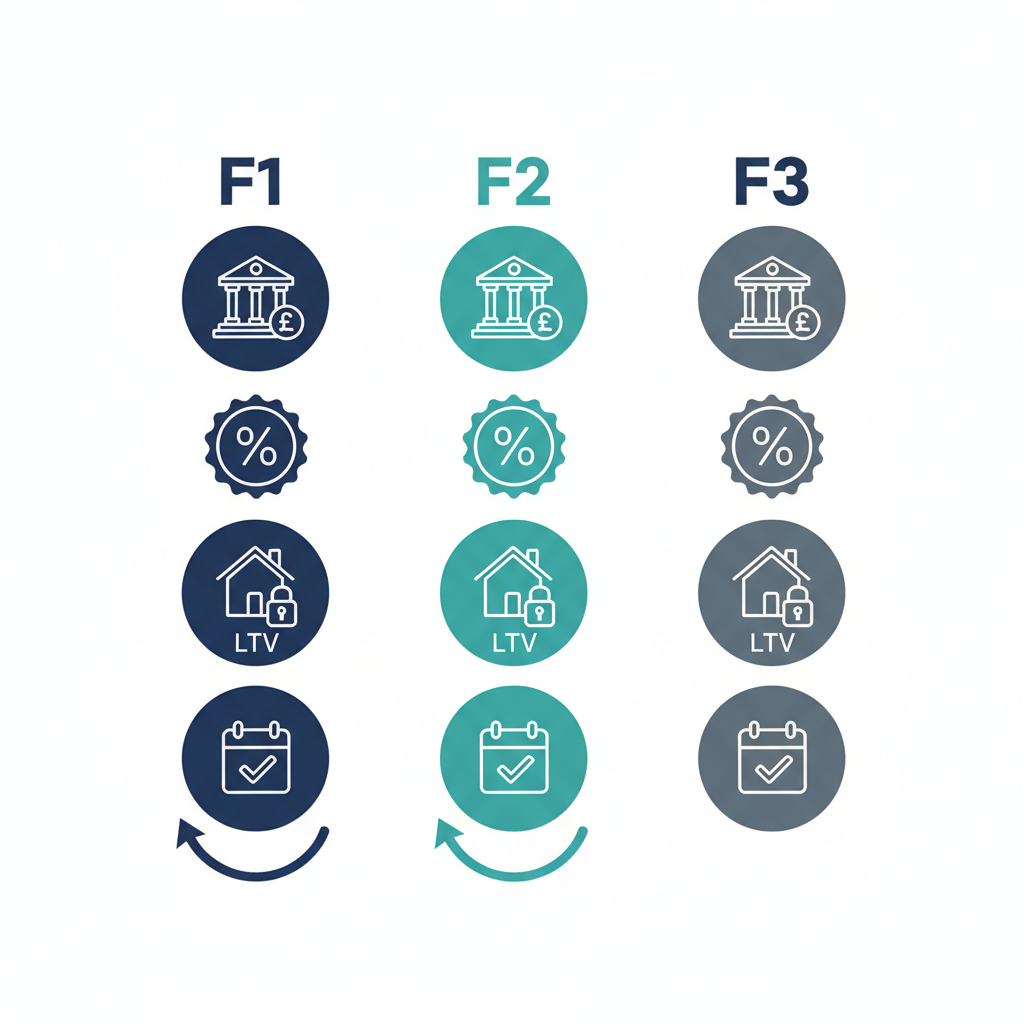
Foundation Home Loans operates a tiered product range specifically designed to accommodate credit impairment. Their F1, F2 and F3 product tiers each map to a defined level of adverse history — this isn't a lender that vaguely "considers" bad credit. They publish precise tolerances, which makes routing decisions straightforward once you know where your client sits.
The F1 tier is the cleanest adverse tier. It accepts up to 1 County Court Judgement (CCJ) or default registered in the last 24 months, provided it's satisfied and the value is under £500. Rates at F1 currently open around 5.99% on a 2-year fixed, with a 2% arrangement fee on a 75% loan-to-value (LTV) basis. That rate environment assumes a standard single residential tenancy and a rental coverage calculation of 125% at a stressed rate.
F2 broadens the tolerance. Up to 2 CCJs or defaults in the last 36 months are accepted here, with individual values under £2,500. The LTV ceiling tightens to 70% for F2 applicants. Arrangement fees step up to 2.5%. For a portfolio landlord carrying a couple of satisfied defaults from a period of business stress, this is often the most realistic placement.
F3 is where Foundation Home Loans carries the heaviest adverse load. Up to 3 CCJs or defaults registered in the last 36 months, values up to £5,000, are permissible at this tier. Maximum LTV reduces to 65%. Pricing reflects the additional risk, with rates typically opening above 6.50% on a 2-year fixed product. If a landlord has a more recent mortgage arrears marker — 1 month in arrears in the last 12 months is the outer tolerance — F3 is the tier to assess first.
The Four Criteria That Actually Determine Your Tier
1. CCJ and Default Age
The registration date controls the tier more than the value in most cases. A single CCJ registered 25 months ago and satisfied may route cleanly to F1. The same CCJ registered 14 months ago drops the case to F2 minimum. Foundation Home Loans uses the registration date, not the satisfaction date, for this calculation — a distinction that trips up a large number of applications.
2. Mortgage Arrears History
This is the hardest line. No mortgage arrears in the last 12 months is required for F1 and F2. F3 permits 1 month's arrears in the last 12 months but draws a hard stop at any arrears beyond that threshold. Discharged bankruptcies are not accepted at any tier if the discharge date is less than 3 years ago.
3. Portfolio Size and Background Properties
Foundation Home Loans classifies a portfolio landlord as anyone holding 4 or more mortgaged properties. This matters because the underwriting assessment shifts to a portfolio-level stress test. The lender applies an interest coverage ratio (ICR) of 125% across the background portfolio at a stress rate of 5.5% — on a notional interest-only basis regardless of the actual repayment structure.
4. Rental Income Evidencing
For standard tenancies, a current AST and 3 months of bank statements showing rental credits are the baseline requirement. HMO and MUB (multi-unit block) properties are accepted by Foundation Home Loans but require specialist product selection — the HMO product has a minimum valuation threshold of £75,000 per unit and a maximum of 8 lettable rooms. Projected rental income is not accepted in lieu of evidenced rent except on day-one new purchase cases with a signed AST.
Acceptable Property Types and the LTV Limits That Apply
Foundation Home Loans applies different LTV maxima depending on property type, not just credit tier. Standard single-unit residential BTL reaches 75% at F1 as noted. HMOs are capped at 70% LTV across all tiers. MUBs follow the same 70% ceiling. New-build flats carry a 70% maximum at F1, dropping to 65% at F2 and 60% at F3. Ex-local authority flats are accepted up to 65% LTV with a maximum block height of 6 storeys. This last point matters: many adverse credit lenders won't touch ex-local authority stock at all.
Minimum property value is £75,000. Maximum loan size sits at £1 million for standard residential BTL, dropping to £750,000 for HMOs and MUBs. Loan terms run from 5 to 35 years, with a minimum applicant age of 21 and a maximum age at end of term of 85.
How to Structure the Application to Avoid Referral Delays
Foundation Home Loans underwrites in-house, which is an advantage. Cases are not credit-scored to a pass/fail binary — a human underwriter reviews the file. That said, applications with incomplete credit explanation letters routinely sit in referral queues for 5 to 7 working days longer than clean submissions.
Prepare a signed credit explanation letter for every adverse marker, regardless of age or value. Include the registration date, the satisfaction date (or confirmation it's unsatisfied if within tolerance), and the circumstances. Foundation Home Loans underwriters respond positively to landlords who demonstrate the adverse event was circumstantial and time-limited — a business dissolution, a billing dispute, a period of illness — rather than a pattern of financial mismanagement.
Dual representation is permitted, which reduces legal costs on straightforward remortgage cases. The lender's solicitor panel is available for purchases below £500,000, which covers the majority of BTL stock outside London.
Current Rate Positioning
Foundation Home Loans is not the cheapest BTL lender in the market. A clean credit borrower at 75% LTV will find better pricing at mainstream lenders. The value is in the adverse tolerance and the underwriting approach, not the headline rate. For a landlord with a single satisfied CCJ under £500 registered 36 months ago — technically outside even F1's 24-month tolerance — a manual referral to the lender's BDM team has resulted in accommodated cases at F1 pricing where the overall profile is strong.
The 2% arrangement fee on F1 products is worth factoring into the total cost of borrowing calculation. On a £200,000 loan that's £4,000 upfront — higher than Paragon's standard 1.5% or Precise Mortgages' 1.75% on comparable adverse tiers. For landlords refinancing to release capital, the higher fee needs to be weighed against the rate and the realistic alternative placements available.