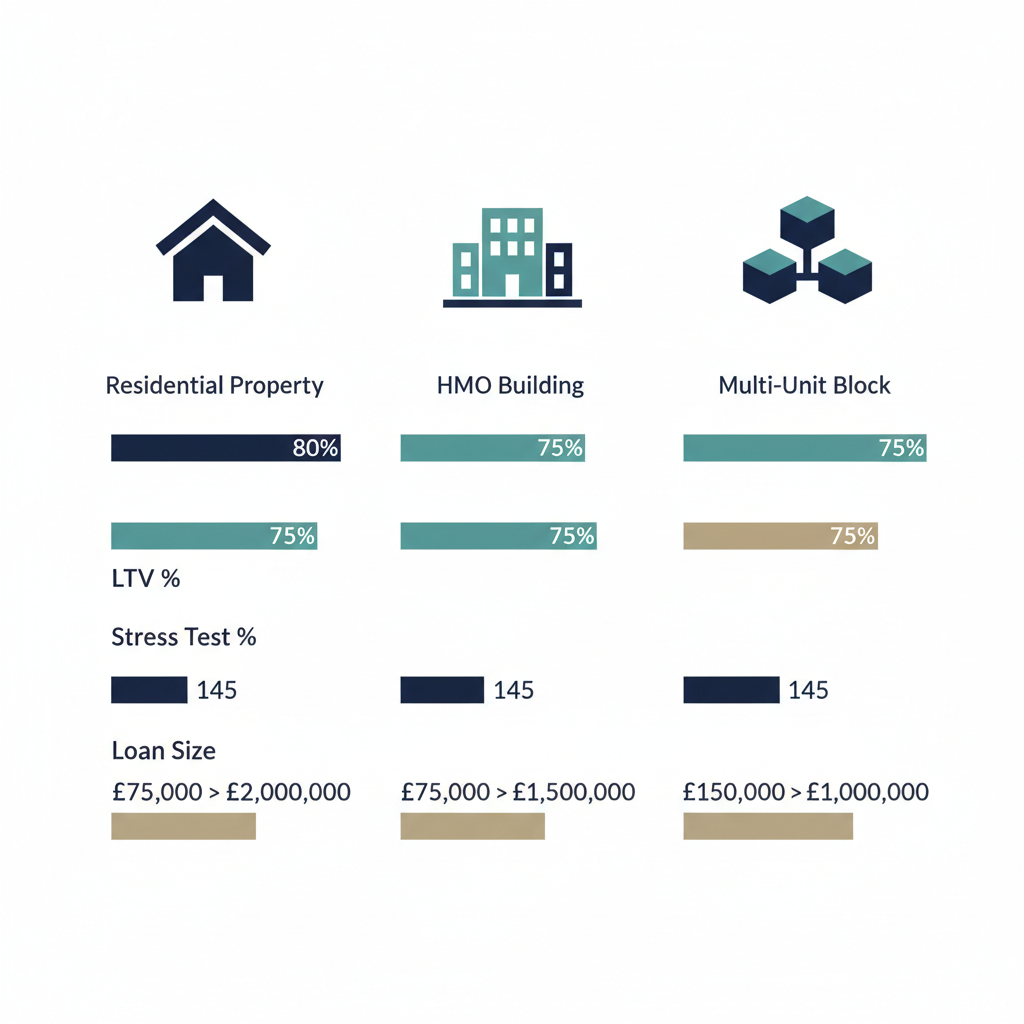
A 5.5% pay rate on a two-year fixed product. That is where Keystone Property Finance's BTL range currently sits for standard single residential investment properties at 75% LTV, and it is the anchor figure worth holding in your head before you dig any further into their criteria.
What the Numbers Show
Keystone's rental stress test runs at 145% of the pay rate, not the reversionary rate. That distinction matters enormously. Where some lenders stress against a notional rate of 5.5% or above regardless of the product you select, Keystone's approach means that a lower headline rate can directly improve the rental income calculation used to determine how much you can borrow. On a £250,000 interest-only mortgage at 5.5%, the stressed monthly payment works out to approximately £1,672. Your rental income therefore needs to clear that figure — with nothing to spare — to satisfy the interest coverage ratio.
The maximum LTV sits at 80% across their standard residential BTL range. However, that 80% ceiling drops to 75% on houses in multiple occupation and multi-unit freehold blocks. HMOs are accepted up to 6 bedrooms, and MUFBs are considered up to 10 units. Push beyond either of those thresholds and the application falls outside standard criteria — Keystone will consider it on referral, but expect a manual underwriting process and potentially a wider margin.
Their minimum loan size is £75,000. The maximum on a single property sits at £1.5 million on standard residential BTL, rising to £2 million on larger portfolio or complex cases handled through their specialist underwriting team. The minimum property value they will accept is £75,000, which filters out the very bottom end of the northern terraced market where some other specialist lenders will still operate.
Portfolio landlords — those owning 4 or more mortgaged properties — are explicitly welcomed. Keystone does not apply an automatic portfolio cap the way some mainstream lenders do. What they do apply is a background portfolio stress test across all existing financed properties, run at 145% ICR, meaning your entire book needs to demonstrate rental sustainability at that coverage level, not just the property you are placing with them. If you have older mortgage products at lower rates, this can work in your favour. If your background portfolio is thinly covered, expect it to be highlighted.
The 5-unit rule applies to their standard assessment pathway. Portfolios of 5 or more mortgaged buy-to-let properties trigger an enhanced portfolio underwriting process, where Keystone will want to see a schedule of assets and liabilities across the entire book. This is not unusual among specialist BTL lenders, but knowing the threshold in advance means you can prepare the documentation rather than be caught short at application stage. A clean asset schedule with current rental figures, outstanding balances and property valuations will accelerate the process considerably.
On product structure, Keystone offers both 2-year and 5-year fixed rates, as well as a tracker range. The 5-year fixes are currently priced around 5.7% to 5.9% at 75% LTV for standard residential BTL, depending on the borrower profile and the strength of the rental income. Arrangement fees are typically 2% of the loan amount. That percentage fee structure means costs scale with loan size — a £400,000 mortgage carries an £8,000 arrangement fee before broker fees are added. Factor that into your net return calculation before committing to a product.
What This Means for Landlords
A 145% stress test at the pay rate is, arithmetically, more demanding than 125% at a notional rate. Take a property generating £1,500 per calendar month in rent. At 125% ICR, that income supports an interest payment of £1,200 per month — implying a loan of approximately £261,818 at 5.5%. At 145% ICR on the same pay rate, that same £1,500 rental income supports a stressed payment of only £1,034 per month — implying a loan of approximately £225,818. That is a £36,000 reduction in borrowing capacity from the ICR methodology alone. If your yields are running at 5% or below, this arithmetic becomes material to the deal.
The HMO acceptance criteria up to 6 bedrooms is commercially relevant. Many high-street lenders stop at 4 bedrooms or decline licensed HMOs entirely. Keystone's willingness to go to 6 rooms, with a maximum of 75% LTV, opens access to a product type where rental yields are typically 7% to 9% — well above the levels needed to clear the stress test. A 6-bed HMO generating £3,000 per month has considerably more headroom than a standard AST generating £900.
The absence of a hard portfolio cap is significant for established landlords. Some lenders impose an absolute limit of 10 properties, or a maximum aggregate exposure of £2 million across their book. Keystone does not publish a blanket ceiling of that type. What they publish is a process — the enhanced underwriting route for portfolios above 5 properties — which is a different constraint. Process constraints can be managed. Hard caps cannot.
New-build flats are accepted, but at a maximum LTV of 75% rather than the 80% available on houses. That 5% reduction is worth noting if you are financing a flat in a new development where the purchase price is at the top of your budget. A £200,000 flat at 80% LTV gives you a £160,000 loan. At 75%, you need an additional £10,000 in deposit. Small difference in percentage terms, real difference in cash required.
Limited company applications are accepted and treated comparably to personal name applications in terms of product availability and pricing, though Keystone will require the company to be a Special Purpose Vehicle incorporated for the purpose of property investment. Trading company applications are not accepted under standard criteria. The SPV must have a SIC code of 68100 or 68209. That is a detail that catches applicants out when their accountant has registered the company under a broader trading classification.
Minimum applicant age is 21, maximum is 85 at the end of the mortgage term. That upper age limit is more generous than the 75-year ceiling still applied by a number of mainstream and specialist lenders, making Keystone a viable option for older landlords extending or refinancing their portfolio into later age brackets.