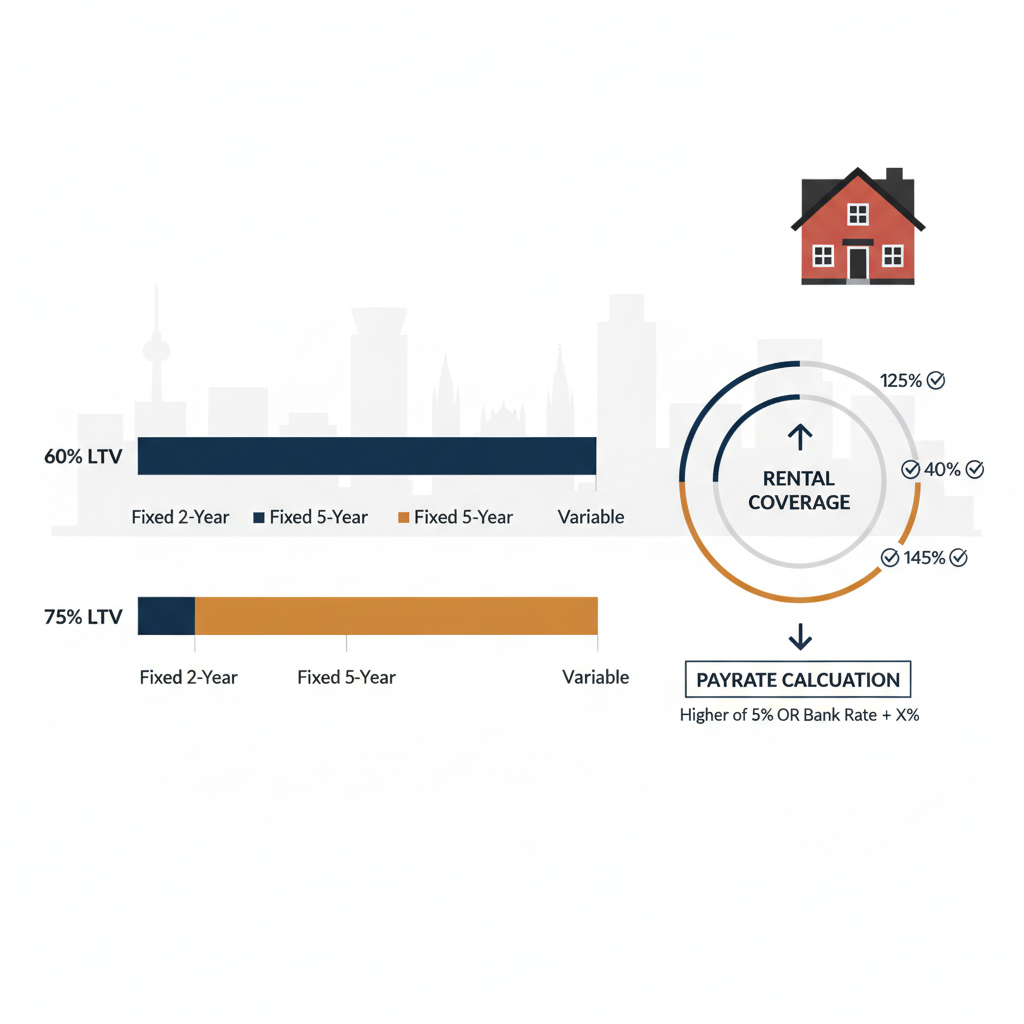
A 4.39% two-year fixed rate sits at the sharper end of the buy-to-let market right now — but that headline figure tells you almost nothing about what the mortgage will actually cost a Manchester landlord. Arrangement fees, stress-test calculations and income cover ratios can push the true cost of a "cheap" deal well above what a slightly higher rate with lower fees would deliver. Here is what a close audit of the current rate sheet actually looks like.
What the Numbers Show
The lowest two-year fixed BTL rates available to Manchester investors currently open at 4.39%, typically reserved for borrowers with a 40% deposit — meaning a maximum loan-to-value (LTV) of 60%. At 75% LTV, which is where most landlords in Greater Manchester are borrowing, the entry point shifts to around 4.74% on a two-year fix. Five-year fixed products at 75% LTV begin at approximately 4.84%, and that gap of 0.10 percentage points between a two-year and five-year fix is historically narrow — worth paying attention to if you are trying to lock in certainty on a Manchester property over a longer hold period.
Arrangement fees are where the rate sheet gets uncomfortable. The 4.39% product charges a 3% fee, which on a £250,000 loan equates to £7,500 added to your balance or paid upfront. A competing product at 4.59% charges a flat £999. Over a 24-month fixed period, the £7,500 fee product only wins if your loan is above approximately £360,000 — below that threshold, the lower-fee option is cheaper in total cost terms, even though the rate is 0.20% higher.
Manchester-specific context matters here. The average BTL property value in Manchester city centre currently sits at around £210,000 to £230,000, while semi-detached stock in areas like Didsbury, Chorlton and Stretford runs between £280,000 and £380,000. At £210,000 with a 25% deposit, your loan is £157,500 — at which point a 3% fee costs £4,725 and the maths firmly favour the flat-fee product at £999. Run the numbers on your specific loan size before the rate headline attracts all your attention.
Gross yields in Manchester average between 5.8% and 7.4% depending on postcode, with M14 and M13 (Fallowfield, Rusholme) consistently delivering above 6.5% due to student and young professional demand. That yield figure directly affects whether your mortgage passes the lender's interest coverage ratio (ICR) stress test. Most lenders currently stress-test at either 5.5% or 8.5% of the pay rate — whichever is higher — and require rental income to cover at least 125% of that stressed payment for basic-rate taxpayers or 145% for higher-rate taxpayers.
At 4.74% on a £180,000 loan, the monthly interest-only payment is £711. Stressed at 8.5% (the figure that applies because it is higher than 5.5%), the stressed payment becomes £1,275 per month. To pass the 145% ICR test as a higher-rate taxpayer, you need monthly rent of at least £1,849. A two-bedroom flat in Ancoats currently achieves between £1,400 and £1,700 per calendar month — which means many Manchester city-centre flats will not pass the standard ICR test at 75% LTV without either a larger deposit or a lender willing to apply the 125% test on the basis that the applicant is a limited company borrower.
This is why the rate alone is not the product. The qualifying criteria attached to it determine whether you can access it at all.
What This Means for Landlords
If you are borrowing through a limited company — which the majority of Manchester portfolio landlords acquiring since April 2020 have been doing to avoid Section 24 tax restrictions — you access the 125% ICR multiplier rather than 145%. On the same £180,000 loan stressed at 8.5%, you need rental income of £1,594 per month rather than £1,849. That difference of £255 per month is enough to make a Manchester city-centre flat financeable that would otherwise be rejected at the individual borrower level. The product at 4.74% that looked out of reach becomes viable through the right vehicle.
Portfolio landlords — defined by most lenders as owning four or more mortgaged properties — face an additional layer of scrutiny regardless of the rate they are chasing. Lenders apply portfolio underwriting, meaning they assess the aggregate rental income and aggregate mortgage payments across your entire portfolio, not just the property being financed. If your existing portfolio has voids, recent rent reductions or properties in negative stress-test territory, this can block access to the headline rate product even if the subject property stacks up perfectly on its own.
Two lenders in particular are currently writing competitively in Manchester at 75% LTV for limited company applications: one is offering a five-year fix at 4.91% with a £1,995 flat fee and ICR stress-tested at the pay rate plus 2%, and another is at 4.84% with a 2% arrangement fee but a minimum loan size of £100,000. For a landlord refinancing a Salford flat at £130,000 loan, the first option is clearly cheaper over the five-year term despite the higher rate.
Tracker products are also worth a look in the current environment. A base rate tracker at Bank of England base rate plus 2.89% currently prices at 5.14% with no early repayment charges and a £995 fee. If the base rate falls by 0.50% before August 2026 — which current swap rates suggest is a realistic scenario — your rate drops automatically to 4.64% without a remortgage cost. Fixed-rate products lock in certainty but also lock in the current rate if the market moves in your favour.
Minimum rental income requirements also vary by lender. Some set a floor of £12,000 annual rent — £1,000 per month — which rules out some lower-value terraced stock in parts of Oldham or Rochdale even if the yield percentage is strong. Others have no minimum rental income threshold but cap their maximum loan at £500,000 per property, which rarely constrains Manchester deals.
The lowest rate on the rate sheet is the starting point for the conversation, not the end of it. A 4.39% product with a 3% fee, a 145% ICR requirement and a £150,000 minimum loan is not the cheapest deal for most Manchester landlords — it is the cheapest deal for a specific borrower profile that may not be yours.