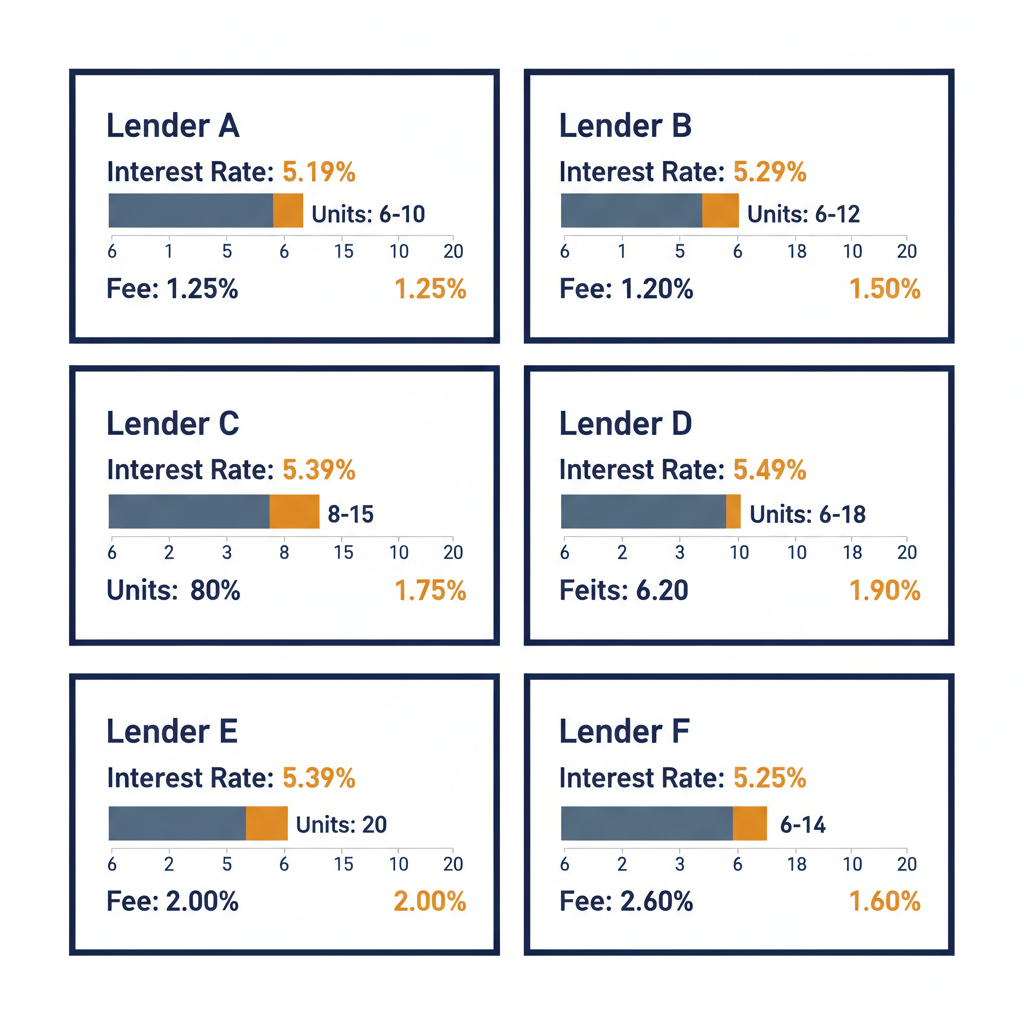
A 5-year fixed rate of 3.99% on a multi-unit freehold block sounds competitive until you read the small print and find the lender caps the block at 6 units and charges a 2% arrangement fee on top. That gap between headline rate and total cost is exactly where landlords lose money on MUFB finance — and it is worth pulling apart lender by lender.
What the Numbers Show
Paragon Bank currently quotes 5-year fixed rates from 5.19% at 75% LTV on MUFB products, with a 1.5% arrangement fee. Their maximum loan size sits at £3 million on a single MUFB asset, and they will consider blocks up to 20 self-contained units. That 20-unit ceiling is meaningful — the majority of specialist lenders draw the line at between 6 and 10 units before routing you into commercial or semi-commercial underwriting, which typically carries rates 0.75% to 1.25% higher.
Shawbrook Bank positions itself squarely in the professional landlord space and will lend on MUFBs up to 10 units at up to 75% LTV. Their 5-year fixed product is currently priced around 5.45%, with an arrangement fee of 1.75%. Minimum loan size is £150,000, which effectively rules out smaller terraced conversions with low individual unit values. Shawbrook also applies a minimum income requirement of £25,000 per annum for individual applicants outside of SPV structures.
Precise Mortgages takes a slightly different approach. They will lend on blocks of up to 10 units, with rates from 5.29% on a 5-year fix at 70% LTV. Their arrangement fee is a flat £995 on loans below £500,000, which makes them worth looking at hard on mid-range deals where a percentage-based fee would erode margin. Above £500,000, the fee reverts to 1.5% of the loan amount, which changes the maths considerably.
Foundation Home Loans currently prices their MUFB 5-year fix from 5.59% at 75% LTV with a 2% arrangement fee. That fee is at the expensive end of the market. However, Foundation will consider applications where the applicant has had a satisfied default registered more than 36 months ago — a concession most lenders in this space do not offer. If your credit file has a blemish, that flexibility can be worth the extra 0.4% on rate.
Aldermore Bank offers MUFB lending up to £2 million at 75% LTV, with 5-year fixed rates from 5.35%. The arrangement fee is 1.25%, which is among the lower percentage fees in this sector. Aldermore caps the block at 6 units, which limits its usefulness for larger assets but makes it one of the more accessible options for converted Victorian terraces with 4 to 6 flats — a very common MUFB profile in Northern cities where individual unit values make percentage fees especially punishing.
Keystone Property Finance, which operates exclusively through intermediaries, will price MUFB cases from 5.49% on a 5-year fix at 75% LTV, with a 1.5% fee. Their differentiator is the rental calculation: they use a stressed rate of 5.5% for limited company SPV applications, compared to 5.5% to 6.5% used by some competitors. On a block generating £4,500 per calendar month in rent, that difference in stress testing can unlock an additional £40,000 to £60,000 in borrowing capacity — which is not a trivial number.
What This Means for Landlords
The unit cap is your first filter, not the rate. If you are buying or refinancing a block of 12 units, only Paragon and a handful of specialist commercial lenders will look at it under residential BTL underwriting. Pushing into commercial territory on a 12-unit block typically adds 0.75% to the rate and increases the arrangement fee to 1.5% to 2%, while shortening the available fixed-rate term to 3 years in many cases.
The minimum loan threshold matters more than most landlords realise at the point of application. At £150,000 minimum, Shawbrook is already excluding a meaningful proportion of smaller MUFB stock in markets like Bradford, Stoke or Sunderland where individual unit values of £40,000 to £55,000 are common. A 4-unit block in those markets may have a gross value of £200,000, leaving a 75% LTV loan of £150,000 — right at the floor. Any slight change in valuation and the deal does not fit.
Rental coverage requirements vary enough to materially affect loan size. Most MUFB lenders require rental income to cover the stressed mortgage payment at 125% in an SPV structure and 145% in personal name. At a 5.5% stressed rate on a £600,000 loan, you need monthly rental income of £3,438 at 125% coverage and £3,975 at 145% coverage. Know which structure you are using before modelling the deal — the difference between personal and limited company ownership can shift your achievable LTV by 5% to 10% on a cash-flow-tight block.
Valuation methodology is a separate issue entirely. MUFB valuers will use either a bricks-and-mortar approach or an investment method based on yield, and the two can produce figures 10% to 15% apart on the same asset. Paragon and Shawbrook both accept investment-method valuations. That matters on a high-yielding block in a lower-value area: a 9% gross yield block valued on investment terms can come in 12% above the bricks-and-mortar figure, directly increasing your available loan.
Early repayment charges on 5-year fixed MUFB products typically run at 5% in year one, stepping down 1% per year to 1% in year five. On a £750,000 loan, exiting in year two costs £30,000. Portfolio landlords refinancing on a 3 to 5 year cycle need to model that cost into their exit strategy from day one, not as an afterthought when a better rate appears.
The honest comparison is not rate alone. It is rate, plus fee, plus stress test methodology, plus unit cap, plus minimum loan, plus valuation approach. Run all six variables against your specific block before you shortlist lenders. The difference between the cheapest-looking product and the right product on a 10-unit block can easily be £25,000 in total cost of finance over a 5-year term.