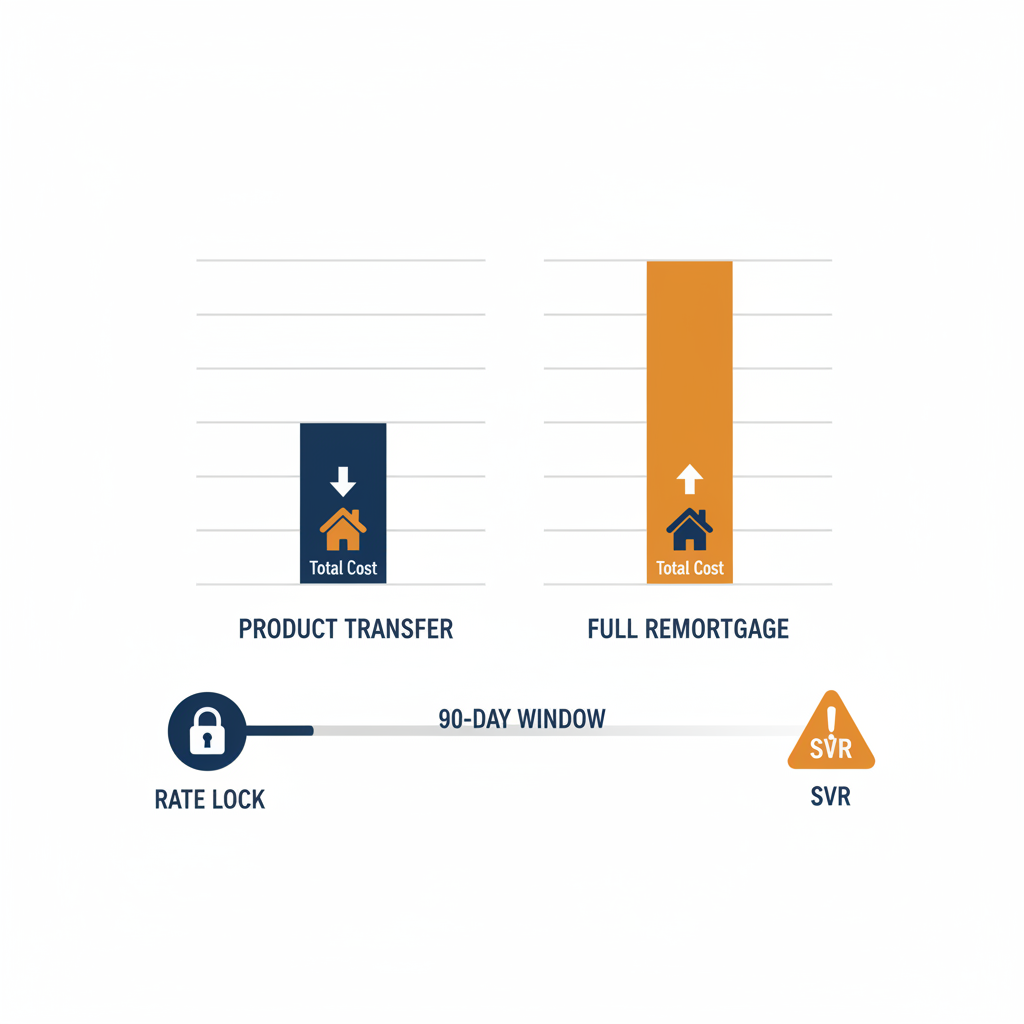
A rate of 8.74%. That is Precise Mortgage's current standard variable rate, and it is the number every buy-to-let landlord on one of their deals needs to tattooed somewhere visible before their fixed term ends. The gap between that SVR and a product transfer rate sitting around 4.89% on a two-year fix is not a rounding error — it is roughly £3,200 per year on a £200,000 interest-only mortgage.
What the Numbers Show
Precise Mortgages currently opens its product transfer window 90 days before the existing deal expires. That is your working runway. Miss the window, fall onto the SVR, and you are immediately paying a rate that is 385 basis points higher than the best available retention product. For a portfolio landlord with three or four Precise-backed properties, that gap becomes material within the first billing cycle.
The product transfer process itself carries no standard valuation fee and no legal fee — two costs that add between £500 and £1,500 to a full remortgage. That saving alone justifies the comparison exercise. On a five-year fix via a full remortgage, you might also pay an arrangement fee of £1,995, whereas Precise's internal product transfer fees are typically capped at £995 on most standard BTL products. The net saving on fees can therefore reach £1,000 before you factor in the rate differential at all.
What you are actually comparing when you conduct a Precise Mortgage Product Transfer analysis is not just rate against rate. It is rate, plus fee, plus the legal and valuation costs of exiting, plus the time-to-completion. A product transfer can complete in as few as 5 working days. A full remortgage to a new lender typically takes 4 to 8 weeks, which means there is a period where you are either on the SVR or paying for a rate lock that may not hold.
The current Precise BTL two-year fixed rate for a product transfer sits at approximately 4.89% at 65% LTV. The comparable two-year fix from a competing lender for a landlord at the same LTV might open at 4.64% — a 25 basis point difference. On a £300,000 loan, that is £750 per year. Over 24 months, that difference is £1,500. But if the competing lender charges a £1,999 arrangement fee versus Precise's £995, the maths flips. You are ahead on the product transfer by £504 before you account for legal and valuation costs, which at the cheaper end still run to £600.
At 75% LTV, the calculation shifts. Precise's product transfer rates at that loan-to-value tier sit closer to 5.34% on a two-year fix. External lenders at 75% LTV may offer 5.09% — a 25 basis point gap that, on a £400,000 mortgage, equates to £1,000 per year. Over two years, £2,000. At that level, a full remortgage starts to look genuinely competitive even after fees, particularly if the external lender is offering a fee-assisted product or cashback of £500 or more.
The stress test is also relevant here. Precise applies an interest coverage ratio of 125% at a stressed rate of 5.5% for basic rate taxpayers and 145% at 5.5% for higher and additional rate taxpayers. A product transfer does not typically require a full affordability reassessment — meaning landlords who have seen rental yields compress or who have taken on additional personal debt since the original application benefit significantly. A full remortgage triggers a new underwrite, and if ICR calculations have tightened, some landlords will simply not qualify for the equivalent external product.
What This Means for Landlords
If you hold a Precise BTL deal with a rate expiry in the next 90 days, the first move is to pull the current product transfer rate sheet. Precise does not always publish these externally at a granular level, but your mortgage broker will have direct access via the intermediary portal. The headline number to request is the transfer rate at your exact LTV band — specifically whether you sit below 60%, between 60% and 65%, between 65% and 75%, or above 75%, because each band carries a different pricing tier and the spread between them can be as wide as 0.45%.
For a portfolio landlord with 5 or more mortgaged properties, the aggregate impact compounds quickly. Five properties averaging a £250,000 balance, all on Precise tracker or fixed deals expiring within 12 months, represent £1.25 million in debt. A 0.20% differential between a product transfer rate and the SVR they would otherwise drift onto is £2,500 per year in excess interest. That is not a minor optimisation — it is the equivalent of losing one month's rent on a mid-range BTL property.
The other consideration is portfolio mortgage conditions. Precise has specific underwriting criteria for portfolio landlords — broadly defined as owning 4 or more mortgaged properties — including background portfolio stress testing. A Precise Mortgage Product Transfer avoids triggering that full portfolio reassessment. For landlords who have expanded since their original Precise application, that procedural protection is genuinely valuable. A new lender will want to stress-test the entire background portfolio, and with stress rates sitting at 5.5% or above, some deals that passed in 2021 at a 4.5% stress rate will not pass today.
One final number worth tracking: 14 days. That is the typical period within which a Precise product transfer offer must be accepted once issued. If you miss that acceptance window, the offer lapses and you return to the queue, potentially at a refreshed rate that is higher. Build the calendar backwards from your expiry date — 90 days out to initiate, 14 days to accept once the offer lands.
Deciding whether to execute a Precise Mortgage Product Transfer or exit to a new lender is not a philosophical question. It is a fee-adjusted, rate-adjusted, underwriting-risk-adjusted calculation that changes depending on your LTV, your tax position, your portfolio size and your remaining fixed term. Run the numbers at 60%, 65% and 75% LTV. Compare the all-in cost over the full product term, not just the headline rate. And do not drift onto an 8.74% SVR while you are doing it.