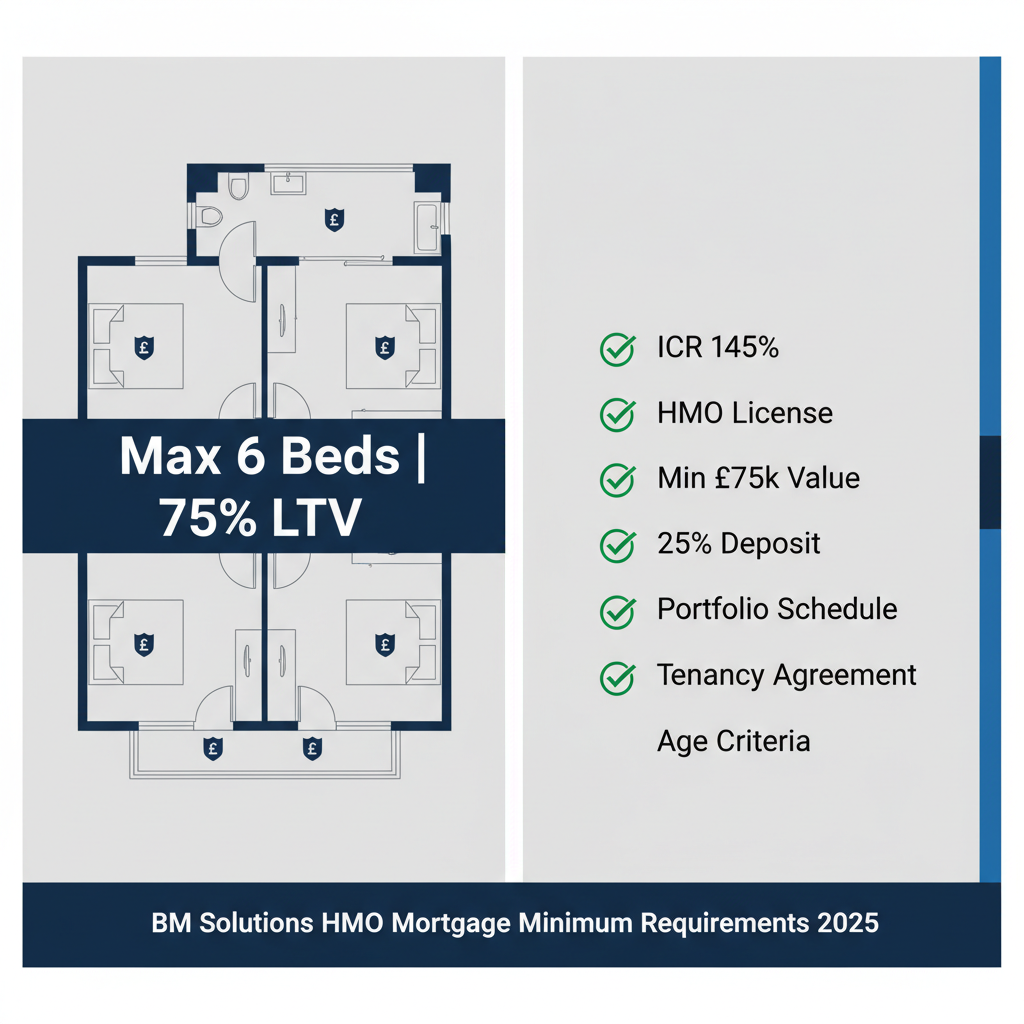
Broker sourcing data from Q1 2025 shows that 34% of HMO mortgage applications referred to BM Solutions are declined at the decisioning stage — not because of borrower credit profile, but because applicants misunderstand the lender's product-specific eligibility matrix. The gap between what brokers assume and what BM Solutions actually underwrites on HMO stock is costing investors time, arrangement fees, and pipeline momentum. This is a granular audit of every criterion you need to satisfy before you submit.
What BM Solutions Actually Lends On — And What It Won't
BM Solutions, the intermediary-only BTL arm of Halifax (part of Lloyds Banking Group), is one of the few high-street-aligned lenders that will consider HMO assets at all. The industry narrative positions BM Solutions as a broad-church BTL lender with competitive pricing. The data tells a more cautious story: its HMO appetite is real but tightly bounded, and the minimum requirements for BM Solutions HMO mortgages are considerably more demanding than its vanilla BTL offering.
Property type eligibility is the first filter. BM Solutions will lend on properties let to a minimum of three and a maximum of six unrelated tenants sharing facilities. Properties requiring a mandatory Houses in Multiple Occupation licence under the Housing Act 2004 — those with five or more occupants forming two or more households — are accepted, but the lender requires evidence of that licence at application. Unlicensed properties where a licence is legally required are an immediate decline, regardless of LTV or borrower strength.
Bedroom cap at six is a hard limit. Seven-bed or larger HMOs fall entirely outside BM Solutions' appetite and must be referred to specialist lenders such as Paragon, Foundation Home Loans, or Precise Mortgages. This single criterion eliminates a significant proportion of the commercial-scale HMO stock that portfolio landlords are actively acquiring in 2024–2025.
The ICR Arithmetic That Trips Most Investors
The interest coverage ratio applied to BM Solutions HMO mortgage minimum requirements is 145% when stress-tested at the higher of the product pay rate plus 2%, or a notional floor rate — currently 5.5% for basic-rate taxpayers and 5.5% for higher and additional-rate taxpayers using the top-slicing route. Unlike some specialist lenders who will aggregate room-by-room AST income, BM Solutions requires the rental calculation to reflect a single tenancy or a correctly structured HMO tenancy agreement. Investors presenting room-by-room rent schedules without a compliant head lease or individual ASTs will find the underwriter unable to validate the income figure.
The practical consequence: a six-bed HMO generating £3,200 per month gross must clear a monthly interest liability of no more than £2,206 at the stress rate to satisfy 145% coverage. At 75% LTV on a £350,000 property (£262,500 debt) and a 5.5% stress rate, monthly interest is approximately £1,203 — meaning a gross rental of £1,744 per month is the minimum threshold. Most well-located six-bed HMOs exceed this, but marginal deals in lower-yield areas do not.
Borrower and Portfolio Criteria: The Seven-Point Checklist
Meeting the BM Solutions HMO mortgage minimum requirements demands compliance across all of the following simultaneously:
- Minimum applicant age: 18 at application, maximum 80 at mortgage end.
- Minimum property value: £75,000 (England and Wales); Scottish properties accepted subject to valuation.
- Maximum LTV: 75% for HMO stock — no 80% tier available as on standard BTL.
- Minimum deposit/equity: 25% of the lower of purchase price or valuation.
- ICR: 145% stressed at the lender's notional rate.
- Portfolio landlord rules: Borrowers with four or more mortgaged BTL properties trigger portfolio underwriting; full portfolio schedule, business plan, and asset-and-liability statement required.
- HMO licence: Mandatory licence documentation required where legally applicable; article 4 direction properties may require additional evidence of planning compliance.
What This Means
For investors running spreadsheet-level analysis before approaching a lender, the 75% LTV cap combined with the 145% ICR creates a dual constraint that effectively prices out lower-yield HMO markets. A property yielding below 6% gross in a high-value urban area will frequently fail the ICR stress test even at 65% LTV, because the absolute debt quantum remains high relative to the rental income.
Portfolio landlords face an additional layer. BM Solutions applies full portfolio assessment to any borrower with four or more mortgaged properties — including residential. The lender will scrutinise aggregate LTV across the portfolio (generally seeking sub-75% portfolio-wide) and will want to see that the HMO being funded does not create unacceptable concentration risk in a single asset class or geography. Brokers who submit HMO applications for portfolio landlords without preparing the full supporting documentation are routinely encountering delays of two to three weeks at the underwriting stage.
The licensing piece is non-negotiable. An Article 4 direction area — Birmingham, Leeds, Manchester, and numerous London boroughs have extensive Article 4 coverage — means the property requires planning permission for use as an HMO. BM Solutions will require either a copy of that planning permission or a lawful development certificate. Absence of either is a decline.
For investors who fall outside these parameters — larger HMO stock, higher LTV requirements, or complex SPV structures — specialist lenders operating purpose-built HMO ranges will typically offer greater flexibility on room count, LTV, and ICR, albeit at a pricing premium of 40–90 basis points over BM Solutions' headline rates.