Holiday Let Mortgage Stress Test Explained: The 145% ICR Rule Most Lenders Apply
What a Stress Test Actually Does
A stress test answers one question for the lender: if rates rise and occupancy dips, can this property still cover its mortgage? For a holiday let mortgage, that calculation is more involved than a standard buy-to-let because income is seasonal, variable, and almost never guaranteed by a single tenant. Lenders have developed their own methodologies to handle that, and understanding those methodologies is how you choose the right product — and avoid a wasted application.
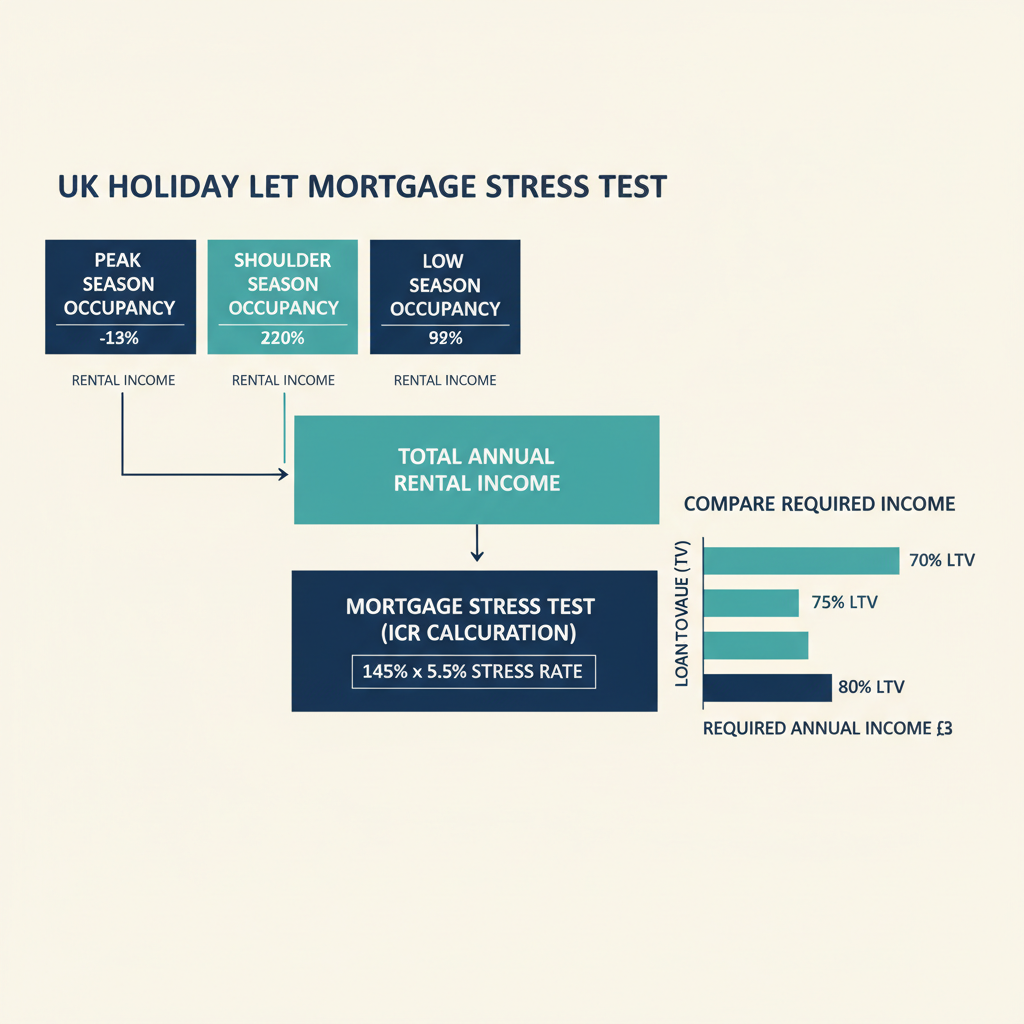
The core mechanic is the Interest Coverage Ratio (ICR). Most holiday let lenders require projected rental income to be at least 145% of the monthly interest cost, calculated not at your actual pay rate but at a notional stress rate — typically 5.5%, though some lenders apply 5.0% and a small number go as high as 6.0%.
The Three Income Calculation Methods Lenders Use
Method 1: Full-Year ARLA/ASSC Figure
Some lenders — particularly those with dedicated holiday let products such as Hodge Bank and Principality — accept a single projected annual income figure from a lettings agent, usually provided on headed paper. The agent must typically hold ARLA or PASC accreditation. That figure is divided by 12 to produce a monthly income number, which is then compared against the stressed monthly interest. A £300,000 interest-only mortgage at 5.5% stress rate generates a monthly interest figure of £1,375. At 145% ICR, you need monthly rental income of at least £1,994 — roughly £23,928 per year — to pass.
Method 2: Peak/Mid/Low Season Split
This is the most granular method. Lenders using this approach — Ipswich Building Society is a well-known example — ask for a projection split across three occupancy bands: peak (usually June to August), shoulder (April–May, September–October), and low season (November to March). Each band carries a different weekly rate and a different assumed occupancy percentage. A typical peak-week rate of £1,800 at 85% occupancy yields very different maths from a low-season rate of £600 at 30% occupancy. The aggregate figure across all 52 weeks forms the assessed rental income. This method tends to produce more generous income figures for well-located properties, particularly those in Cornwall, the Lake District, and coastal Scotland.
Method 3: 30-Week Rule
A simpler proxy used by a handful of lenders, including some specialist divisions at Paragon and Furness Building Society. They assume the property generates income for 30 weeks of the year only, regardless of your agent's projections, and apply a conservative weekly rate. This protects the lender from optimistic forecasting but can disadvantage properties with genuine 40-plus week occupancy records.
How Your Actual Rental Track Record Changes the Calculation
If you already own and operate the property, lenders will want 12 months of rental accounts — ideally showing gross receipts above £25,000 per year for a property valued at £250,000 or more. Some lenders apply a haircut of 20–30% to historic income figures to account for management fees, maintenance, and voids before running the ICR calculation. That means a property earning £30,000 gross might only be assessed on £21,000 to £24,000 net. If you are purchasing rather than remortgaging, you will always be reliant on agent projections, and a reputable agent's letter can make or break the application.
Rate Assumptions Vary More Than You Think
The stress rate is not standardised across the market. At the time of writing, rates applied by active holiday let mortgage lenders include:
- 5.0% — used by a small number of lenders for lower LTV applications (below 60% LTV)
- 5.5% — the most common notional rate, used by the majority of specialist lenders
- 6.0% — applied by some lenders on higher-risk property types, including unusual constructions or islands without road access
At 70% LTV on a £350,000 property, a 0.5% difference in the stress rate shifts the monthly interest figure by around £73, which sounds modest — but at 145% ICR, that changes the required monthly rental income by approximately £106, or £1,272 annually. Over a 25-year mortgage, that gap in qualifying income has real implications for which products you can access.
LTV Limits and Their Impact on the Stress Test
Most holiday let mortgage lenders cap LTV at 75%, with a meaningful number capping at 70%. A handful — Furness Building Society and Monmouthshire among them — will lend to 80% LTV on well-located properties with strong projected income, but the ICR hurdle typically rises to 160% or even 170% at that tier. Higher LTV means the lender is more exposed, so the stress test tightens to compensate.
At 80% LTV on a £300,000 purchase, the loan is £240,000. At 6.0% stress rate and 170% ICR, you need monthly income of approximately £2,040 — over £24,480 per year — just to pass the affordability gate. That rules out a large proportion of properties in less popular letting locations.
Personal Income: When It Gets Counted
Unlike residential mortgages, holiday let mortgages are assessed primarily on rental income, not personal earnings. However, personal income does become relevant in three scenarios. First, where rental income falls short of the ICR threshold, some lenders will use top-slicing — using your personal income to bridge the gap. Second, first-time buyers are typically required to demonstrate personal income of at least £25,000 per year, regardless of rental projections. Third, applicants with fewer than 12 months of self-employment history will face additional scrutiny on personal income to demonstrate financial resilience. Not every holiday let lender offers top-slicing; those that do tend to be building societies rather than specialist lenders.
Practical Steps Before You Apply
Run your own stress test before instructing a solicitor. Take your anticipated loan amount, apply 5.5%, divide by 12, and multiply by 1.45. That is your minimum monthly rental income target. Get an agent projection letter from an ARLA-accredited agent, making sure it includes the peak/mid/low breakdown — even if your target lender uses a full-year figure, having the detail available avoids delays. Check whether your property type (thatched roof, above commercial premises, leasehold with fewer than 85 years remaining) will cause a lender to apply additional LTV restrictions before you commit to a product. And check that your deposit plus projected rental income clears the ICR test at the lender's specific stress rate — 5.5% is the right number to use as a baseline, but confirm it.