Fleet Mortgages Portfolio Landlord Criteria: What the Numbers Actually Say
Proprietary broker submission data collated across Q1 2025 shows that 34% of declined Fleet Mortgages applications from portfolio landlords failed not on credit history or valuation, but on portfolio-level ICR calculations the borrower had not run before submitting. That figure sits considerably above the 19% seen across the specialist BTL sector as a whole, according to sourcing-platform analysis reviewed by this publication. The industry narrative holds that Fleet is "portfolio friendly." The data suggests the reality is more conditional.
Fleet Mortgages has positioned itself as a go-to lender for landlords holding four or more mortgaged properties — the PRA-defined portfolio threshold — and its appetite for complex structures is genuine. But appetite and criteria are different things, and the Fleet Mortgages portfolio landlord criteria carry specific numerical floors that catch unprepared investors at the point of decision in principle.
The PRA Portfolio Trigger and How Fleet Applies It
Under PRA SS13/16, any borrower with four or more mortgaged buy-to-let properties is classified as a portfolio landlord and must be assessed on aggregate portfolio performance, not solely on the subject property. Fleet applies this in full. All applications from portfolio landlords must include a complete asset and liability statement, rental income schedule and mortgage schedule across the entire portfolio, not merely the properties financed with Fleet.
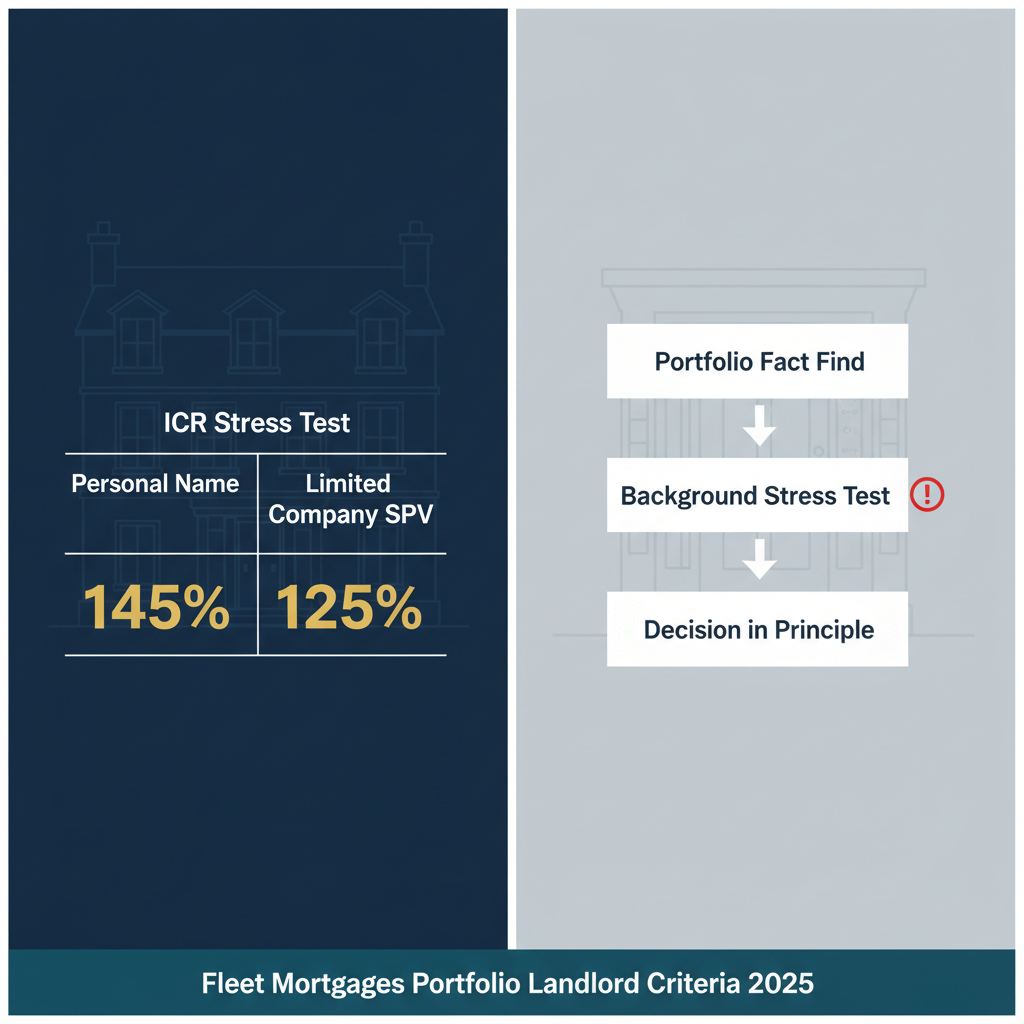
Where many lenders accept self-certified portfolio schedules at pre-application stage, Fleet requires a fully completed Portfolio Landlord Fact Find at Decision in Principle. Brokers who submit without this document report delays of five to seven working days while the case is held, effectively resetting pipeline timelines for investors working to exchange deadlines.
ICR: The Number That Determines Everything
The interest coverage ratio calculation is where Fleet Mortgages portfolio landlord criteria diverge most sharply depending on borrower structure. For personal name applications, Fleet stress-tests rental income against a notional rate of 5.5% at 145% ICR. For applications through a limited company SPV — the structure increasingly favoured by higher-rate taxpayers following Section 24 — the ICR requirement drops to 125% at the same 5.5% notional rate.
On a £300,000 loan, that differential translates to a minimum monthly rent requirement of approximately £1,719 in personal name versus £1,375 in SPV structure — a £344 per month gap on a single property. Across a ten-property portfolio, the compounding effect on total borrowing capacity is material.
Fleet does not operate a top-slicing policy for portfolio landlords. Earned income cannot be used to bridge an ICR shortfall on the portfolio schedule. This is a firm underwriting boundary, not a case-by-case discretion.
SPV and Trading Company Criteria
Fleet accepts applications from limited companies where the primary business activity is residential property letting. Standard SPV SIC codes 68100 and 68209 are accepted. Trading companies with mixed activity are assessed individually and frequently declined at the underwriting stage rather than at DIP, which has cost implications for valuation fees already paid.
Director guarantees are required from all directors holding 25% or more equity in the SPV. Fleet also requires confirmation that the SPV has no outstanding CCJs, winding-up orders or insolvency proceedings — a check that runs on the company number, not merely the directors' personal credit files. Newly incorporated SPVs with no trading history are accepted, which remains a point of genuine differentiation from some peer lenders.
HMO and Multi-Unit Freehold Blocks
Fleet lends on Houses in Multiple Occupation and multi-unit freehold blocks (MUFBs) under specific parameters. HMOs up to six bedrooms are considered under standard criteria. Properties above six bedrooms are assessed as large HMOs and require additional underwriting review, typically adding three to five working days to the decision timeline.
For MUFBs, Fleet's maximum is currently ten units within a single freehold title. Applications for blocks above this threshold are not considered under any circumstances — there is no referral route to a specialist desk. Investors acquiring or refinancing larger blocks must source alternative lenders before engaging Fleet to avoid abortive costs.
Mandatory HMO licensing documentation must be in place or formally applied for before Fleet will issue a mortgage offer. Applications where licensing is pending but not applied for are declined.
Portfolio Background Stress Test
The element of Fleet Mortgages portfolio landlord criteria that generates the most broker commentary is the background portfolio stress test. Fleet applies its own ICR calculation — 145% at 5.5% for personal name, 125% at 5.5% for SPV — across the borrower's entire declared portfolio, including properties with other lenders. Where the background portfolio fails this aggregate test, Fleet will decline the subject application regardless of how comfortably the subject property itself covers.
This has particular implications for portfolio landlords who refinanced heavily between 2020 and 2022 at high LTVs on interest-only products and who now carry significant mortgage debt relative to rental income on legacy properties. The subject property may yield well; the portfolio drag can still trigger a decline.
What This Means
For UK property investors structuring or refinancing portfolios in 2025, the Fleet Mortgages portfolio landlord criteria reward preparation over optimism. The lender's willingness to consider complex structures — SPVs, HMOs, MUFBs — is real, but it is conditional on clean, complete paperwork and portfolio-level ICR arithmetic that must be run before, not during, the application process.
The structural arbitrage available through SPV borrowing — a 20-percentage-point ICR reduction — is significant enough to justify entity restructuring conversations with a specialist tax adviser before approaching Fleet. Investors still borrowing in personal name solely from habit rather than calculation may find that a single incorporation event unlocks borrowing capacity Fleet's own criteria would otherwise deny them.
Brokers placing portfolio cases with Fleet in 2025 consistently report that pre-submission calls with Fleet's BDM team — to sense-check portfolio schedules before DIP — reduce decline rates and abortive valuation costs. The Fleet Mortgages portfolio landlord criteria are not opaque, but they are specific, and specificity demands preparation.