Limited Company Buy to Let Mortgage Pros and Cons: What the Numbers Actually Show
Sourced from specialist lender rate sheets and ICR stress-test data compiled across Q1 2025, the picture that emerges contradicts the advice most landlords still receive from generalist brokers: limited company buy to let mortgages now account for 47% of all new BTL originations at specialist lenders including Paragon, Foundation Home Loans, and Fleet Mortgages — up from 31% in 2021. The industry says incorporation is complex and expensive. The data says it is increasingly the default for portfolio landlords building above three properties.
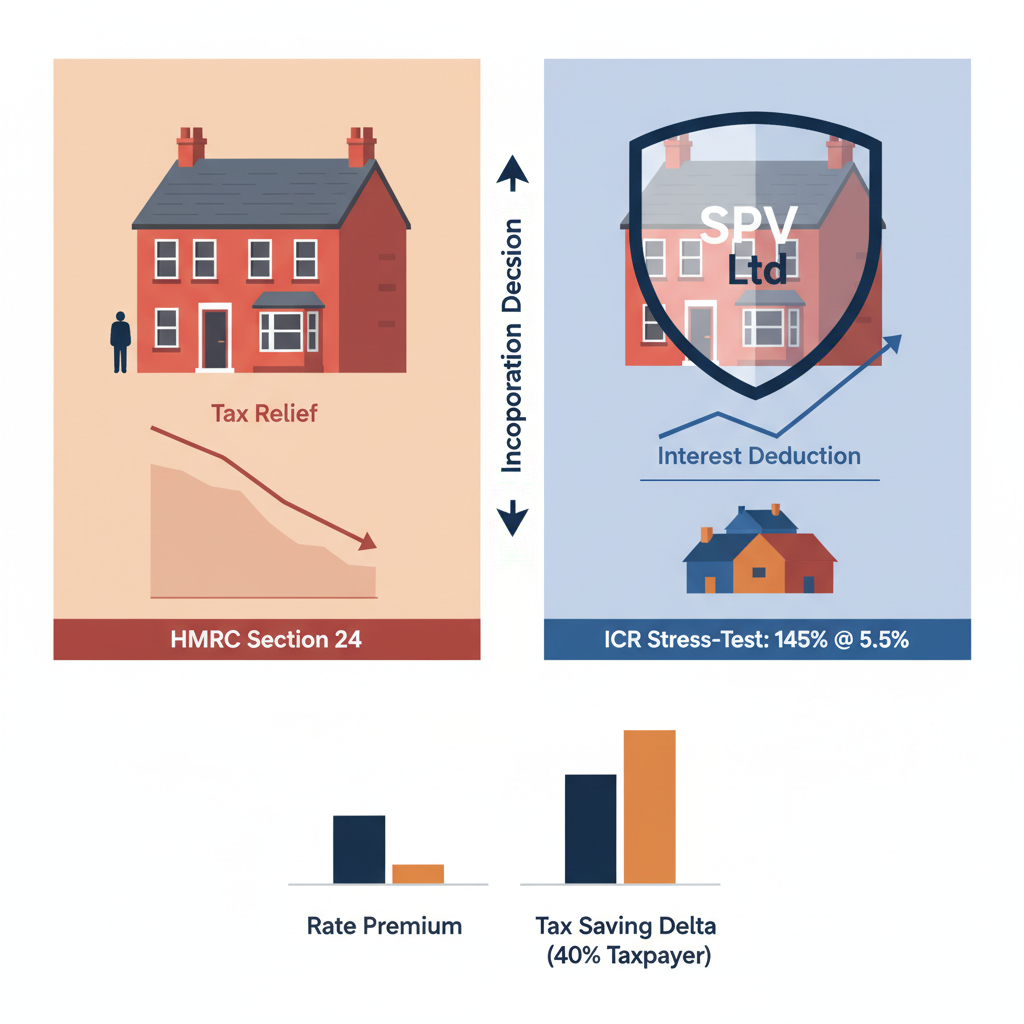
The shift is structural, not cyclical. Section 24 — the phased removal of mortgage interest relief for personally held properties — is now fully implemented. Basic-rate taxpayers face a modest drag; higher-rate and additional-rate taxpayers face a sustained, compounding cost that erodes yield on geared property. The limited company SPV (Special Purpose Vehicle) sits outside this restriction entirely, retaining full mortgage interest deductibility against rental income. That is the engine driving incorporation.
The rate premium is real, but it is not the whole calculation.
Product-level data from specialist lender sourcing tools shows that limited company buy to let products carry a rate premium of between 0.30% and 0.85% over equivalent personal-name products on five-year fixed rates as of Q1 2025. On a £250,000 interest-only mortgage, that translates to £750–£2,125 in additional annual interest cost. For a basic-rate taxpayer, this premium rarely justifies the structure. For a 40% taxpayer with three or more mortgaged properties, the Section 24 saving typically absorbs that premium within the first twelve months of trading.
ICR stress-testing is stricter inside limited companies — but lenders are converging.
One of the most persistent objections to limited company buy to let mortgages is the affordability calculation. Lenders historically stressed SPV applications at 145% ICR against a notional rate of 5.5%, versus 125% for personal applicants with basic-rate declarations. That gap has narrowed. As of Q1 2025, a majority of specialist lenders now offer 125% ICR at stressed rates to limited company applicants with clean credit profiles and four or more properties, treating experienced portfolio landlords as commercial counterparties rather than retail borrowers.
HMO and MUFB: the structure becomes near-mandatory.
For HMO investors and those acquiring multi-unit freehold blocks (MUFBs), the limited company structure has moved from advantageous to near-essential. Specialist lenders pricing HMO products — including Precise Mortgages, Shawbrook, and West One — offer their most competitive rates and highest loan-to-values exclusively through SPV applications, with LTVs of up to 75% available on licensed HMOs inside SPVs versus 70% on the same assets held personally. The operational rationale is that HMO income is commercial in nature; the lender appetite reflects that.
The cons are real and must be costed explicitly.
Product choice narrows: the mainstream high-street lender market remains largely closed to SPV borrowers. Approximately 40% of the total BTL product universe is unavailable to limited company applicants, including most building society and retail bank propositions. Arrangement fees and legal costs are duplicated — both the company and the mortgage require legal representation on purchase, adding £800–£2,500 per transaction. Accountancy costs increase: a dormant or simple SPV typically costs £600–£1,200 per year to maintain through a specialist property accountant.
Director loan mechanics and dividend extraction introduce complexity. Profits retained in the SPV are subject to corporation tax at 25% (above £50,000 profit from April 2023), and extracting cash as salary or dividends triggers personal tax at the recipient's marginal rate. For landlords who need income now rather than compound growth, the SPV can create a cash-flow trap unless extraction strategy is planned from inception.
Remortgaging an existing portfolio into SPVs requires SDLT and CGT analysis.
The most common error in the incorporation conversation is treating it as costless to transfer existing personally held properties. Each transfer triggers Stamp Duty Land Tax at the prevailing rate (including the 3% additional dwellings surcharge) and potentially Capital Gains Tax on accumulated gains. For properties purchased pre-2015 in London and the South East, the CGT exposure on a five-property portfolio can run to six figures, entirely eliminating the benefit of incorporation. The analysis must be property-by-property, not portfolio-level.
What This Means
For a landlord at or approaching the 40% income tax threshold with one or more mortgaged BTL properties, the limited company buy to let structure is no longer a marginal decision — it is a default that requires a specific, costed reason to reject. For those below the higher-rate threshold, with unmortgaged property, or with portfolios generating income they need immediately, the personal structure frequently remains superior. The meaningful variable is not whether to incorporate, but when: for new acquisitions, the SPV presents lower friction and clearer economics. For existing portfolios, the transfer costs demand a held-period analysis before any move.
Specialist lenders have built their entire product architecture around this bifurcation. The BTL market in 2025 is functionally two markets — personal and corporate — with specialist lenders dominating the corporate tier and high-street lenders anchoring the personal tier. Understanding which market applies to your strategy is now a prerequisite, not an optional refinement.