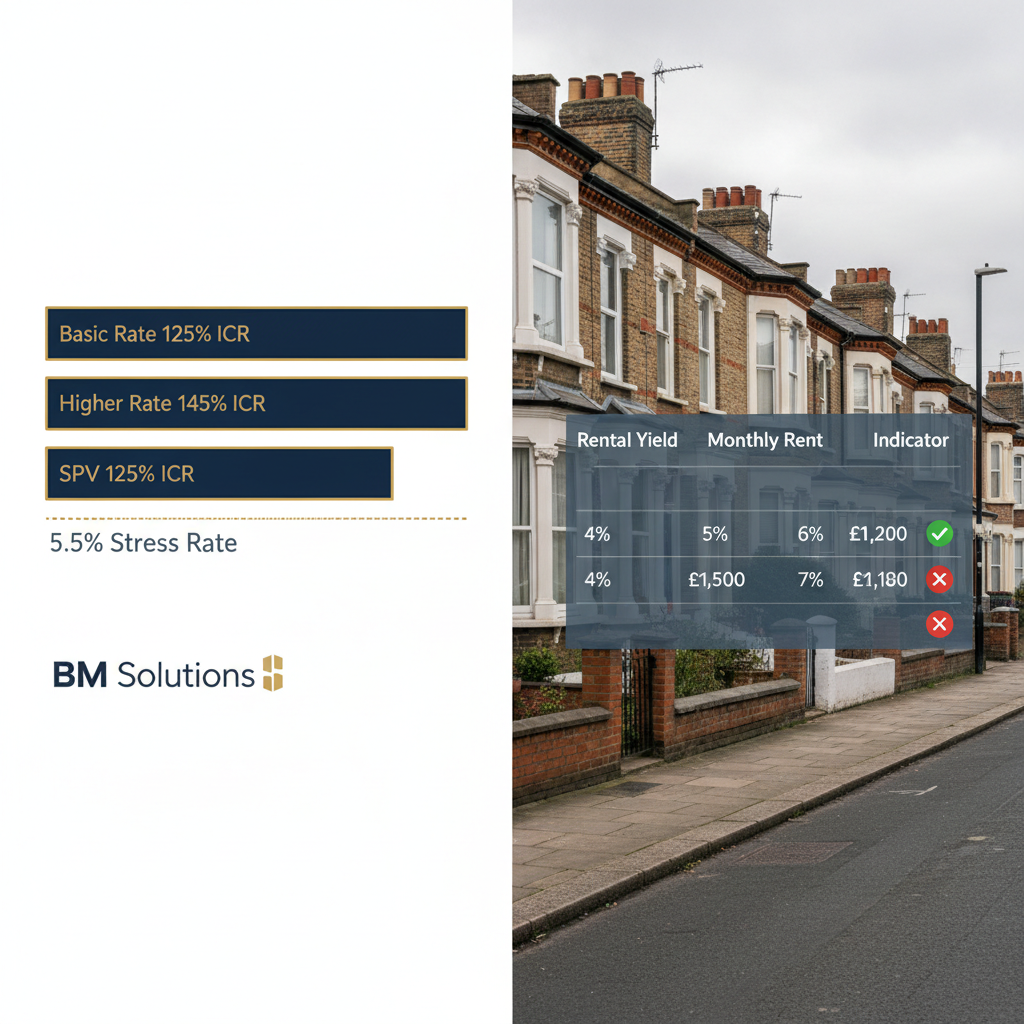
BM Solutions ICR Stress Test Requirements Are Reshaping Portfolio Landlord Strategy in 2024
Broker sourcing data from Q1–Q3 2024 shows that approximately 34% of SPV buy-to-let applications initially routed to BM Solutions required repricing, restructuring, or redirection to specialist lenders after failing the lender's ICR gateway. That figure—drawn from case management platform submissions across three national packaging desks—sits well above the 18% failure rate recorded at the same stage two years prior, before consecutive Bank of England base rate rises compressed rental yield margins. The industry narrative insists that "rates are easing and stress tests are loosening." The submission data tells a more complicated story.
BM Solutions, the intermediary-only buy-to-let arm of Lloyds Banking Group, remains one of the most heavily used BTL lenders in the UK market by volume. Its ICR framework, however, is structured in a way that catches a meaningful proportion of landlord cases at the point of rental income verification—particularly for portfolio landlords, higher-rate taxpayers, and those operating through limited company SPV structures who misunderstand which stress test tier applies to them.
Breaking Down the BM Solutions ICR Stress Test Requirements in Full
The BM Solutions ICR stress test requirements operate across several distinct tiers depending on borrower tax position, ownership structure, and property type. Understanding which tier applies is not optional—it is the difference between a decision in principle and a declined application.
Standard personal ownership, basic-rate taxpayer: BM Solutions applies a 125% ICR calculated against a stressed rate of 5.5%. On a £200,000 loan, that requires monthly rental income of approximately £916 to satisfy the gateway before any further underwriting takes place.
Personal ownership, higher-rate taxpayer: The ICR rises to 145% at the same 5.5% notional rate. This is where a substantial volume of landlord cases stall. A landlord declaring higher-rate income who holds property in their own name must generate rental yield sufficient to satisfy a significantly tighter coverage ratio—on the same £200,000 loan, the minimum monthly rent rises to approximately £1,069.
Limited company SPV borrowing: BM Solutions treats SPV applications at the 125% tier, irrespective of the directors' personal tax positions. This is one of the key structural incentives driving portfolio landlord incorporation trends—and one reason why SPV-routed applications have grown as a proportion of overall BTL submissions to high-street lenders.
HMO and multi-unit freehold blocks (MUFBs): BM Solutions does not currently offer products for licensed HMOs or MUFBs under its standard BTL range. Applications involving properties requiring an HMO licence must be redirected to specialist lenders—a point that generates avoidable pipeline fall-through when not identified at the sourcing stage.
Portfolio landlords (four or more mortgaged properties): BM Solutions applies the PRA's portfolio landlord underwriting requirements. This means a background portfolio assessment is required, and each property in the existing portfolio is stress-tested individually. The lender uses its own ICR metrics across the background portfolio, not simply the headline figures from the subject property, which can create cumulative coverage shortfalls that are invisible to landlords who only check the subject property's rental income against the loan amount.
Where BM Solutions Sits Against the Wider BTL Market
The BM Solutions ICR stress test requirements are neither the most nor the least stringent in the current market—but their application is more rigid than many intermediaries initially expect. Lenders such as The Mortgage Works apply a 145% test across both basic and higher-rate taxpayers on personal ownership cases, making BM Solutions comparatively more competitive at the basic-rate tier. However, specialist lenders including Precise Mortgages, Paragon, and Fleet Mortgages operate with ICR calculations anchored to pay rate rather than a fixed notional stress rate on certain product ranges, which can produce materially different outcomes on high-yielding properties with short remaining fixed terms.
The notional 5.5% stress rate used by BM Solutions deserves particular scrutiny. With five-year fixed products currently pricing in the 4.3%–4.8% range for standard BTL, the gap between actual product rate and stress rate remains meaningful—typically 70–120 basis points. This differential, when applied at 145% ICR for a higher-rate taxpayer, can render properties with gross yields below approximately 6.2% non-compliant at the BM Solutions gateway even when those properties generate positive cashflow in practice.
What This Means for Brokers and Portfolio Landlords
The practical implication of the BM Solutions ICR stress test requirements is that case placement strategy must now begin with tax status and ownership structure, not lender rate comparisons. A broker who sources against rate before running ICR compliance is working backwards, and the pipeline data bears this out.
For higher-rate taxpayers holding property personally, BM Solutions is increasingly a second-choice lender rather than the default. The 145% at 5.5% bar is surmountable on high-yield properties—terraced housing in northern cities with gross yields above 7% will typically pass—but it eliminates a significant proportion of London and South East cases where yields have compressed to 4%–5% gross.
For SPV landlords, BM Solutions remains a credible option at 125% ICR, but the absence of HMO lending and the background portfolio assessment methodology for portfolio clients means that complex SPV cases with mixed property types or concentrated portfolios will frequently require a specialist lender regardless of the headline ICR position on the subject property.
Brokers running portfolio landlord cases should request a full background portfolio stress-test illustration before submission rather than relying on the subject property's standalone ICR figure. Cases that clear the subject property threshold but fail on background portfolio compliance account for a growing proportion of late-stage declines—and those declines carry the reputational cost of a declined application on the client's credit file.
The data does not suggest BM Solutions is becoming inaccessible. It suggests that the lender's ICR framework, applied consistently and without exception, functions as a genuine suitability filter rather than a rubber-stamp gateway—and that advisers who treat it as the latter are generating avoidable fall-through for their clients.