A 2-year fixed rate of 4.79% sits at the front of Godiva Mortgages' limited company buy-to-let range at 65% loan-to-value — and that single figure tells you quite a lot about where this lender is pitching itself.
Godiva Mortgages is the intermediary-only lending brand of Coventry Building Society. It does not accept direct applications. Every case must be submitted through a whole-of-market broker, which matters if you are a portfolio landlord managing multiple SPV structures and need someone who can navigate the underwriting properly.
What the Numbers Show
The 4.79% opening rate applies to limited company applications at 65% LTV on a 2-year fix. Step up to 75% LTV and that rate moves to 5.14% on a comparable product. The 5-year fixed equivalent at 65% LTV is priced at 5.09%, giving you a spread of 30 basis points between the 2-year and 5-year fixes at the same LTV band — tighter than many competitors, which makes the 5-year option worth modelling carefully against your refinance costs.
Arrangement fees are set at £1,999 across most limited company products. That is not the cheapest in the market — some lenders are quoting £999 — but Godiva's headline rates partially absorb that difference, so the true cost comparison requires a full APRC calculation rather than a rate-only view. On a £250,000 mortgage, the £1,999 fee represents 0.80% of the loan, which stacks differently depending on portfolio scale. If you are refinancing 4 properties simultaneously, that fee compounds to £7,996 across the portfolio.
The minimum loan size for limited company BTL at Godiva is £25,000, with a maximum loan cap of £1,000,000 on a single property. Portfolio landlords holding assets above that threshold will need to split applications or look at specialist lenders for higher-value stock. The maximum LTV across all limited company products is 75%, so high-leverage strategies are not well served here.
Godiva accepts Special Purpose Vehicle (SPV) limited companies, the standard structure most portfolio landlords are using post-2017. The accepted SIC codes include 68100 (buying and selling of own real estate) and 68209 (other letting and operating of own or leased real estate). Trading companies are not accepted — if your company has mixed commercial activity, you will need to restructure before applying.
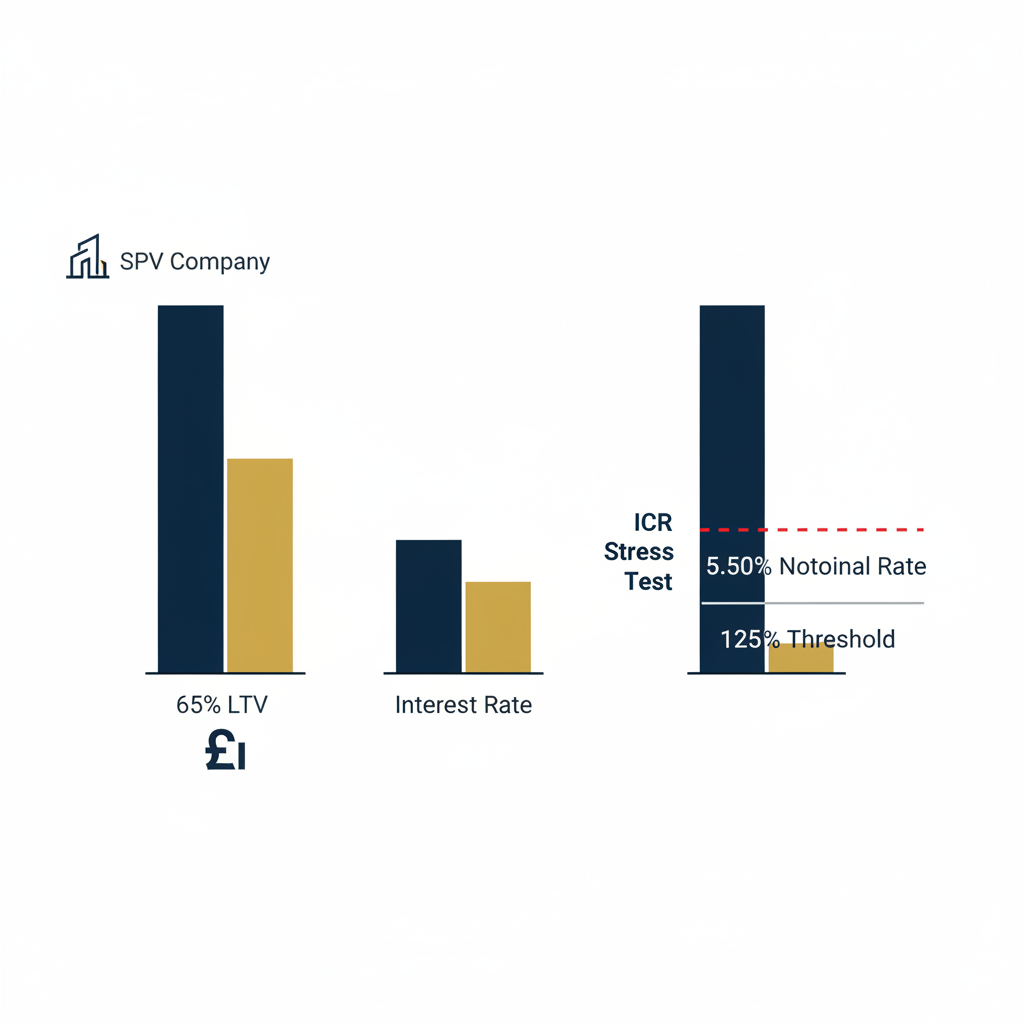
The interest coverage ratio stress test runs at 125% of the monthly interest payment, calculated at a notional rate of 5.50%. On a property generating £1,200 per month in rent, that means the interest payment must not exceed £960 per month (£1,200 ÷ 1.25). At 5.50% notional, that limits the loan to approximately £209,455 on that rental income — a meaningful constraint if you are buying in high-yield areas and trying to maximise leverage.
Personal guarantee requirements apply. Godiva requires a director's personal guarantee for limited company applications, which is standard practice across most BTL lenders but worth confirming if you have multiple directors with different risk appetites. All directors with a shareholding of 25% or more are typically required to guarantee the debt.
For portfolio landlords — defined as those with 4 or more mortgaged buy-to-let properties — Godiva follows the Prudential Regulation Authority's 2017 underwriting standards. That means a full portfolio statement is required, showing all existing BTL properties, their outstanding balances, monthly rental income and current lenders. Applications without a complete portfolio schedule will not progress. Prepare this before submission, not during it.
What This Means for Landlords
The Godiva Limited Company Mortgage proposition sits in the mid-market: more competitive than high-street lenders operating through their retail branches, but not as aggressive as challenger lenders prepared to price at 4.49% or below on similar LTVs. The real question is whether the underwriting flexibility justifies the rate premium over the cheapest available options.
For most SPV investors with clean company accounts and properties yielding above 6.5%, Godiva's stress test at 5.50% notional will be passable without too much difficulty. A property worth £300,000 generating £1,625 per month in rent (6.5% gross yield) allows borrowing of approximately £252,000 at 84% of value before the stress test bites — but the maximum LTV cap of 75% is the binding constraint at £225,000, not the ICR calculation. That means well-yielding properties in the Midlands and North of England are likely to fit this lender's criteria more comfortably than lower-yield London assets.
Product transfer options exist for existing Godiva customers, though the range for limited company switchers is narrower than the full acquisition range. Check the revert rate — currently the Coventry Building Society standard variable rate equivalent — before assuming a product transfer is the right move at expiry. In a higher-rate environment, sitting on a revert rate of 8.24% for even 60 days while a new deal is arranged costs a £200,000 borrower approximately £823 in avoidable interest.
The 75% LTV ceiling also has an implication for remortgage cases where property values have fallen since original purchase. If you bought at £350,000 with a £262,500 mortgage (75% LTV) and the property is now valued at £330,000, your loan-to-value sits at 79.5% — outside Godiva's acceptable range. At that point, you either need to reduce the loan balance by £14,250 before completing or use a lender with an 80% LTV product.
A Godiva Limited Company Mortgage works best for landlords running a clean SPV with 3 to 8 properties in the £150,000 to £500,000 price bracket, yielding above 6%, who want a lender with genuine intermediary-only underwriting rather than a call centre making ad hoc decisions. The £1,000,000 single-asset cap and 75% LTV ceiling are the two numbers to test your deal against before you spend time packaging a case.