Portfolio Landlord Background Stress Test: What the 5.5% ICR Calculation Means for Your Next Purchase
What Triggers Portfolio Status
Once you own 4 or more mortgaged buy-to-let properties, lenders classify you as a portfolio landlord. That classification changed everything after the Prudential Regulation Authority issued supervisory statement SS13/16 in September 2016, which came fully into force by October 2017. From that point, any lender operating under PRA rules must apply an enhanced underwriting assessment — not just on the property you are buying, but across your entire existing portfolio. That background assessment is the portfolio landlord background stress test, and understanding it is the difference between a smooth application and an inexplicable decline.
What the Background Stress Test Actually Calculates
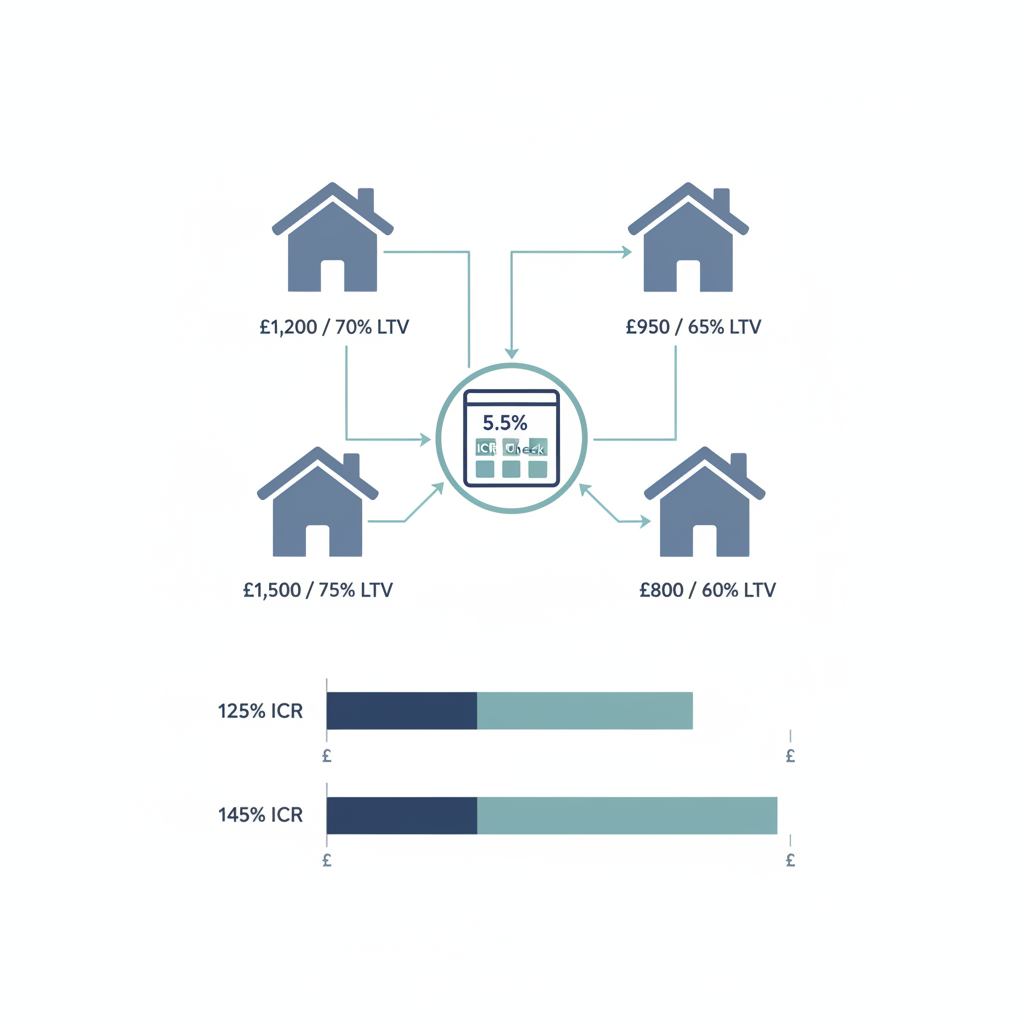
The lender takes every mortgaged BTL property you own and applies a notional interest rate — typically 5.5%, though some lenders use 5.75% — to the outstanding mortgage balance on each one. They then check whether the rental income on each property, or your portfolio in aggregate, covers that stressed payment at 125% for a basic-rate taxpayer or 145% for a higher- or additional-rate taxpayer. If a property has a passing ICR individually but your aggregate portfolio fails, many lenders will still decline or restrict your new loan.
Santander, for example, applies a 5.5% stress rate and requires 145% ICR across the entire background portfolio for higher-rate taxpayers. Barclays uses a minimum 5.5% stress rate with a 125% ICR for basic-rate taxpayers. TMW (The Mortgage Works) uses 5.5% on background properties with a 145% requirement. These are not negotiable on application day — they are baked into the system.
Why "Background" Is the Critical Word
The stress test on the property you are actually buying is straightforward — rental income versus your mortgage payment on that one asset. The background stress test is the one that catches landlords off guard. A portfolio landlord who has 10 properties mortgaged at a blended average rate of 3.2% might sail through on the purchase property, then fail the background check because several older properties have low passing rents relative to 5.5% stressed debt.
Lenders will ask you to complete a portfolio schedule — a spreadsheet showing every property address, current mortgage balance, current lender, monthly payment, rental income, and property value. Virgin Money requires this completed before submission. NatWest has its own proprietary schedule template and will not accept third-party versions. Prepare this document before you approach any lender, because an incomplete schedule adds weeks to the process.
The Three Common Failure Modes
Aggregate rental shortfall. Your portfolio in total generates, say, £9,800 per month in rent, but the 5.5% stress test against your total outstanding BTL mortgage debt of £1.8 million requires £10,350 per month at 145% ICR. You fail by £550 per month. The fix is either reducing debt (remortgaging onto capital repayment to reduce balances is not quick), or finding a lender with a 125% ICR requirement if your tax position allows.
High LTV properties dragging the average. A property purchased at 80% LTV five years ago with flat capital growth generates a high stressed monthly payment relative to its rent. Even if 8 out of 10 properties pass comfortably, 2 failing properties can pull the aggregate calculation below threshold with some lenders' methodologies.
Holiday lets and HMOs counted differently. Some lenders exclude HMO income from the background rental calculation and instead apply a standard single-let rental estimate, which can reduce your aggregate passing income by 20-35%. Check the lender's specific HMO policy before submission, not after.
Lenders Who Take a More Flexible Approach
Not all lenders approach the portfolio landlord background stress test identically. Specialist lenders such as Fleet Mortgages, Precise Mortgages, and Foundation Home Loans apply a portfolio-level assessment but may use 5.5% with 125% ICR regardless of taxpayer status — useful for higher-rate taxpayers who have strong aggregate rental income. Fleet Mortgages requires a minimum portfolio rental coverage of 100% in aggregate as a secondary check and sets its own portfolio LTV cap at 75%.
Some building societies — including several smaller regionals — have applied for and received PRA waivers or operate under a proportionate approach, meaning they may assess background properties on an interest-only basis at a rate closer to current market rates, such as 4.5%, rather than 5.5%. These lenders are worth identifying when your portfolio has tight margins.
How to Prepare Your Portfolio Schedule Properly
Every row must be accurate. An inconsistency between what you declare and what a credit search or Land Registry check reveals is treated as a material discrepancy. Lenders will verify outstanding mortgage balances against bank statements or mortgage account statements — typically the most recent 3 months. Rental income must be evidenced by tenancy agreements and, for existing tenancies, 12 months of bank statements showing credit. For a 10-property portfolio, that is potentially 40 documents before you have even supplied ID.
Organise your schedule as follows: property address, purchase price, current estimated value, outstanding balance, current lender, mortgage type (interest-only or repayment), monthly contractual payment, monthly rental income, tenancy type (AST, HMO licence, holiday let). Add a column showing the stressed monthly payment at 5.5% and the ICR at 125% and 145% — do the lender's maths yourself so you can see problems before they do.
Timing Your Application Around Rate Expiry
When you have 4 or more properties, the timing of your remortgages matters more than the rate you achieve on any single deal. A portfolio landlord applying for a new purchase at the same time two existing properties are on SVR — Nationwide's standard variable rate is currently 7.74%, which substantially inflates the stressed monthly payment on those two properties — will face a harder background test than if those properties had been refinanced onto 5-year fixes in advance. Build a 12-month refinancing plan before you pursue new acquisitions.