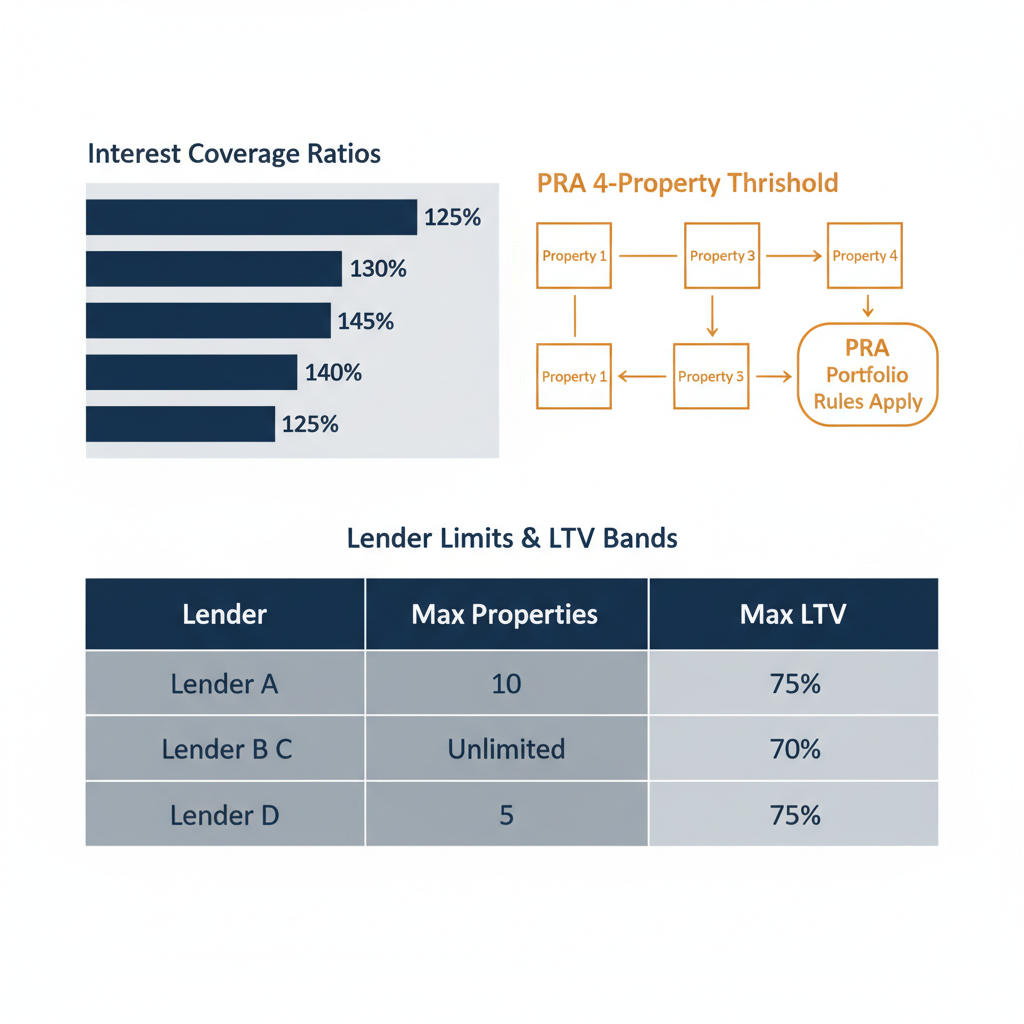
The figure that defines whether you qualify as a portfolio landlord is four. Own four or more mortgaged buy-to-let properties simultaneously, and the Prudential Regulation Authority's 2017 underwriting standards kick in. Every lender regulated under those rules must treat you differently from a standard BTL borrower — with heavier documentation requirements, portfolio-wide stress tests, and in many cases, a specialist underwriting team reviewing your application manually.
That single threshold — four mortgaged properties — separates a relatively smooth BTL application from one that can take three to four weeks longer to complete.
What the Numbers Show
Pulling apart what lenders currently require, the first split is between those who will lend to portfolio landlords at all and those who quietly cap exposure at three mortgaged properties. Lloyds Banking Group — which includes Halifax and BM Solutions — will assess portfolio landlords but applies a maximum portfolio debt cap of £3 million across its brands combined. Exceed that and you are looking at a referral to its specialist team, which in practice means an extended timeline.
NatWest operates with a 10-property cap for its standard BTL range. Barclays cuts off at 6 properties in background before referring cases to its intermediary specialist desk. Both figure out at 145% interest coverage ratio on a stressed rate of 5.5%, applied not just to the subject property but across every mortgaged BTL you own. That stress test across a 10-property portfolio with average loan sizes of £200,000 can generate a significant income requirement — one that catches investors off guard if they have any void periods dragging average rents down.
Specialist lenders operate on different numbers. Paragon Bank — arguably the market's most established portfolio landlord lender — has no stated upper property limit. Its stress rate currently sits at 5.5% for standard BTL and 5.0% for five-year fixed products, and it applies the 125% ICR at 5.0% for higher-rate taxpayers using a limited company. Paragon's standard arrangement fee is 0.3% of the loan, though complex cases attract a flat £500 processing charge on top. Fleet Mortgages applies a 145% ICR at 5.5% on personal name applications and 125% at 5.5% for limited company applications. Precise Mortgages accepts background portfolios up to £5 million in value before applying enhanced underwriting layers.
The documentation requirement is where portfolio applications add the most friction. From the 30 September 2017 PRA deadline, lenders have been required to collect a business plan, cash flow forecasts, an asset and liability statement, and evidence of rental income across the entire portfolio. In practice, that means a spreadsheet — often the lender's own template — listing every property you own, its current value, outstanding mortgage balance, monthly rent, and lender name. Lenders including Aldermore, Paragon, and Foundation Home Loans all provide their own portfolio schedule templates. Submitting the wrong format adds at minimum five working days to processing.
Limited company applications add another layer. As of Q1 2024, approximately 80% of new BTL purchase applications from portfolio landlords in the UK were made through a Special Purpose Vehicle structure, according to figures from the Intermediary Mortgage Lenders Association. Lenders accepting SPVs — including Precise, Keystone Property Finance, and The Mortgage Works — typically require the SPV to hold an SIC code of 68100 or 68209. Keystone currently prices its five-year fixed limited company products from 5.14% at 70% LTV, with a 2% arrangement fee on the loan amount.
Personal name applications are not dead, but the pricing gap has widened. The Mortgage Works — the BTL arm of Nationwide — currently prices its personal name five-year fixes from 4.79% at 65% LTV for standard BTL, against 4.94% for its equivalent limited company product. The 15 basis point premium for company name borrowing is relatively narrow by market standards, making TMW one of the more competitive options for landlords still holding properties personally.
What This Means for Landlords
The practical consequence of the 2017 PRA changes is that your background portfolio can block a new application entirely — not because your new purchase fails to stack up, but because two existing properties have rental yields under 5% and drag the portfolio-wide ICR below the lender's threshold. You might have £800,000 in equity across eight properties and still be declined because aggregate rental income of £4,800 per month does not cover aggregate mortgage payments of £3,900 per month at a stressed 5.5% rate.
That is not hypothetical. It is the reason why lenders like Paragon and Fleet have become default options for experienced portfolio landlords — not because their rates are cheapest (they are not always), but because their underwriters understand rental business economics and apply some discretion on a case-by-case basis rather than running every application through a rigid automated decision engine.
Portfolio landlords with more than 11 properties will find their options narrow to fewer than a dozen lenders in the mainstream market. Above £3 million in background portfolio borrowing, the realistic shortlist shrinks to Paragon, Fleet, Aldermore, Keystone, Foundation Home Loans, Precise, Lendinvest, and a handful of regional building societies operating specialist commercial or semi-commercial BTL desks. Rates in that segment typically open at 5.2% on a two-year fix and 4.9% on a five-year fix at 65% LTV, but the arrangement fees — commonly 1.5% to 2% of the loan — mean the total cost of borrowing looks very different from the headline rate.
One area where lenders are diverging sharply is HMO and multi-unit freehold block exposure within a background portfolio. Lenders including Halifax will not accept HMOs as security at all on their residential BTL range. NatWest caps HMO units at 6 lettable rooms. Paragon, by contrast, will lend on HMOs with up to 20 rooms under its specialist range, applying a minimum rental income of 125% of the stressed monthly mortgage payment.
If your portfolio contains a mix of standard single-let properties, HMOs, and a limited company SPV structure, your application is going to a specialist lender regardless of the headline rate comparison. Running a like-for-like rate comparison on a portfolio application without factoring in fee structures and the actual likelihood of approval with a given lender is the fastest route to wasted time and an unnecessary credit footprint.
The four-property threshold triggers everything. Plan around it before you buy property number four, not after.