A 2-year fixed product switch rate of 6.44% at 70% LTV, with zero product fee — that is the number that opens Aldermore's intermediary proposition in the second half of 2026. Pull up the full BTL mortgage guide dated 14 October 2026 and the picture becomes more nuanced: a wide product range built around fee-versus-rate trade-offs, layered ICR thresholds, and loan caps that shift materially depending on property type. Here is what the numbers actually say.
What the Numbers Show
Loan limits and LTV
Aldermore's BTL maximum LTV is 80% to a loan cap of £500k, 75% to £1m on standard residential investment properties, and 75% to £1.5m or 65% to £2m on HMO and multi-unit freehold (MUFB) properties. Portfolio landlords using the multi-property product can aggregate up to £5m at 75% LTV, or up to £10m at 65% LTV.
First-time landlords are capped at 75% LTV and £500,000, must be at least 25 years old, earn a minimum of £25,000 per year, and must have been an owner-occupier for at least 12 months. That £25,000 income floor is a hard stop — evidence is required, not optional.
Rates and fee structures
The 14 October 2026 product guide shows the 2-year fixed range for individuals and companies with single residential investment properties opens at 6.61% with a zero product fee, stepping down to 5.11% with a 3% fee, and 4.11% with a 5% fee. At the higher-LTV 80% tier, the zero-fee 2-year fixed is priced at 7.06% with no product fee, or 6.31% with a 1.50% fee.
On 5-year fixed products, zero-fee rates open at 6.61% for both the 65% and 75% LTV tiers, falling to 6.01% at 3% fee, and as low as 5.21% with a 7% fee. The reversion rate — where clients land if they do nothing at the end of their deal — sits at 8.38%, which is Aldermore's Managed Rate (AMR) plus 0%.
For portfolio landlords on the multi-property product, the 2-year fixed opens at 6.56% (zero fee) at 65% LTV and 8.56% (zero fee) at 80% LTV. The HMO and MUFB multi-property range carries its own pricing — check the current product guide before quoting.
An EPC incentive is available: a 2-year fixed for properties with an EPC rating of A, B or C is priced at 5.06% with a 3% product fee. For landlords with energy-efficient stock, that 55 basis point discount over the equivalent standard rate is worth modelling.
ICR thresholds
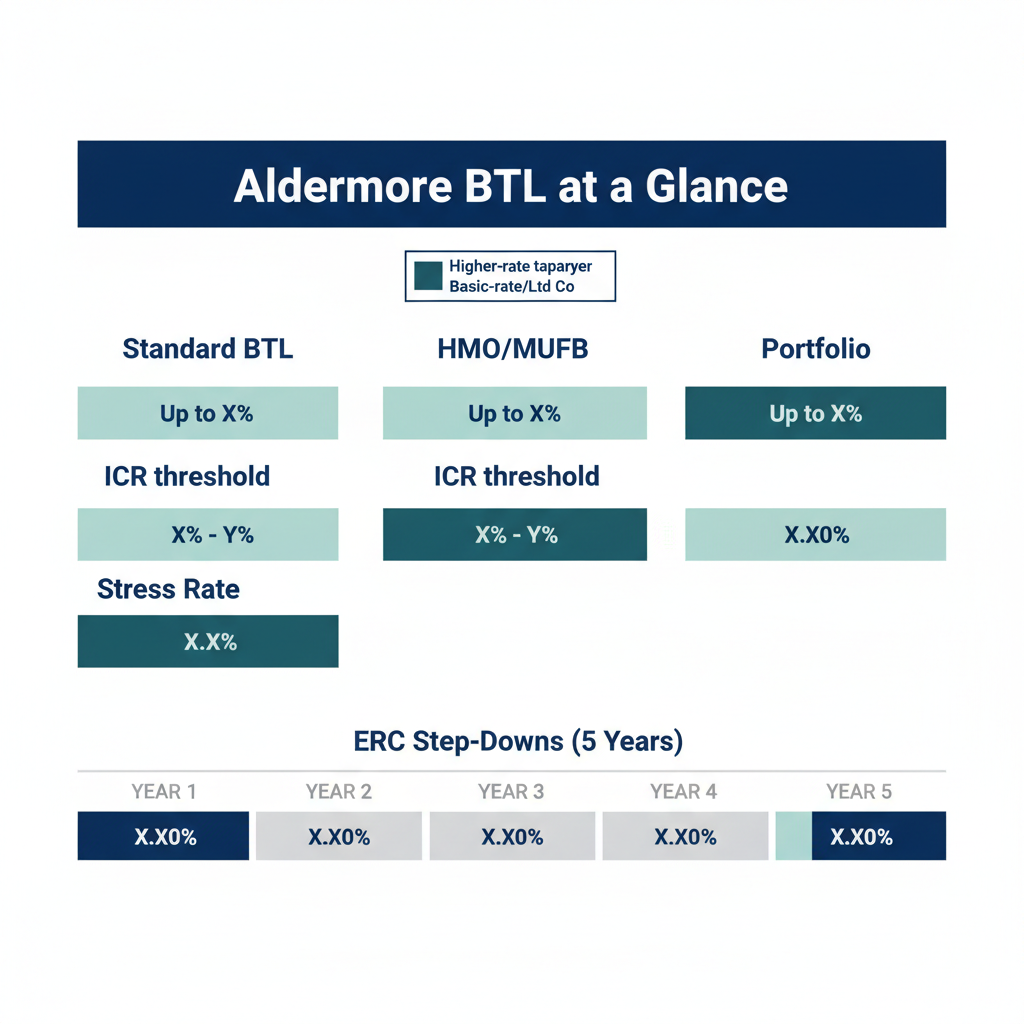
This is the area where an Aldermore mortgage broker earns their fee. For single residential investment properties (including MUFBs), Aldermore applies a minimum ICR of 140% for individuals who are higher- or additional-rate taxpayers. The threshold drops to 125% for companies or individuals who are basic-rate taxpayers.
On HMO properties, higher- and additional-rate taxpayer individuals face a 145% ICR, while companies or basic-rate taxpayer individuals are assessed at 130%.
The stress rate applied depends on the fix length. For 2-year fixed and discount products, the stress rate is the higher of the pay rate plus 2%, or 5.5%. For 5-year fixed products, it is the higher of the pay rate itself, or 4.0%. That differential matters enormously for borderline cases. A landlord failing affordability on a 2-year fix at 5.5% stress may well pass on a 5-year fix stressed at their actual pay rate.
Early repayment charges
On the product switch range, the 2-year fixed carries an ERC of 2.50% in year one, and the 5-year fixed carries 4.50% in year one, stepping down to 3.50% in year three, 3.00% in year four, and 2.50% in year five. These are the figures from Aldermore's October 2026 product switch guide — verify the specific ERC schedule in your client's mortgage offer, as it is set at point of application.
Overpayments of up to 10% of the outstanding balance can be made each year without incurring an early repayment charge. That is useful headroom for landlords who want to reduce their LTV ahead of a product switch.
Clients can switch to a new deal up to 17 weeks before their current rate or ERC period ends. Getting this conversation started early — especially with a 5-year fix rolling off — is one of the clearest broker add-value points.
Procuration fees
Aldermore pays 0.65% gross (0.60% net via mortgage clubs) on BTL and specialist BTL new business. The product switch (retention) rate is 0.35% gross, 0.30% net. On a £350,000 BTL loan, that is £2,275 gross on new business — a reasonable return on a well-prepared case.
Conveyancing incentives
Remortgage cases benefit from free legal fees for individuals and assisted legal fees for companies, paid directly by Aldermore. On a standard remortgage this removes a cost that might otherwise run to several hundred pounds, and it simplifies the client conversation on total cost.
What This Means for Landlords
Three decisions recur when placing a case at Aldermore. First, fix length. The lower stress floor on a 5-year fixed — pay rate or 4.0%, whichever is higher — versus 5.5% on a 2-year fix can unlock materially more borrowing for the same rent. Run both scenarios every time before recommending a term.
Second, structure. The 125% ICR for limited companies versus 140% for higher-rate personal-name borrowers is not a small gap. On a property generating £18,000 annual rent, the maximum loan under a 5.5% stress differs meaningfully depending on which entity holds the title. Do the arithmetic before committing to a structure.
Third, property type. The HMO uplift — 145% ICR for higher-rate taxpayers and 130% for basic-rate and companies — means a landlord moving from a standard single-let to HMO borrowing faces a tighter affordability test even if the gross yield is higher. HMO lending up to £1.5m at 75% LTV and £2m at 65% LTV gives real capacity for experienced operators, but the numbers need to stack at those ICR levels.
Aldermore's BTL offering is broad enough to cover first-time landlords, portfolio holders, HMO operators, and limited companies. The criteria are detailed and the rate-versus-fee matrix is wide. An experienced Aldermore mortgage broker who reads the product guide before picking up the phone will place far more of these cases than one who relies on a sourcing system alone.