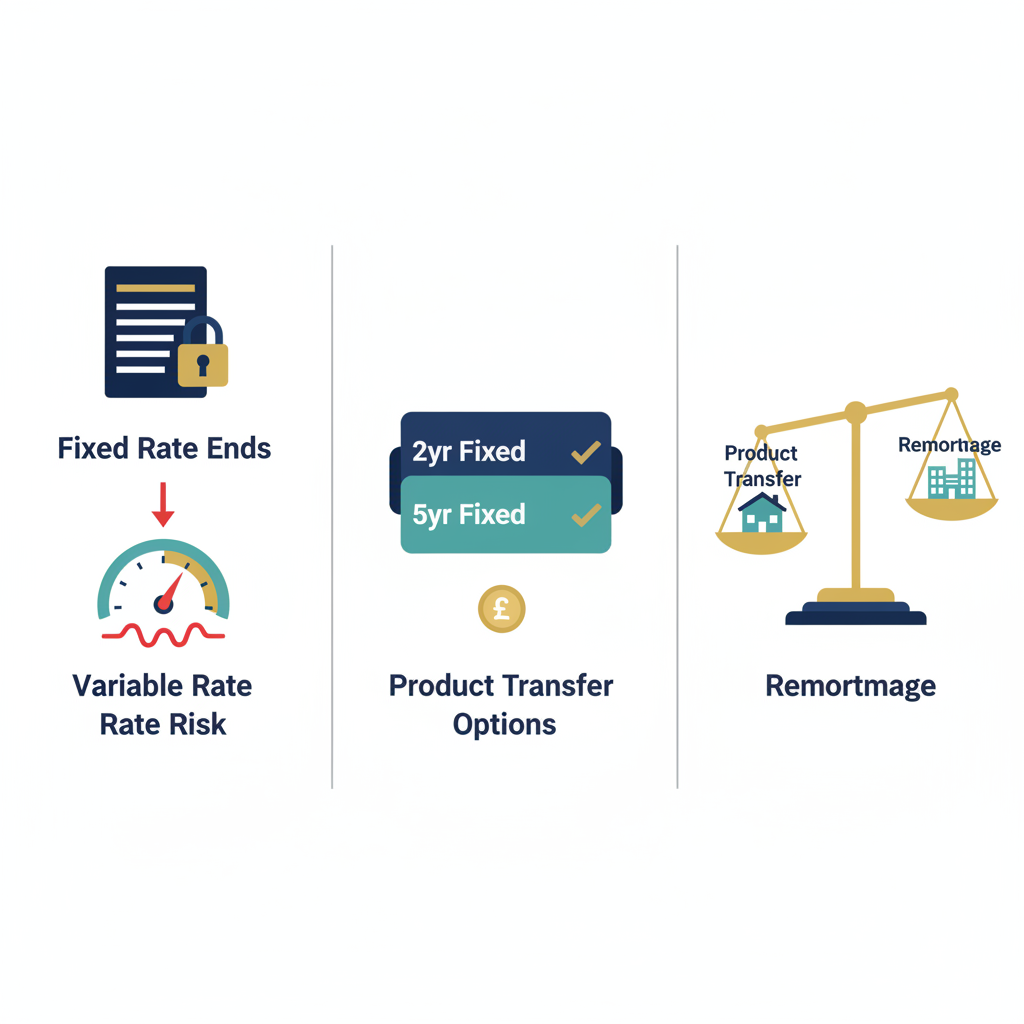
Miss the window on your Vida Homeloans buy-to-let mortgage and your rate doesn't stay the same — it jumps. Vida's BTL reversion rate is currently 8.64%, set at the Vida Variable Rate of 5.80% (last updated 1 February 2026) plus a margin of 2.84%. On a £200,000 interest-only balance, that's £1,440 a month in interest. Even moving to a fixed product transfer rate reduces that meaningfully. This article covers exactly how Vida Homeloans Buy-to-Let Product Transfers Explained works in practice, so you don't pay more than you need to.
What is a Vida product transfer — and why does it matter to you?
A product transfer (sometimes called a product switch or retention) is simply moving your existing Vida mortgage onto a new fixed rate deal when your current one ends. You stay with Vida. The loan amount doesn't change. No new lender, no solicitor, no Land Registry involvement. For landlords whose fixed rate is approaching its end date, the question is straightforward: take a Vida product transfer, or remortgage elsewhere?
The wrong choice costs money. If your Vida 2-year fixed ended today and you did nothing, you would move onto the reversion rate — the variable rate your mortgage reverts to when the fixed period ends if you do not refix with Vida or another lender. At 8.64%, that is significantly above the rates available on a product transfer. The difference on a £200,000 balance is around £227 a month compared with a 5-year fixed product transfer rate of 7.28% — that's more than £2,700 a year in avoidable cost.
Verdict: who a Vida product transfer suits
A Vida product transfer makes most sense if your credit profile has not dramatically improved since you took out the original mortgage, if your property or rental circumstances have changed in ways that make a fresh lender application uncertain, or if simplicity matters more than chasing the absolute lowest rate. It is worth looking elsewhere if your credit has significantly improved and mainstream lenders are now accessible to you, if you want to raise additional capital, or if the net saving after fees and legal costs at another lender clearly outweighs the transfer cost. Rates, criteria and offers change and may be withdrawn at short notice; your individual circumstances affect what is available, and nothing here constitutes a guarantee of any particular rate or approval.
How It Works in Practice
Switching your mortgage product with Vida is described as quick and easy. If your current fixed or discounted variable rate has already expired or is due to expire within the next 6 months, and you meet the eligibility criteria, your broker can request a product switch. That 6-month window is important: you can secure a new rate well before your deal ends, giving you certainty while still benefiting from your current fixed rate until it expires.
Vida's Product Switch Hub is where brokers can browse the full range of residential and BTL products available for product switches. The BTL product transfer range includes both 2-year and 5-year fixed options, with fee-paying and fee-free variants. On the product switch range current as of 22 October 2026, a 2-year fixed carries a rate of 7.09% with a £795 product fee, a fee-free 2-year option sits at 7.54%, a 5-year fixed with a £795 fee is 7.28%, and a fee-free 5-year option is 7.43%. Following the November 2026 update, selected BTL product transfer rates have been reduced by up to 0.15%, so current rates will be at or below those October reference points — check Vida's Product Switch Hub for the live figures before advising.
Early repayment charges (ERCs) apply during the new fixed term. On a 2-year fixed product transfer, ERCs are 4% in year one and 3% in year two. On a 5-year fixed, they are 5%, 5%, 4%, 3% and 2% across the five years. Build these into your comparison before recommending the longer fix.
One of the practical advantages of a Vida product transfer over a full remortgage is process simplicity. Because you are not applying for new credit with a new lender, the process is significantly lighter. Vida's intermediary pages describe it as a quick switch. That said, always check the current product switch criteria with Vida directly, as eligibility conditions can apply.
The November 2026 rate cuts and the £250 cashback deadline
As part of Vida's November 2026 update, every Vida mortgage product now carries at least £250 customer cashback. Where a product already included cashback, an extra £250 has been added, and this offer is available until 17 December. That means a BTL product transfer completed before 17 December carries a minimum £250 cashback — and potentially £500 or more if the specific product already had cashback attached.
Vida has also increased its product transfer procuration fee from 0.40% to 0.50%, which matters from a broker economics perspective — a higher proc fee on product transfers means your adviser is properly compensated for the work of reviewing and arranging your switch, rather than being incentivised only to place new business elsewhere.
Why a Vida product transfer can suit landlords with complex credit
Vida is a specialist lender. Its BTL criteria highlights include lending for first-time and experienced landlords, up to 85% LTV, and accommodation for expats in selected worldwide and EEA countries. Its credit tiers — Vida 36 for the cleanest profiles, Vida 24 for moderate credit history, and Vida 6 for more adverse backgrounds — mean it lends to a wider range of borrowers than a high-street bank.
If your credit profile has not changed since you took out your original Vida mortgage, applying to a mainstream lender now carries real risk of either rejection or a worse rate than you expect. A Vida Homeloans Buy-to-Let Product Transfer keeps you within the lender that already knows your case and your property. Vida's new business proposition explicitly covers specialist cases including adverse credit, complex income, later-life borrowing and residency requirements — the same flexibility that applied when you first borrowed can work in your favour when you switch.
Common Mistakes
Drifting onto the reversion rate. This is the most expensive mistake. The reversion rate is the variable rate your mortgage moves to when the fixed period ends if you do not refix; it is set at a margin above the Vida Variable Rate, which moves broadly in line with the Bank of England base rate. At 8.64%, leaving £200,000 on the reversion rate costs £1,440 a month in interest. Fixing at 7.28% costs £1,213 — the same loan, £227 less every month.
Leaving it too late. The product switch window opens when your fixed rate is due to expire within the next 6 months. Do not wait until the final weeks. Arrangements can typically be put in place well before the end date, and your new rate starts when your existing deal expires — there is no overlap of rates.
Not comparing the full cost. The lowest headline rate on a product transfer is not always the cheapest option overall. A 7.09% rate with a £795 product fee will cost more in total than a 7.43% fee-free option on certain loan sizes and terms. On a £200,000 balance over 2 years, the break-even point between a £795-fee deal and a fee-free deal is determined entirely by the rate differential. Run the numbers, not just the rates.
Assuming a remortgage is always better. A remortgage to a new lender involves legal work, a valuation and a full underwriting process. Fees can easily reach £1,500 to £2,500 when you include legal costs and valuation charges. Unless the rate saving is material after those costs — and your credit profile genuinely qualifies you for the better rate elsewhere — the product transfer is frequently the better net outcome.
Ignoring the cashback deadline. The £250 cashback offer runs until 17 December. A product transfer booked after that date may not carry the same cashback. For landlords with deals ending in early 2027, it is worth checking whether you can arrange the product switch now to secure the offer, while the new rate takes effect only when your current deal ends.
Overlooking structure. Limited company SPV borrowers and HMO landlords have additional considerations. Vida has reduced the ICR (interest coverage ratio) for HMOs and multi-unit blocks to 125% for SPV borrowers, which may affect what product you qualify for on a switch. If your property is an HMO or held in a limited company, confirm the applicable ICR and rental stress test with your broker before proceeding, rather than assuming the standard residential product switch rates apply to your case.
Illustrative comparison — £200,000 interest-only BTL balance
The table below is illustrative only, using verified rates for Vida and estimated illustrative figures for a remortgage. It does not represent a specific product recommendation. Individual rates and fees vary by LTV, credit tier, and lender criteria.
*Rates effective from 22 October 2026 and reduced by up to 0.15% for selected BTL PTs in November 2026. Check Vida's Product Switch Hub for current live rates. Illustrative only. Not a quote or commitment.
How a broker handles this
Your broker accesses Vida's BTL product transfer rates directly through the Product Switch Hub, compares them against the whole of market for a remortgage, and factors in fees, ERCs, valuation costs and legal charges to produce a true like-for-like comparison. For limited company SPV cases or HMOs with 6 or more bedrooms, the adviser also checks that the product and ICR requirements fit the structure — criteria that standard online rate tables do not reflect. The switch itself, once arranged, is straightforward: Vida handles the administration, no solicitor is required on the product transfer side, and the new rate activates when the old one expires.
*Rates effective 22 October 2026; BTL PT rates reduced by up to 0.15% in November 2026 — verify current figures on Vida's Product Switch Hub before advising. Figures illustrative only on a £200,000 interest-only balance.