The Single Factor That Decides Everything
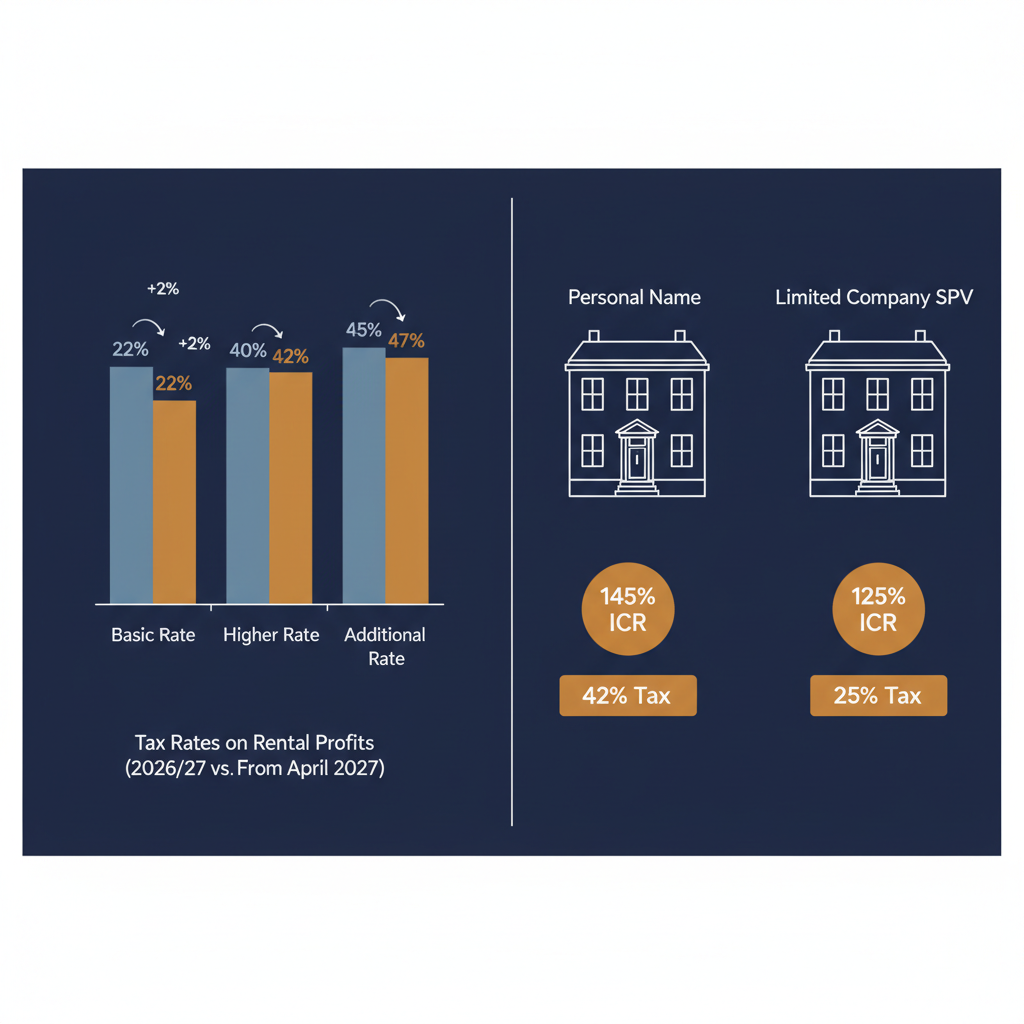
From 6 April 2027, income tax rates on property income will increase by 2 percentage points across all bands — basic rate rises from 20% to 22%, higher rate from 40% to 42%, and additional rate from 45% to 47%. That is the headline. But the decision this forces on higher-rate landlords is not about those 2 points in isolation. It is about whether the structure you use to hold property — personal name, limited company, or spousal transfer — still makes financial sense once those rates land alongside the existing Section 24 mortgage interest restriction.
The complications come from three places: Section 24 restricting how mortgage interest is treated, the personal allowance tapering above £100,000 of total income, and the separate property income tax rates of 22%, 42%, and 47% that take effect on 6 April 2027. Get this interaction wrong and the tax on your rental profits rises by far more than 2 percentage points. Get it right and the 2027 change is manageable. That is the decision this article sets out.
Higher-Rate Taxpayer Landlords: What the 2027 Property Income Tax Rise Means for Your Buy-to-Let starts with one question: are you holding property in the most tax-efficient structure before April 2027?
How Section 24 Works — and Why 2027 Makes It Worse
The Section 24 tax change restricts the amount of tax relief landlords can claim on mortgage interest and other finance costs. Before Section 24, landlords could deduct 100% of their mortgage interest payments from rental income before calculating tax. Now, landlords must pay tax on their full rental income and can only claim back a 20% basic rate tax credit on mortgage interest, regardless of whether they're a basic, higher, or additional rate taxpayer.
Higher and additional-rate taxpayers are most impacted, as they previously received 40% or 45% relief but now only get 20%. You pay tax on a gross profit you never actually received in cash — the mortgage interest went straight to the lender — and you get back only a 20% credit. For higher-rate taxpayers, the rate rises from 40% to 42% but the credit only rises from 20% to 22%, so the 20 percentage-point gap between rate and credit remains unchanged. The good news is the gap does not widen. The bad news is it does not close, either.
From April 2027, your rental profit is taxed at the new property rates (22%, 42%, or 47%), and your finance cost tax credit is calculated at the property basic rate (22%). The credit increasing to 22% partially offsets the rate rise, but only partially.
The Worked Example: Before and After April 2027
Take a landlord with a salary of £60,000, annual rent of £15,000 and mortgage interest of £8,000. The higher rate starts when total income exceeds £50,270 — that is the personal allowance of £12,570 plus the basic rate limit of £37,700.
With a £60,000 salary already consuming the full basic-rate band, the entire £15,000 of rental profit sits in the higher-rate band.
Current position (2026/27)
Under Section 24, the full £15,000 is taxable. Tax on that profit at 40% = £6,000. The Section 24 credit on £8,000 of mortgage interest at 20% = £1,600. Net tax on the rent: £4,400.
After 6 April 2027
Tax on £15,000 at 42% = £6,300. Section 24 credit on £8,000 at 22% = £1,760. Net tax on the rent: £4,540. The increase is £140 per year for this landlord.
That may sound modest. But scale it. A landlord with £60,000 of rental profit at 42% instead of 40% pays £1,200 more annually before the credit adjustment — and this is before considering band-creep.
When Rental Income Pushes You Into a Worse Position
Basic-rate taxpayers may find themselves pushed into higher tax brackets due to how taxable profits are now calculated. Section 24 adds your gross rent to your total income. If you earn £45,000 from employment and receive £10,000 in rent, your adjusted net income for band purposes is £55,000 — above the £50,270 threshold — meaning part of your rental income falls in the higher-rate band despite your feeling like a basic-rate earner.
When your total taxable income crosses £100,000, the personal allowance starts to taper at £1 lost for every £2 of income above the threshold. The combined effect is that the marginal tax rate on income between £100,000 and £125,140 is effectively 60%.
Because Section 24 inflates your reported income, a geared landlord can be pushed over the £100,000 line and into the personal allowance taper even though their actual cash profit has not moved. Bonuses, company benefits and rental income all count towards the £100,000 taper. From April 2027, the property income that tips you over that line is taxed at 42%, not 40%. The £100,000 to £125,140 mechanism is untouched by the 2027 reforms, so the 60% trap survives intact, and because rental income above the threshold is now taxed two points higher, the add-back is marginally more expensive than before.
When Personal Ownership Still Makes Sense
Keeping property in your own name costs less to set up and costs nothing in SDLT on what you already own. An additional residential property purchase attracts an extra 5% SDLT surcharge on each band. That surcharge applies to any company purchase too, so it is not a reason to incorporate — but it does mean the existing portfolio stays where it is for most landlords.
Personal ownership makes sense when: your total income sits comfortably below £50,270 and rental income does not push you into the 40% band; your mortgage interest is low relative to rent and the Section 24 credit absorbs most of the restriction; or you are approaching the end of a fixed term and plan to sell. If your combined income stays below £50,270 after adding gross rent, you pay the new 22% basic property rate from 2027, and the revised 22% credit leaves you broadly neutral.
When a Limited Company Makes Sense
Section 24 applies to individuals only — limited companies can still deduct mortgage interest in full. The 22/42/47% property income rates are personal income tax rates and only apply to individuals receiving rental income. A company pays corporation tax at 25% on profits above £250,000, with a small profits rate of 19% on profits below £50,000, and marginal relief between those thresholds.
The case for a limited company strengthens when: you are a confirmed higher-rate taxpayer with significant mortgage debt; you are buying new properties and not transferring existing ones (which would trigger CGT and SDLT); and you can reinvest profits inside the company rather than extracting them as dividends, which carries its own tax cost.
The mortgage angle matters here. The interest cover ratio (ICR) for a basic-rate personal borrower and a limited company is typically 125%, while a higher-rate taxpayer borrowing personally typically faces 145%. On a property with £1,200 per month in rent (£14,400 annually) and a 5.5% stress rate:
- Personal higher-rate route: Maximum loan = £14,400 ÷ (1.45 × 0.055) = approximately £180,500
- Limited company route: Maximum loan = £14,400 ÷ (1.25 × 0.055) = approximately £209,500
The ICR treatment is the other half: company borrowers are tested at 125% rather than the 145% applied to higher rate taxpayers in personal name, which means the company can typically borrow 10% to 15% more against the same rent. On the same rent, the company route unlocks roughly £29,000 more borrowing in this example — a meaningful difference when assembling a portfolio.
When Spousal Transfer or Mortgage Reduction Makes Sense
If one spouse is a basic-rate taxpayer and the other is higher-rate, allocating more of the rental income to the basic-rate spouse can entirely eliminate the Section 24 problem without needing incorporation. A Declaration of Trust adjusting beneficial ownership is one route; an outright transfer is another, though CGT and SDLT implications apply depending on existing equity and mortgage balance. This is a heavily fact-specific area — take advice from a qualified tax adviser before acting.
Paying down the mortgage reduces interest costs and therefore limits how hard Section 24 bites. If your property is lightly geared, the 2027 changes are a minor inconvenience. If it is mortgaged at 70% or above, the tax on phantom profit is real cash leaving your account every January 31st.
The Calculation That Decides It
The single calculation that tells you which route makes sense is your effective tax rate on rental profit under each scenario, net of all costs: Section 24 credit, corporation tax, dividend tax on extraction, and any SDLT or CGT triggered by restructuring.
For a confirmed higher-rate taxpayer buying a new property, the numbers typically favour a limited company: corporation tax at 19–25% versus a personal rate of 42% from 2027, full interest deduction inside the company, and a less restrictive 125% ICR against 145% personally.
For a landlord transferring existing property into a company, the CGT and 5% SDLT surcharge on transfer often makes the breakeven point five to ten years away. Many landlords who already hold mortgaged property personally are better placed managing the existing portfolio in their own name while routing new acquisitions through a company.
The 2027 changes do not make personal ownership unworkable. They do make the Higher-Rate Taxpayer Landlords: What the 2027 Property Income Tax Rise Means for Your Buy-to-Let calculation sharper and the margin for error smaller.
From 6 April 2027, property income in England, Wales and Northern Ireland is taxed at 22% basic, 42% higher and 47% additional; only Scotland is carved out, where Holyrood-set rates continue to apply.
The arithmetic above is illustrative. The right answer for your portfolio depends on your total income, mortgage balances, the ages of your fixed-rate deals, and how you plan to exit. Speak to a qualified tax adviser before making any structural changes to your property ownership.