A 3.49% opening rate from The Mortgage Works sits on the same product guide as a background portfolio stress rate that just increased to 5.25%. That tension — headline rate cut, tighter affordability test — is the defining story of the best buy to let mortgage rates available to UK landlords right now.
What the Numbers Show
The Mortgage Works has made selected rate increases and reductions across its new business range, with fixed rates now starting from 3.49% and tracker rates from 3.99%. All trackers will include a switch-to-fix option. That starting rate puts TMW at the sharp end of mainstream BTL pricing — and well below the market average.
The gap between best and average is substantial. The average two-year fixed-rate BTL mortgage at 75% LTV currently sits at 5.89% across all lenders. As of 15 October 2026, the Bank of England base rate stands at 3.75%, while the average five-year fixed rate across all mortgage types is running at 5.99%. The best buy to let mortgage rates available to portfolio landlords with clean credit and the right LTV are therefore running roughly 240 basis points below the all-lender average — but the criteria to access them are exacting.
At 75% LTV on a two-year fix, Zephyr Homeloans and Kensington Mortgages both price at 3.64% with Kensington carrying fees of £10,108 and an APRC of 6.6%. Early repayment charges apply for the full two-year initial period on the Kensington product. Zephyr's equivalent comes with fees of £14,400 — higher in cash terms, which matters on smaller loans.
For purchase, NatWest is pricing at 3.93% fixed to August 2028 with a £3,999 product fee, while HSBC sits at 4.45% fixed to October 2028, also with a £3,999 fee. On the remortgage side, The Mortgage Works is offering 3.69% interest-only fixed to October 2027 with no product fee — a meaningful option for landlords managing cash flow during a void period or portfolio reshuffle.
Five-year fixed pricing is led by specialist lenders. Rely Mortgages is currently showing the best five-year fixed BTL rate at 4.55% including fees, with BM Solutions at 4.73% on a 75% LTV five-year fix carrying a £6,100 fee. Paragon Bank has launched two-year fixed rates from 3.80% and five-year fixed rates from 4.80%, with selected five-year fixes carrying no early repayment charge in year one and 3% in years two through five.
Aldermore Bank has increased selected BTL fixed rates by up to 0.17%, with two-year fixed rates now starting from 4.11% and five-year fixed rates from 5.21%. That is a reminder that not every lender moved in the same direction this month.
Molo Finance reduced rates across its specialist BTL and semi-commercial ranges, cutting two-year fixes by five basis points and five-year fixes by seven basis points with effect from 19 October 2026. On HMOs and multi-unit blocks, where fewer lenders compete, incremental cuts like this move the dial.
What This Means for Landlords
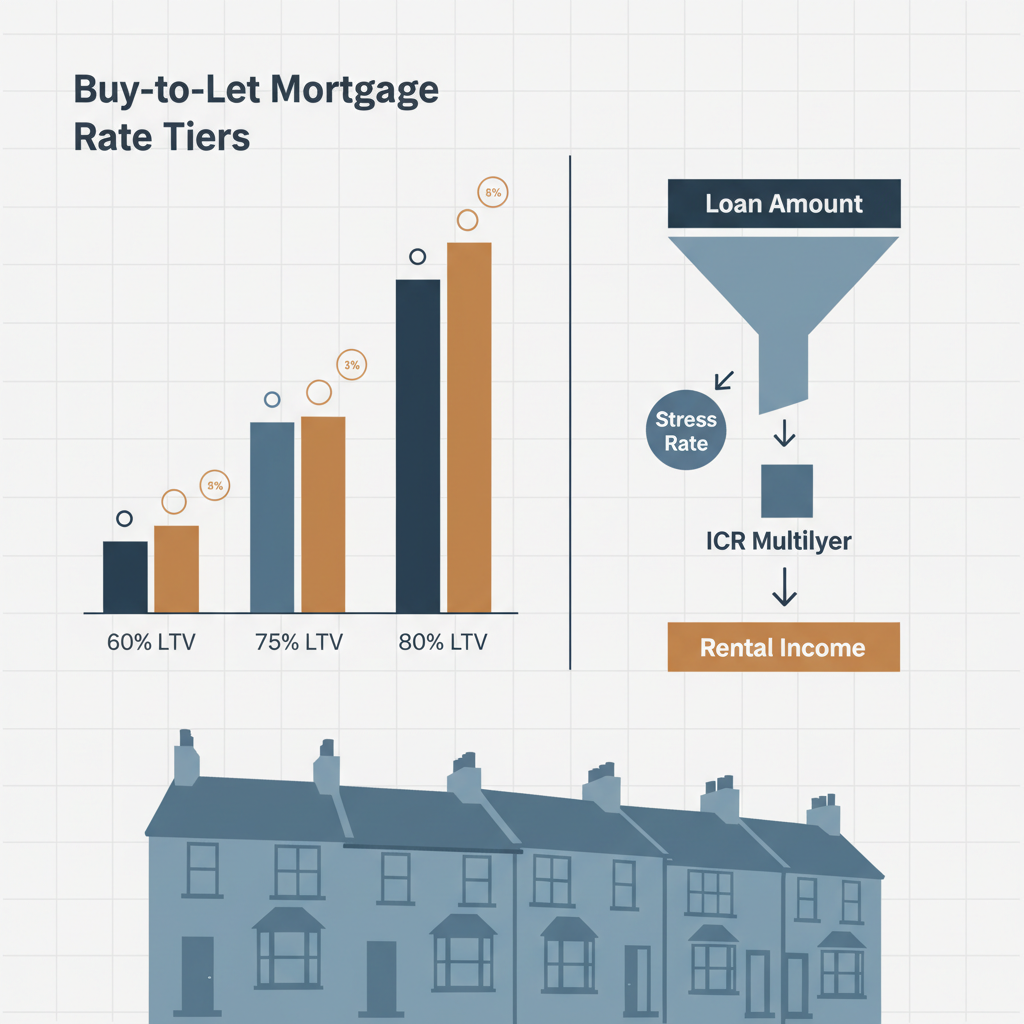
The rate you see quoted and the loan you are actually offered are two different things. Every BTL application is filtered through an interest cover ratio (ICR) test before the rate becomes relevant.
The standard ICR requirements in 2026 are 125% for basic-rate taxpayers and limited company borrowers, and 145% for higher-rate taxpayers owning property in personal name. The floor stress rate is typically 5.5% across mainstream and specialist BTL lenders. On a two-year fix at 3.64%, the lender does not test affordability at 3.64% — it tests at 5.5% minimum.
The Mortgage Works has raised its income coverage ratio rate used to assess background BTL properties from 5% to 5.25%, while simultaneously reducing the background ICRR to 125% for basic-rate taxpayers (down from 145%), with higher-rate taxpayers continuing at 145%. The practical effect: basic-rate landlords with a TMW portfolio deal get more borrowing capacity; higher-rate landlords in personal name do not.
TMW has also launched like-for-like AVM two-year trackers at 75% LTV with rates from base rate plus 0.34%, designed for landlords refinancing without additional borrowing. Both products carry no early repayment charges and use a reduced stress rate of 4.5% or pay rate — whichever is higher — which improves affordability on straight remortgages.
Here is an ICR worked example using verified inputs. A property generating £1,200 per month in rent (£14,400 per year). Lender stress rate 5.5%, ICR 145% (higher-rate taxpayer). Maximum loan = £14,400 ÷ (5.5% × 145%) = £14,400 ÷ 0.07975 = £180,564. At 75% LTV that implies a property value of approximately £240,752. If the property is worth £300,000, the ICR test — not the LTV cap — is the binding constraint.
For portfolio landlords, BM Solutions requires a minimum personal income of £30,000, a maximum 75% aggregate LTV across the portfolio, and minimum 145% rental cover at a 5.5% stress rate across all properties, with a cap of 10 BTL mortgages with the lender.
The most competitive BTL rates in 2026 are concentrated at 60% or 65% LTV; stepping up to 75% typically adds 0.30% to 0.50%, and 80% LTV adds a further 0.40% and is offered by only a handful of specialist lenders. That LTV tiering is the fastest lever landlords can pull — additional equity release from one property can fund a more competitive rate on another.
The best buy to let mortgage rates require clean credit, the right LTV tier, and rental income that clears the stress test. Where all three align, the pricing available in October 2026 is the most competitive seen in several years.