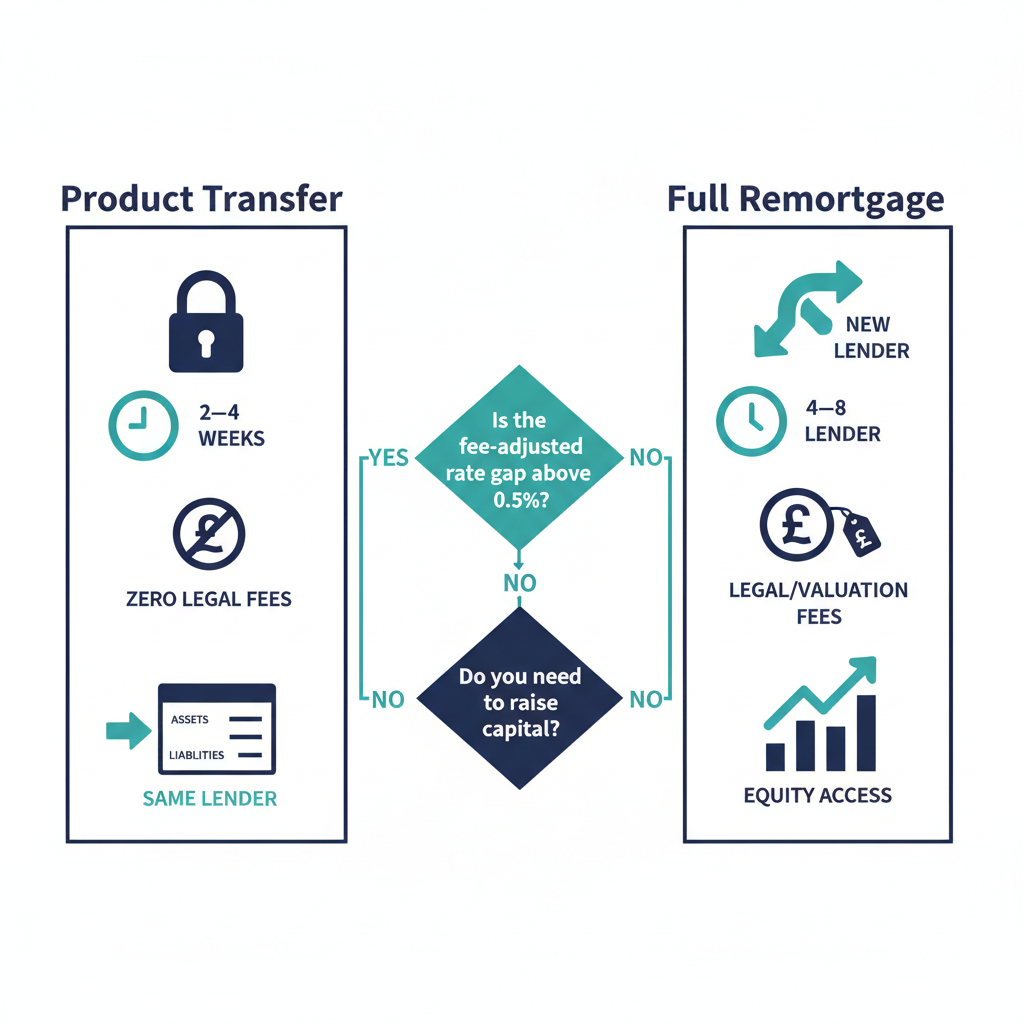
The Single Factor That Decides Everything
BTL lenders care first about whether the rent covers the mortgage — the interest cover ratio (ICR) — and fees lean heavier too: percentage-based arrangement fees of 2–5% of the loan are common, rather than the flat fees typical in residential lending. Both those facts are relevant, but they are not the deciding factor between a product transfer and a remortgage.
The deciding factor is fee-adjusted rate gap. Calculate the total cost of your lender's retention product — rate plus any product fee — over the new fixed term. Do the same for the best open-market alternative including arrangement fee, legal costs and valuation. If the gap is less than your switch costs, stay. If it exceeds them, move. Everything else is secondary.
This is the question you need to answer by the three-month mark before your BTL fixed rate ending. BTL fixed rate ending? Product transfer vs remortgage: what landlords should do 3–6 months before is exactly the window in which that calculation is live and actionable.
When a Product Transfer Makes Sense
A product transfer is a window of time before your fixed deal ends during which you negotiate a new deal with your existing lender, usually without incurring an early repayment charge. It means switching products without switching lender.
Legal fees on a product transfer are none or minimal, there is usually no valuation, and processing takes 2–4 weeks, versus 4–8 weeks for a full remortgage. For a portfolio landlord managing five or more properties simultaneously, that time difference matters.
A product transfer makes commercial sense in three specific situations:
1. Your lender's retention rate is within 0.3% of the open market. On a £200,000 interest-only loan, 0.3% equals £600 per year — below the cost of typical remortgage fees. Legal fees on a BTL remortgage typically run to several hundred pounds, and a valuation is usually required. Once you factor in a £500–£900 legal bill and a valuation of £250–£800, a 0.3% rate advantage can evaporate entirely in year one.
2. Your LTV or credit profile has deteriorated. If your current lender's retention rates are close to the open market — particularly if you have a higher-risk profile such as high LTV, portfolio landlord or HMO — the certainty of a quick transfer can be worth accepting a slightly worse headline rate. A lender already on risk has no incentive to decline you on a like-for-like transfer.
3. You are inside an ERC period and cannot wait. The Mortgage Works charges ERCs of 5% until 30/11/2028, then 4% until 30/11/2029, then 3% until 30/11/2030, then 1% until 30/11/2031 on five-year fixes. On a £200,000 loan with 18 months left on a five-year fix, a 3% ERC equals £6,000. A same-lender switch using that lender's internal "switch to fix" option avoids that charge entirely.
When a Full Remortgage Makes Sense
Start looking for a new BTL mortgage deal at least three to six months before your current rate expires. Many lenders allow you to lock in a rate up to six months in advance, protecting you from rate increases while you complete the switch.
The open market currently prices considerably below where many landlords' reversion rates sit. TMW's standard variable rate typically falls between 7.99% and 8.49%. Accord Mortgages' buy-to-let SVR currently stands at 6.74%. Those reversion rates are the default if you do nothing, and the argument for moving to the open market is clearest when:
1. The rate gap is above 0.5% after fees. In a case study where a landlord's two-year fix ended and their lender offered a product transfer at 5.75%, while another lender offered 5.25% on a remortgage with a £2,000 fee, on a £150,000 loan the 0.5% saving was £750 per year — less than the £2,000 fee over two years, making the product transfer cheaper overall. Flip that calculation: if the rate gap is 0.75% or more, the remortgage wins on most loan sizes above £150,000.
2. You need to raise capital. A remortgage allows you to borrow against equity growth. That cash is commonly used as the deposit on a further BTL purchase — a deliberate cycle of equity recycling. A product transfer only moves the existing balance pound-for-pound; it cannot release equity.
3. The stress test allows a larger loan elsewhere. Under updated aggregate portfolio policy, some lenders test properties in a limited company structure against an ICR of 125%, while those held personally may remain at 145%. If you have moved property into a limited company structure since your original mortgage, a fresh remortgage could unlock a lower stress-rate test and potentially a larger loan.
4. Your lender's criteria no longer fit your portfolio. An HMO converted since origination, a change in tenancy type, or a portfolio that now exceeds your lender's aggregate limit all require a new lender. If your current deal has already ended and you are on the SVR, you can remortgage at any time without early repayment charges.
The Calculation That Decides It
Run this in three steps. Use verified inputs only — do not estimate the rate your lender will offer; request the actual retention product range.
Step 1 — Total cost of staying (product transfer)
Take the retention rate offered. Multiply the outstanding balance by that rate and divide by 12 to get monthly interest. Add any product transfer fee. Sum across the full fixed term.
Example: £200,000 balance. Retention offer: 5.40%, no product transfer fee. Monthly interest: £900. Two-year total: £21,600.
Step 2 — Total cost of moving (full remortgage)
Take the best open-market rate available. The Mortgage Works currently offers 3.69% with no product fee on a two-year BTL remortgage; HSBC offers 4.43% on a five-year fix at £3,999 fee. Calculate monthly interest on the same balance, multiply across the term, then add all switch costs: arrangement fee, legal fees (budget £500–£900 if not free), and valuation (budget £250–£800 if not waived).
Example: £200,000 balance. Open-market 5yr fix: 4.43%, £3,999 fee. Monthly interest: £738. Five-year interest: £44,280. Total cost including fee: £48,279. Versus 5.40% product transfer over same period: £54,000. Saving from switching: £5,721 after fee.
Step 3 — ICR check on the new rate
For five-year fixed products, the ICR calculation rate will be either the product charging rate or 4.50%, whichever is the greater, at lenders such as Paragon. A 125% ICR means the rent must be at least 1.25 times the interest at the lender's stress rate. Higher-rate taxpayers are usually tested at 145%, small HMOs at 145%, large HMOs at 160%, and multi-unit blocks at 150%.
Formula: minimum annual rent = loan × stress rate × ICR. If rent ÷ (stress rate × ICR) is below your current balance, the remortgage will fail on affordability and a product transfer becomes your only compliant option.
Six months out: confirm the exact end date of every loan and reserve a product. Most lenders let you book one this far ahead and allow you to swap if pricing improves before completion. Five months out, re-run the ICR at the new pay rate and again at the lender stress rate. Three months out, decide between the product transfer and the full remortgage.
That sequence — not the rate alone — is what separates landlords who manage the BTL fixed rate ending? Product transfer vs remortgage: what landlords should do 3–6 months before decision well from those who drift onto an SVR above 8% and scramble to recover cashflow.
SVR on BTL is typically 1.5–2.5% above fixed rates. That's £3,000–£5,000+ per year on a £200,000 mortgage. No fee saving justifies that outcome.