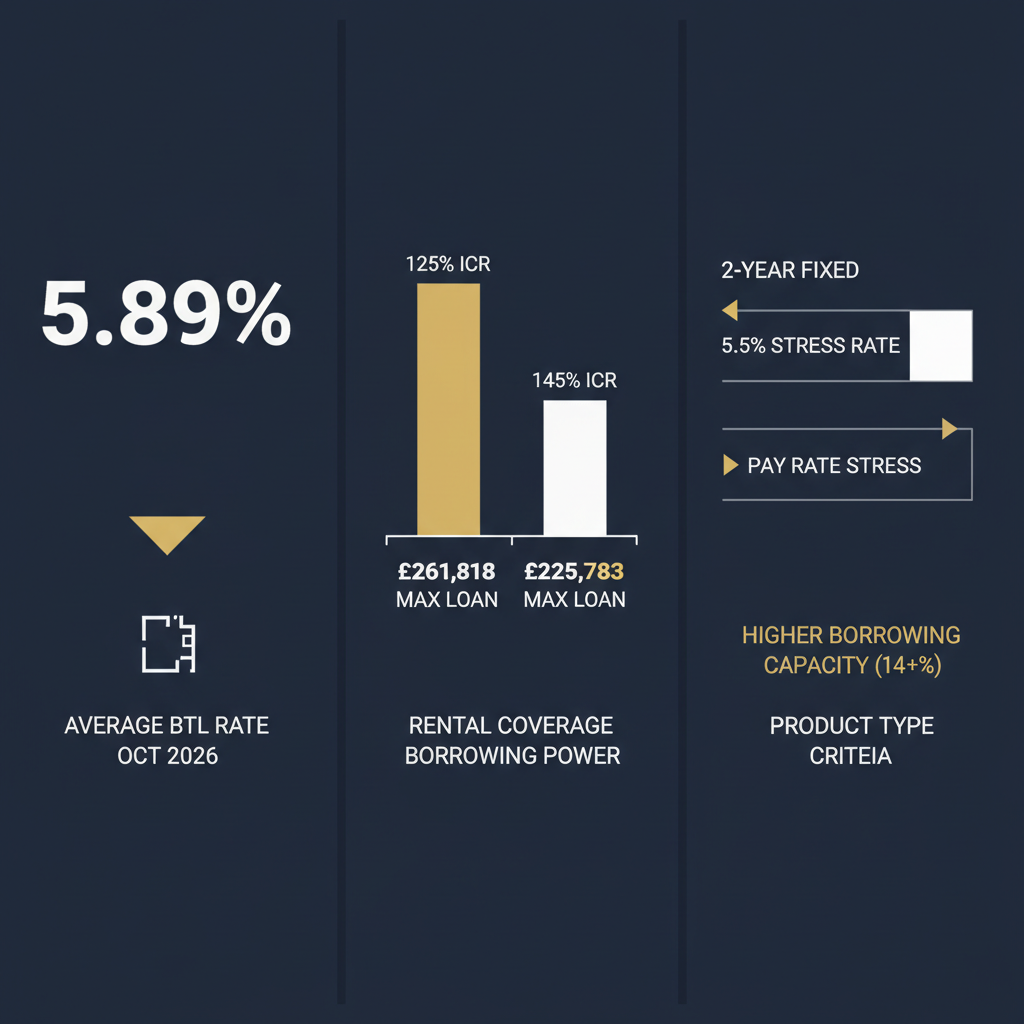
The average buy-to-let two-year fixed rate sits at 5.89% across all lenders right now, though the big six lenders are pricing at 5.24% for the same product at 75% LTV. That 65-basis-point gap is not random noise — it is a direct consequence of how lenders tier their pricing by distribution channel, deal size and borrower profile. A good buy to let mortgage broker does not just find the lower number; they establish whether you qualify for it before wasting anyone's time.
What the Numbers Show
The Bank of England base rate stands at 3.75%, yet the average two-year fixed mortgage rate is 5.97% and the average five-year fix is 6.01% — confirming that lenders are pricing well ahead of base rate. Bank Rate has stood at 3.75% since 18 December 2025, down from the 5.25% peak it held from August 2023 to August 2024. Fixed rates are priced off swap rates, not Bank Rate directly, which is why a hold at 3.75% has not automatically translated into cheaper BTL mortgages.
The Mortgage Works (TMW) has made selected rate changes across its new business range, with fixed rates now starting from 3.49%. For landlords with a 25% deposit or more, rates have decreased by up to 0.07% on two-year fixes and by up to 0.04% on five-year deals. That is incremental, but at BTL loan sizes the basis points add up. TMW's two-year remortgage-only product sits at 3.49% with a 3% fee, available up to 65% LTV. A 3% fee on a £250,000 loan is £7,500 upfront. Whether that beats a higher-rate, fee-free product depends on the term — work the total cost over the fixed period, not the headline rate.
BM Solutions (part of Lloyds Banking Group) has updated its personal-ownership BTL and let-to-buy range, combining 65% and 75% LTV bands into a single 0–75% LTV band, with 0–65% LTV products withdrawn. BM Solutions is a broker-only lender — you cannot apply directly. It lends up to 75% LTV (80% on loans up to £350,000 for EPC A-to-C properties), up to £2m per property. That 80% LTV option for energy-efficient properties is one of the criteria points that only surfaces when you audit the full product guide, not the summary sheet.
BM Solutions indicative broker-facing ranges as of Q3 2026 show two-year fixed rates at 60% LTV typically between 4.20% and 4.80%, and two-year fixed rates at 75% LTV typically between 4.55% and 5.20%. These move daily, so treat them as a calibration point rather than a live quote.
What This Means for Landlords
The rate is not the lending decision — the ICR stress test is. Affordability is assessed on the rent through an interest coverage ratio applied at a stressed rate: the core mechanism of all buy-to-let underwriting. The rental stress test measures whether expected rent covers mortgage interest at a notional stressed rate, not the product's pay rate.
The ICR percentage is typically 125% for a limited-company/SPV borrower and for a basic-rate individual, and 145% for a higher- or additional-rate individual. That gap is consequential. On a £200,000 loan, at a 5.5% stress rate, a basic-rate taxpayer needs minimum monthly rent of £1,146 (£200,000 × 5.5% × 125% ÷ 12). The same loan for a higher-rate taxpayer requires £1,329 per month (£200,000 × 5.5% × 145% ÷ 12). Flip the ICR to 145% for a higher-rate individual and the borrowing ceiling drops by around £24,000 on the same rent. Same property, same rent, but the borrower type moves the borrowing power materially.
The PRA's SS13/16 sets the regulatory floor: lenders should assume a minimum borrower interest rate of 5.5% during the first five years of the contract unless the rate is fixed for five years or more. Five-year fixes are therefore stressed at a lower rate — often the pay rate or pay rate plus a small loading — which increases maximum borrowing. At a 4.80% stress rate on a five-year fix, maximum borrowing on £1,500 monthly rent rises to £258,619 versus £225,710 at a 5.5% rate — 14% more borrowing on the same rent.
The Mortgage Works increased its income coverage ratio rate used to assess background BTL properties from 5% to 5.25%, while simultaneously reducing the background BTL ICRR to 125% (down from 145%) where it can verify the applicant is a basic-rate taxpayer. Higher-rate taxpayers continue to be assessed at 145%. This is a meaningful dual-move: the stress rate went up, but the ICR came down for eligible landlords. Whether it helps or hurts your specific case is a calculation, not a guess.
The PRA defines a portfolio landlord as a borrower with four or more mortgaged BTL properties at the time of application. From the fourth mortgaged BTL onward, lender underwriting moves from individual-property assessment to portfolio-wide assessment. The full BTL portfolio enters the stress test, the lender requests a business plan and cash-flow projection, and concentration of assets in single locations or property types becomes a material credit factor.
Fee-charging specialist brokers typically charge a fixed fee, a percentage of the loan, or a combination of an upfront fee and the lender's procuration fee. Their value is in the cases that fee-free models handle poorly: portfolio assessments, limited company and SPV purchases, HMOs, first-time landlords, adverse credit, and anything needing manual underwriting.
BM Solutions requires the whole portfolio to cover 145% of the interest at a 5.5% stress rate, an overall LTV no higher than 75%, and minimum income of £30,000 for portfolio landlords. Not every lender applies portfolio stress this way. Some test only the subject property if background properties are performing; others test every mortgage on the schedule at a single stressed rate. A buy to let mortgage broker who regularly places portfolio cases knows which lender's model works best for your specific mix of LTVs and rents — before the application goes in, not after a decline.
Some lenders cap assessable HMO rent at a percentage of a single-let valuation; others assess full room-by-room income; stress rates are often higher; and licensing status is scrutinised. The gap in borrowing capacity between two lenders on the same five-bed HMO can be tens of thousands of pounds.
The average gross buy-to-let rental yield for the UK in Q3 2025 was 7.15%, compared with 6.93% in Q3 2024. A rising yield environment helps ICR calculations. But CPI inflation increased to 3.5% in September 2026, above the Bank's 2% target, and rate uncertainty is rising. Market pricing as of 19 October 2026 implies the Bank of England base rate rises from 3.75% to around 4.5% by April 2027. If that materialises, any landlord on a two-year fix taken at today's rates refinances into a materially different market. A five-year fix locks out that risk for longer and, because of the lower stress rate, may unlock more borrowing today as well.
The numbers stack differently for every landlord. What does not vary is that lender criteria change faster than most landlords check them — which is exactly where an experienced buy to let mortgage broker earns their fee.