The Mortgage Works repriced its October 2026 product guide with new business fixed rates starting from 3.49% and tracker rates from 3.99%. That matters because even at the sharper end of the rate sheet, the stress rate lenders apply to your rental income bears no resemblance to the product rate you will actually pay. Those two numbers — the rate on your statement and the rate used to size your loan — are what this article is about.
What the Numbers Show
The absolute minimum buy to let mortgage deposit stands at 25% of the property valuation, creating a 75% LTV ceiling for most applicants. That is the starting point, not the destination. Most BTL lenders require you to be at least 21, own your own home or have previously been a homeowner, and have a minimum personal income of £25,000 per year — though some lenders have no minimum income requirement if the rental coverage is strong enough.
BM Solutions (Lloyds Banking Group's broker-only BTL arm) lends at 75% LTV up to £1m and 65% LTV from £1m to £2m. An 80% LTV is possible on borrowing up to £350,000 where the property is EPC A to C and the rent covers. That EPC carve-out is narrow. Most landlords will not qualify, and the energy-efficiency criteria are assessed by valuation, not by the applicant's self-declaration.
The Mortgage Works made selected rate changes in October 2026. New business fixed rates start from 3.49%, while tracker rates start from 3.99%, and all trackers include a switch-to-fix option. The lender increased the maximum age at application for first-time landlords from 70 to 75, up to 70% LTV. There is also no maximum age for experienced landlords applying up to 70% LTV, up from 65% LTV.
Deposit size controls the LTV band, and the LTV band directly controls the stress rate The Mortgage Works applies. At 65% LTV or lower, the stress rate is 4.00% or the pay rate. Above 65% LTV, the stress rate rises to 4.50% or the pay rate — whichever is higher. Dropping from 75% LTV to 65% LTV therefore does two things at once: it cuts the loan and it lowers the hurdle rent must clear.
The core measure is the interest coverage ratio, or ICR: rental income has to cover mortgage interest by a set percentage at a stressed rate. As a general guide, the ICR sits around 125% for limited company borrowers and basic-rate taxpayers, and around 145% for higher and additional-rate taxpayers. The Mortgage Works (September 2026 intermediary criteria) applies an ICR of 125% for basic-rate taxpayers and limited companies, 160% for higher-rate taxpayers, and 175% for HMOs.
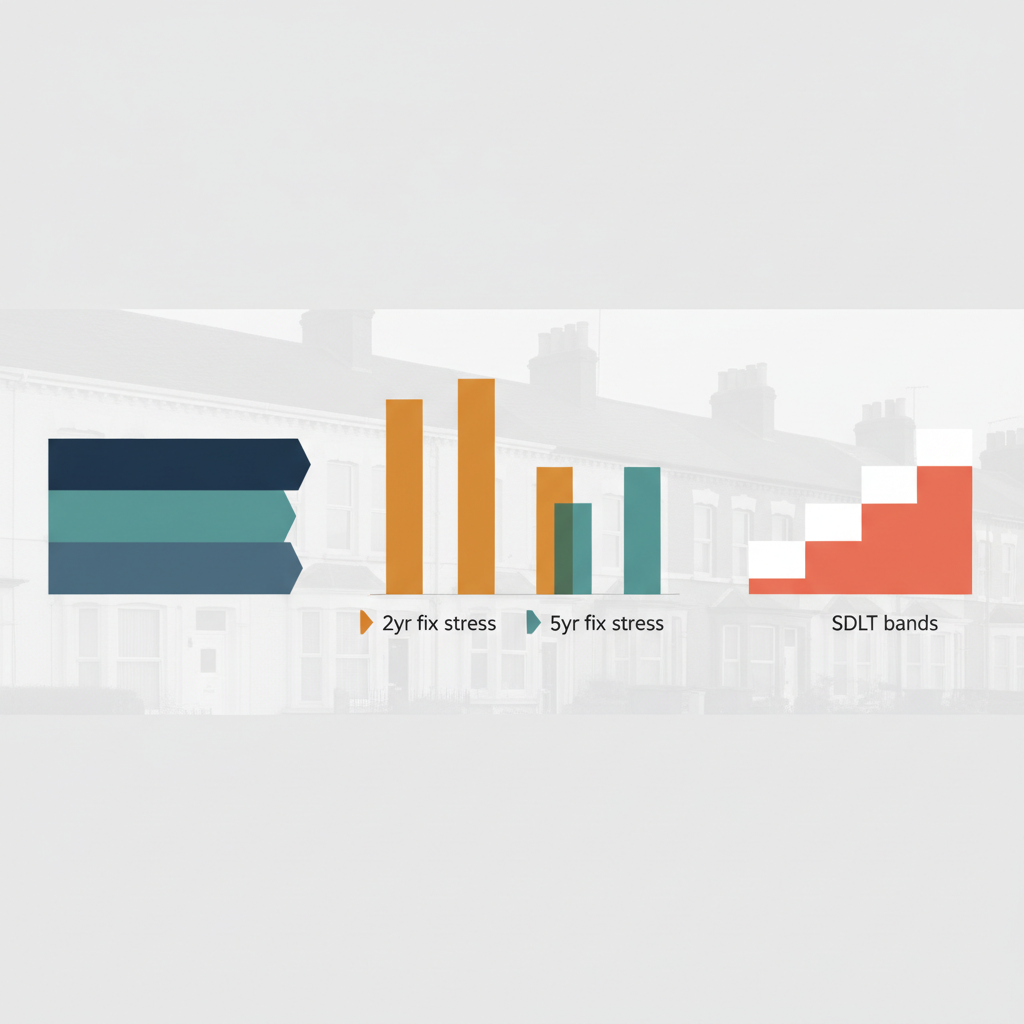
The arithmetic is straightforward once you know the inputs. The maximum loan formula is: annual rent ÷ (ICR × stress rate). Take a property generating £14,400 per year. At a 125% ICR and 5.5% stress rate, the maximum loan is £14,400 ÷ (1.25 × 0.055) = £209,455. When lender criteria were checked in October 2026, most lenders tested two-year fixes at roughly 6–7.5% and five-year fixes at about 4.5–6%. Feed 7% into the same calculation — £14,400 ÷ (1.25 × 0.07) — and the maximum loan falls to £164,571. The property value has not moved; the buy to let mortgage deposit requirement just grew.
Most lenders set a 25% minimum buy-to-let deposit, but rental coverage and stress testing usually push the real figure to 30% to 40%. That is the sentence the headline LTV table never shows you.
What This Means for Landlords
BM Solutions will assess the entire portfolio for landlords with four or more properties. Key criteria include: maximum 10 buy-to-let mortgages with BM, minimum personal income of £30,000, maximum 75% aggregate LTV across the portfolio, and minimum 145% rental cover at a 5.5% stress rate across all properties. A single under-yielding property can breach that aggregate test and block an otherwise clean application.
The tax wrapper you choose also changes which ICR row applies to you. Ltd company borrowers benefit from full mortgage-interest deductibility and a lower 125% ICR threshold (treated as basic-rate for stress purposes), but pay a higher product rate — typically a 0.3–0.6% premium over personal-name — and a higher arrangement fee. On a £200,000 loan, 0.5% on the rate is £1,000 extra per year in interest cost. Whether the ICR benefit outweighs that depends on your marginal tax rate.
For five-year fixes, the stress arithmetic is kinder. For five-year fixed products, most lenders stress at the actual pay rate. At current rates around 4.22%–4.50%, a five-year fix gives you a meaningfully lower denominator in the max-loan calculation than a two-year fix does, which can recover £20,000–£40,000 of borrowing capacity on a standard BTL.
Then there is the acquisition cost the buy to let mortgage deposit calculation often ignores. Stamp duty buy to let in England and Northern Ireland now adds a 5% surcharge to every band, a change that came in on 31 October 2024. The current BTL SDLT rates are: 5% up to £250,000; 10% from £250,001 to £925,000; 15% from £925,001 to £1,500,000; and 17% over £1,500,000. On a £300,000 purchase, the SDLT bill alone is £17,500. That is cash that cannot go into the deposit and cannot be added to the mortgage.
The buy to let mortgage deposit must come from your own funds — gifted deposits are not accepted by most BTL lenders. That rules out the parental-gift strategy many residential borrowers lean on and means the 25% minimum is a genuinely liquid, personally-held sum — before SDLT, valuation fees and legal costs are added.
If you can push your deposit up to 40%, you drop into the 60% LTV band. At that level you access the best pricing tiers, the lightest stress rates, and you give yourself maximum headroom against future rate rises that might otherwise trigger an ICR breach on remortgage. The question for most portfolio landlords is not whether a 25% buy to let mortgage deposit is technically sufficient. It is whether the resulting loan actually passes the stress test — and in many cases, particularly for higher-rate taxpayers on shorter fixes, it does not.