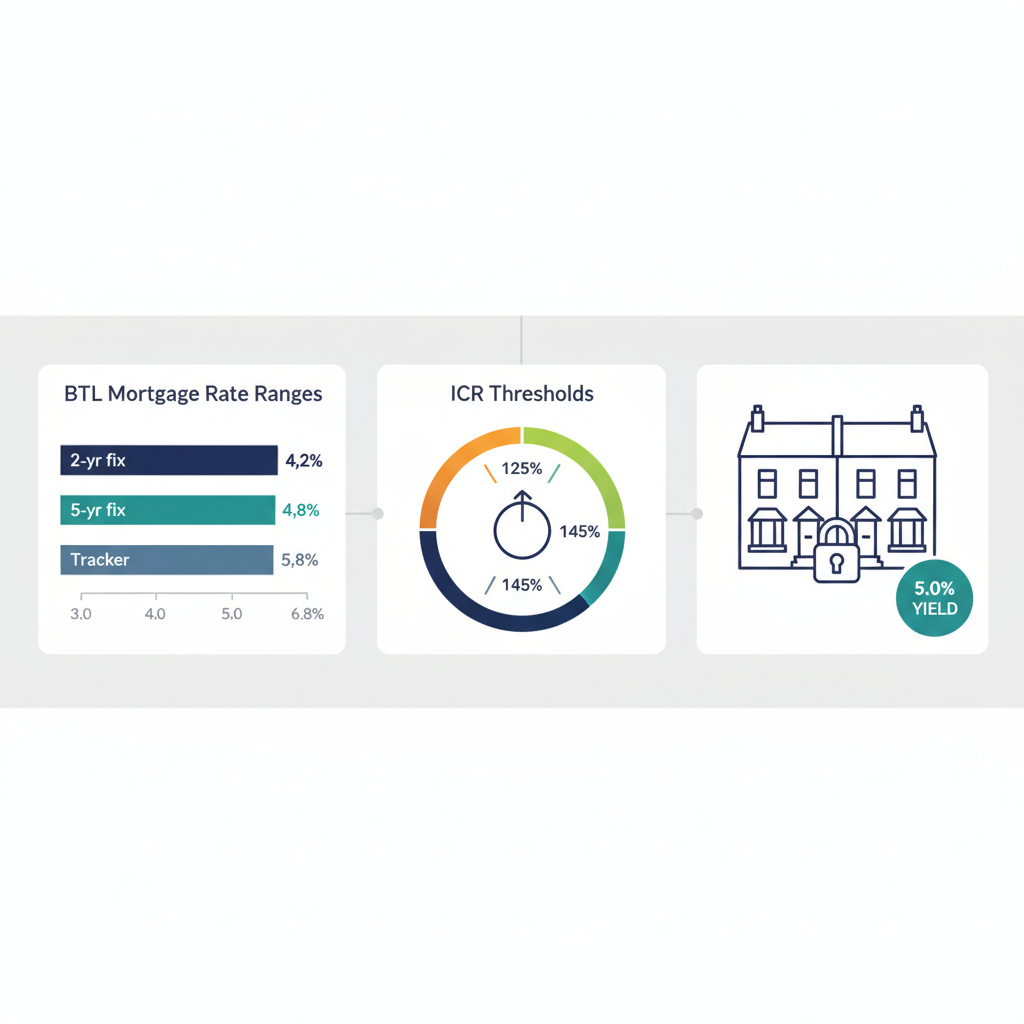
The cheapest two-year fixed rate on today's best-buy tables for buy to let mortgages UK sits at 3.64%, currently offered by Zephyr Homeloans — but it carries a large arrangement fee that can easily exceed the rate saving on smaller loans. Before you chase the headline figure, it's worth pulling apart exactly what you'll pay, what the lender will actually lend, and whether your rent figure clears the stress test.
What the Numbers Show
The Mortgage Works (TMW), the buy-to-let lender owned by Nationwide Building Society, is pricing its two-year fixed buy-to-let range at 3.79% for borrowers up to 65% LTV who take the 3% product fee, rising to 5.34% at 65–75% LTV with no fee. Its five-year fixed equivalent sits at 4.64% (3% fee, up to 75% LTV) and 5.27% (no fee, up to 75% LTV). Push above 75% LTV and TMW's no-fee five-year fix moves to 5.77%.
On the best-buy tables updated in November 2026, BM Solutions — the broker-only arm of Lloyds Banking Group — leads on both the two-year fix at 3.77% (£6,100 fee, 75% LTV) and the five-year fix at 4.55% (£6,100 fee, 75% LTV). That £6,100 fee is steep; on a £150,000 loan it adds the equivalent of roughly 0.40% per year to a two-year product, so run the true cost before applying.
The average interest rate across all new buy-to-let loans in the UK was 4.82% in Q2 2026, 12 basis points higher than the previous quarter but 18 basis points lower than the same quarter of 2025. That average spans products from low-fee five-year fixes down to high-LTV shorter deals, so it's a useful sanity check rather than a target.
In Q2 2026 there were 58,051 new buy-to-let loans advanced in the UK, worth £10.7 billion — up 20.6% by number and 25.0% by value compared with the same quarter the previous year. Lending volumes are recovering sharply.
On 30 July 2026, the Bank of England announced it would hold the base rate at 3.75%. Most analysts expect UK mortgage rates to remain elevated through late 2026, with persistent inflation concerns and ongoing swap rate volatility meaning individual lenders' fixed rates continue to move independently of official BoE policy.
What This Means for Landlords
The rate on your offer letter is not the rate that decides how much you can borrow. Every buy to let mortgages UK application is filtered through an Interest Coverage Ratio stress test first.
Lenders do not test against the rate on the product they are offering you. They test against a minimum stress rate, sometimes called a floor rate — typically 5.5% across mainstream and specialist BTL lenders in 2026. For five-year fixed products, most lenders stress at the actual pay rate. That distinction matters: a five-year fix at 4.64% stresses at 4.64%; a two-year fix at 3.79% still stresses at 5.5%.
On top of the stress rate, lenders apply an ICR threshold: 125% for basic-rate taxpayers and limited company borrowers, and 145% for higher-rate taxpayers owning property in their personal name. The Mortgage Works (September 2026 intermediary criteria) applies 125% for basic-rate taxpayers and limited companies, 160% for higher-rate taxpayers, and 175% for HMO cases.
Here is the maths on a concrete case. A higher-rate taxpayer wants a £200,000 interest-only loan and applies for a two-year fix. The stress rate is 5.5%. Annual stressed interest = £200,000 × 5.5% = £11,000. Apply the 145% ICR multiplier: £11,000 × 1.45 = £15,950 required gross annual rent, or £1,329 per month. If the property realistically rents at £1,329 or above, the case clears that lender's ICR test. Drop the rent by £50 a month and it fails — even if the actual mortgage payment would be £617 per month.
Five-year fixed products get significantly better stress testing than two-year fixes; limited company structures attract a 125% ICR regardless of the director's tax position. That is one reason portfolio landlords frequently prefer limited company ownership and five-year fixes, especially at higher LTVs.
BM Solutions requires the whole portfolio to cover 145% of the interest at a 5.5% stress rate, an overall LTV no higher than 75%, and a minimum income of £30,000 — tighter than a single-property case and worth checking before placing a multi-property remortgage there.
Most buy-to-let mortgages need a deposit of 25%, meaning a maximum loan to value of 75%. Some specialist lenders offer 80% LTV but with higher rates and stricter ICR requirements.
On early repayment charges: most BTL mortgages in 2026 carry ERCs of 1–5% of the outstanding balance if you exit early, with fixed-rate products typically carrying 3–5% ERCs applying for the duration of the initial fix. BM Solutions has also launched two-year tracker products with no early repayment charges and a 1% product fee — worth considering if you expect to sell or refinance before the fixed period ends.
The average gross buy-to-let rental yield for the UK in Q2 2026 was 7.27%. At that yield, a £250,000 property generates £18,175 a year in rent. Against a £187,500 loan (75% LTV), the basic-rate stress test at 5.5% and 125% ICR requires £12,891 annual rent — comfortably cleared. The same property fails for a higher-rate taxpayer if the ICR rises to 145% and you push the loan toward the LTV cap on a shorter fix.
The gap between the cheapest two-year fix and the cheapest five-year fix is currently around 85–100 basis points at comparable LTVs and fee levels. That premium buys you a lower stress rate on the ICR test, protection from repricing for five years, and potentially a larger loan. For most portfolio landlords holding property for the long term, that is a meaningful trade.