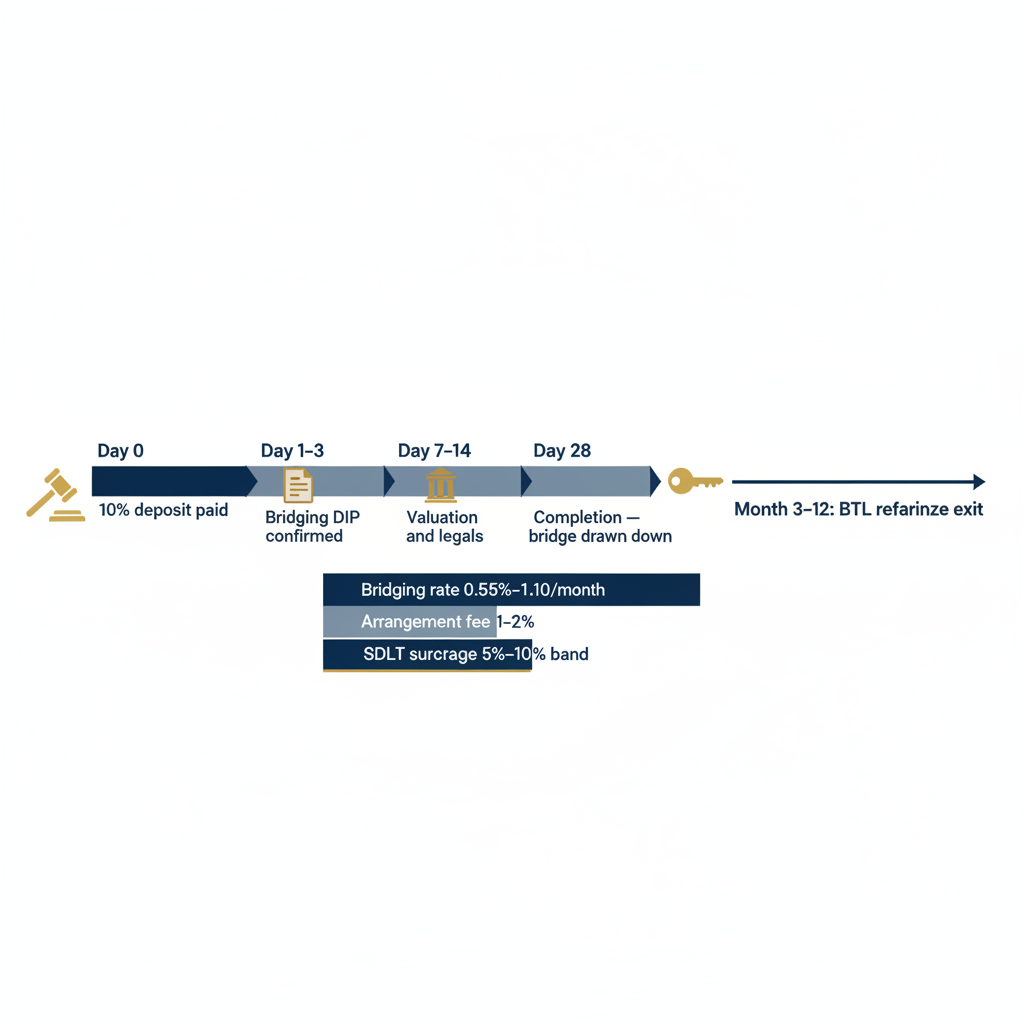
UK bridging loan rates start from about 0.55% per month for low-LTV residential security — and that single figure is the one every portfolio landlord needs pinned to the wall before walking into an auction room. Buying a buy-to-let at auction: how to finance it in 28 days is not a theoretical exercise. The clock starts the moment the gavel comes down.
Why the 28-Day Deadline Rules Everything
At a traditional UK property auction, the winning bidder exchanges contracts immediately on the fall of the hammer and must complete — pay the full purchase price — within 28 calendar days. A standard residential mortgage takes 6–8 weeks to arrange. That gap makes a conventional BTL mortgage unworkable for traditional unconditional lots. It is not a matter of trying harder or finding a faster lender; the timelines are structurally incompatible.
The Modern Method of Auction (MMoA) offers a different structure: a reservation fee (typically 4–5% of the price) and 56 days to complete — 28 to exchange, a further 28 to complete. That window is wide enough for a standard BTL mortgage application if your solicitor and broker move immediately. For anything on the traditional unconditional model, bridging finance is the tool.
A 10% deposit is commonly required when buying at a traditional, unconditional UK auction, calculated from the hammer price, not the property's guide price. That cash leaves your account on the day. You then have 14 days from completion to file your SDLT return and pay HMRC — missing that deadline triggers automatic penalties starting at £100.
What the Numbers Show
At up to 50% LTV, current bridging rates sit at roughly 0.55%–0.75% per month. From 65%–70% LTV, you are typically looking at 0.75%–0.95% per month. At 70%–75% LTV, rates run from 0.85% to 1.10% per month. Most auction BTL purchases sit in the 70%–75% LTV band, so model accordingly — not at the headline 0.55% floor.
Above 75% LTV using cross-collateral security, rates typically range from 0.95%–1.30% per month. That is the specialist tier, with fewer lenders competing and tighter underwriting. The headline LTV available from many auction bridging lenders is 75%, though some lenders offer up to 80% LTV on standard residential lots and up to 90% on refurbishment cases, from 0.61% per month.
Fees sit on top of the rate. Arrangement fees run 1%–2% of the gross loan. Valuation fees typically fall between £500 and £2,500 depending on property value and type. Your own legal fees run £1,000–£3,000, the lender's legal fees a further £800–£2,000 — and both sets are paid by you. Some lenders also impose minimum interest periods, typically three months, meaning you pay for the full minimum term even if you exit earlier. Genuinely penalty-free early repayment is available from many lenders but not all.
Work through a real example. A £300,000 auction lot, 75% LTV bridge, gives a gross loan of £225,000. At 0.95% per month over a 6-month term, interest totals £12,825. Add a 2% arrangement fee (£4,500), £1,500 in valuation costs, and £2,000 in dual legal fees, and the total bridging cost before exit is roughly £20,825. That is the number to stress-test against your expected yield before you bid — not after.
The additional-property SDLT surcharge was raised from 3% to 5% on 31 October 2024. From 1 April 2025, BTL investors pay 5% on the first £125,000, 7% on £125,001–£250,000, and 10% on £250,001–£925,000. On a £300,000 purchase, that produces an SDLT bill of approximately £20,000. Factor it into your maximum bid alongside bridging costs, not as an afterthought on the way out of the room.
What This Means for Landlords
The exit strategy is what separates a well-structured auction deal from an expensive mess. The bridge is not the destination — the BTL refinance is. Buying a buy-to-let at auction: how to finance it in 28 days is ultimately about ensuring your exit lender will take you out comfortably before the bridge term expires.
Buy-to-let mortgage affordability is sized mainly on the property's rental income, not your salary. Lenders apply an interest coverage ratio (ICR) — the rent must cover the mortgage interest by 125% to 145% — calculated at a notional stress rate of about 4.5%–10.5%, depending on lender and fix length.
Most major BTL lenders use a stress rate of 5.5% for 5-year fixes and 7% or higher for shorter fixes. Basic-rate personal-name BTL is tested at 125% ICR, higher-rate at 145%. Limited companies are usually tested at 125% regardless of personal income.
Run the maths before you bid. Maximum BTL loan = annual rent ÷ (ICR × stress rate). On £1,200 per month rent, a basic-rate borrower using a 5-year fix at a 5.5% stress rate and 125% ICR can support a loan of approximately £209,000. The same figures at 145% ICR drop the maximum loan to around £180,000. The difference between 125% and 145% ICR in this example is nearly £29,000 in maximum borrowing — and that is with all other factors equal. If your bridge is at 75% LTV and your BTL exit only supports 60% LTV on the rental income, you have a shortfall to fund from elsewhere.
Bridging facilities can close within 7 to 14 days, ensuring you meet the 28-day completion deadline without risking your deposit. Arrangement fees run 1–2% of the gross loan, with lower percentages on facilities above £1m. Get your Decision in Principle before auction day. Lender-backed terms within 24 hours mean you know your maximum bid before you raise your hand.
Three things determine whether the deal stacks: the bridging rate and total cost, the SDLT bill, and whether the rental income will pass the BTL lender's ICR stress test at a loan amount that allows you to repay the bridge in full. Model all three before the auctioneer opens the bidding.