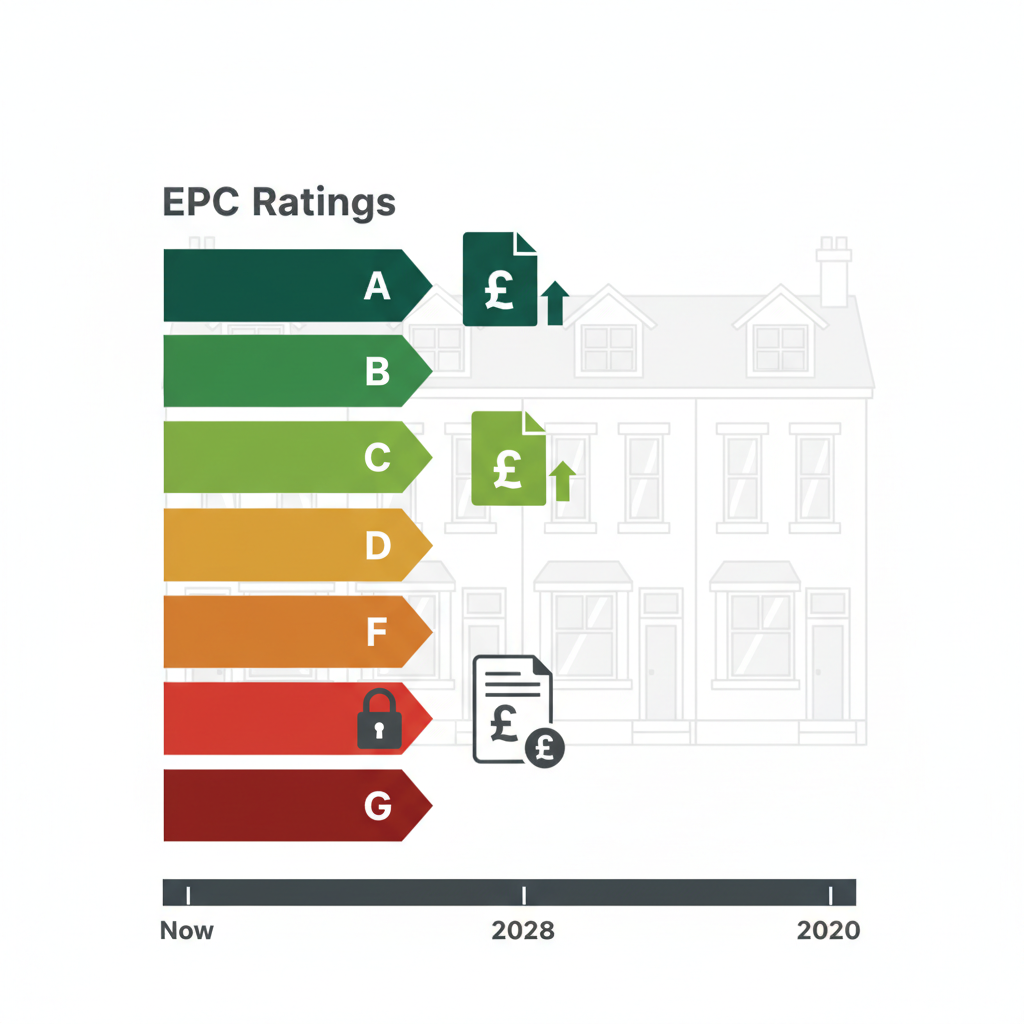
The single factor that decides whether your EPC situation is a problem or an opportunity is straightforward: does your property currently meet the legal minimum to be let, and will it meet the proposed minimum by 1 October 2030? Those two questions govern every lending decision a BTL mortgage underwriter will make on your portfolio between now and that deadline.
The Framework: What the Law Says Right Now
Since April 2020, it has been illegal to let a home in England and Wales with an EPC rating below Band E. That is the number that matters today. Mainstream mortgage lenders demand a valid EPC demonstrating compliance with current MEES regulations — currently an E rating in England and Wales — before approving a BTL mortgage. There is no grey area: a property that cannot legally be let cannot generate rental income, and without rental income there is no BTL case to underwrite.
Under new plans announced by the government, properties let by private landlords in England and Wales will need a minimum EPC rating of C by October 2030. Research by The Mortgage Works in Summer 2025 found that a third of landlords with a BTL mortgage who have a property in EPC Band D or below said they would sell their rental properties if the proposals were implemented, while 25% said they plan to bring all their properties to at least a C by the government deadline.
The government has consulted on requiring EPC C for new tenancies from 2028 and all tenancies from 2030, but as of mid-2026 this has not been passed into law. The legislation is not yet on the statute book, but the direction of travel has been consistent for years, and lenders are already pricing the risk.
When Upgrading to EPC C Makes Sense
The case for upgrading is clear if you plan to hold the asset for more than five years. At 75% LTV, Paragon Bank's 2-year fixed rates start at 3.40% for properties rated EPC A to C, while rates for properties rated D or E start at 3.45%. Five-year fixed rates at 75% LTV start at 4.80% for EPC A–C properties and 4.85% for those rated D or E. That differential is only 5bps today, but lender appetite for sub-C stock will narrow as 2030 approaches, and the pricing gap will almost certainly widen.
The government's impact assessment published alongside the January 2026 policy response puts the average landlord cost of reaching C at £5,387 per property under the preferred policy option. For properties already sitting in the upper end of Band D, the number is considerably lower. A Band D property typically needs only a loft insulation top-up and heating controls, estimated at £500 to £2,500. An E-rated property needing cavity wall insulation and a boiler upgrade runs £1,500 to £5,000.
ECO4 can fund insulation and heating in rented homes rated E, F or G with an eligible tenant (closes 31 December 2026). The Boiler Upgrade Scheme offers £7,500 towards an air source or ground source heat pump, or £9,000 until March 2027 for oil or LPG homes with no mains gas connection. Crucially, the Boiler Upgrade Scheme grant does not count against the £10,000 landlord cost cap, making a grant-funded heat pump one of the most budget-efficient large improvements available.
Upgrading also makes sense if you are approaching a remortgage on a D or E property. Lenders are tightening underwriting for properties rated E or below, particularly for higher-LTV BTL mortgages. Getting the work done before you approach the market gives you access to green-tier pricing and removes a risk flag from the valuer's report.
When Selling Makes More Sense
For properties rated F or G, the arithmetic changes. EPC improvements range from under £50 for a hot water cylinder jacket to over £15,000 for a heat pump or external wall insulation. An F-rated terrace with solid walls could require external wall insulation costing £10,000–£20,000 — and may still not reach C without a heat pump on top of that. Landlords who fail to comply with the new standard face penalties of up to £30,000 and restrictions on renting properties.
If you are trying to mortgage an EPC F or G BTL property, the property cannot be legally let, so it has no rental income. Most BTL lenders will decline or require evidence of a plan to achieve EPC E before completion. Some specialist lenders and bridging finance providers will lend on below-minimum EPC properties as a short-term measure while improvements are completed — but that is bridging territory, not standard BTL mortgage territory.
Selling also makes sense if refurbishment costs eat materially into your equity position. Selling into a market that hasn't yet fully priced in the EPC C requirement may realise more value than selling after the rule — and the visible cost of compliance — is confirmed. With the legislation still awaiting Parliamentary approval, there is a window to exit at a price that does not yet reflect a mandatory upgrade liability.
It is estimated that up to 4% of rental properties will not achieve a minimum EPC C rating at all. For those assets, any lending will be highly restricted by 2030 regardless of spend.
The Calculation That Decides It
Run three numbers before committing to either path.
Step 1 — Upgrade cost net of grants. Get a current EPC from an accredited assessor. The certificate's recommendation report shows indicative costs per measure. Deduct any ECO4 or Boiler Upgrade Scheme grant you are eligible for. The government estimates landlords will pay between £6,100 and £6,800 to comply with the proposals. It has set a maximum cap of £15,000 per property, with an affordability exemption which would lower it to £10,000 and could be applied based on lower rents or council tax band.
Step 2 — Mortgage rate saving. Calculate what the green-tier rate differential is worth over your fixed-rate term. On a £200,000 BTL loan, 5bps saves £100 per year — not transformative on its own, but combine it with improved rental demand and the avoided cost of a forced remortgage onto a restricted-criteria product at a higher rate, and the number grows materially.
Step 3 — Exit value comparison. A D-rated property upgraded to C typically sees a rental value increase of £500–£1,500 per annum, with a payback period on upgrade costs (via rental uplift alone) of 8–12 years. If your hold horizon is shorter than the payback period, a sale before the 2030 legislation lands is likely the stronger return.
If the rule is confirmed with only a year or two of lead time, landlords who start planning now will get quotes, financing and contractor slots at a fraction of the cost and hassle of those who wait until the deadline is imminent. With an estimated 2.5–2.9 million properties needing upgrades, contractor availability will tighten as the deadline approaches. The EPC rules for landlords are moving in one direction. The question is whether you plan around them now, or absorb a premium for leaving it late.