The Single Factor That Decides Your Strategy
Your property's current EPC score — not your mortgage rate, not your portfolio size — is the variable that determines whether you spend £1,500 or £10,000 on energy upgrades, and whether you can access green financing right now or must upgrade first. Everything else follows from that number.
The government proposes raising the minimum EPC rating to C by 2030 for all rental properties. From the end of December 2028 onwards, any rented property accepting new tenancies is required to have an EPC rating of C or above "where practical, cost-effective and affordable." That two-stage deadline matters: 2028 for new tenancies, 2030 for all tenancies. Miss the first gate and you cannot re-let a void property.
The government has proposed a £10,000 cost cap tied to a band C standard from 2030, with 10% of property value used instead where the property is worth under £100,000, and has proposed that qualifying spend from October 2025 would count. Start tracking expenditure now. Every qualified invoice from that date could reduce the gap between your spend and the cap.
When Doing the Upgrade Now Makes Sense
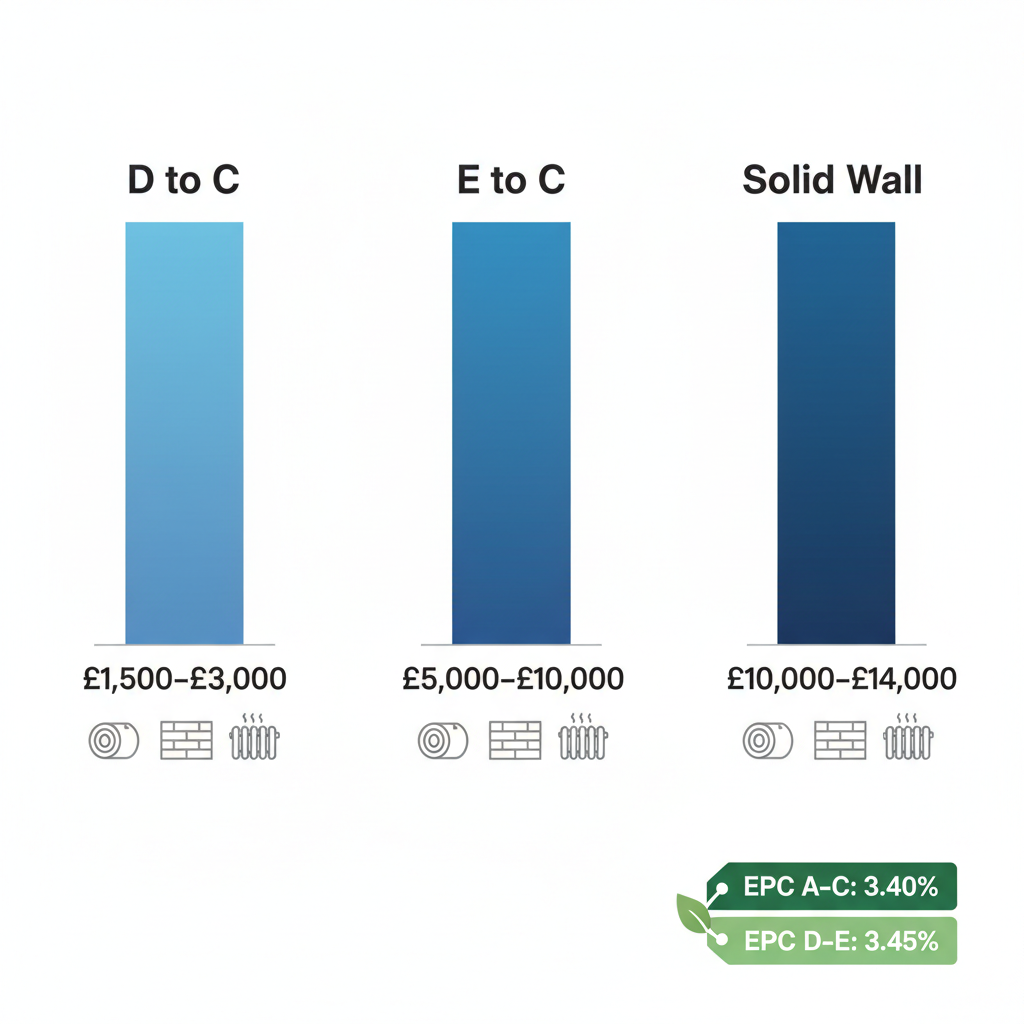
If your property sits at EPC D, the maths strongly favours acting promptly. A typical D-to-C pathway — cavity wall insulation, loft top-up, heating controls and LED lighting — costs £1,500 to £3,000. That is not a rounding error on a portfolio decision; it is a realistic bill for two or three days' work.
Loft insulation offers the best return: £300 to £600 for 5 to 10 EPC points. Cavity wall insulation (£400 to £1,500 for 10 to 15 points) and LED lighting (£100 to £300 for 2 to 5 points) are also highly cost-effective. Run those three measures together on a 1930s semi and you will almost certainly cross the band C threshold without touching the heating system.
The best cost-per-point measures are a hot water cylinder jacket (around £35 per EPC point), loft insulation top-ups (around £75 per point), draught-proofing, and cavity wall insulation (around £100 to £115 per point). Sequence your spend by cost per point, not by what feels most impactful.
The financing angle reinforces the case. At 75% LTV, Paragon Bank's 2-year fixed rates start at 3.40% for properties with EPC ratings from A to C. Rates for properties rated EPC D or E start at 3.45%. Five-year fixed rates at 75% LTV start at 4.80% for properties rated EPC A to C and 4.85% for those rated D or E. That 5-basis-point differential is modest on a single product, but across a multi-property portfolio remortgaging in the same cycle, it adds up.
When Holding Off (and Planning Carefully) Makes Sense
E-rated properties — and anything older than 1919 — present a different calculation. E-to-C upgrades typically cost £5,000 to £10,000. For solid-walled Victorian stock, the primary cost driver is wall insulation. Internal solid wall insulation typically costs £8,000 to £14,000 and adds 10 to 15 EPC points; external solid wall insulation costs £10,000 to £20,000 and adds 12 to 18 points. Those are life-of-roof decisions, not routine maintenance.
The cheapest EPC improvements are hot water cylinder insulation (£15 to £30), low energy lighting (£20) and draught-proofing (£80 to £120), going by the sample EPC in GOV.UK's landlord guidance. For an E-rated solid-walled property, stack all the low-cost measures first, reassess the EPC, and only then commission a quote for wall insulation. You may find you are closer to C than assumed.
The government's own impact assessment puts the average landlord cost at £5,387 per property across all property types, under its preferred policy option. That average masks the D-rated flat at £1,800 and the Victorian terrace at £12,000+. Know which bucket your property sits in before budgeting.
If a property still fell short after the spend cap threshold of qualifying spend, the landlord would be able to register a cost cap exemption on the PRS Exemptions Register, valid for 10 years. Exemption is a legitimate outcome, not a loophole — but it requires documented expenditure up to the cap, not a decision to do nothing.
The Calculation That Decides It
Step 1 — Cost to reach C
Start with your current SAP score (shown on the existing EPC certificate). You need SAP 69 to reach the bottom of band C. If you are at SAP 60 (mid-D), you need 9 points. Upgrading from little or no loft insulation to the full 270mm standard can boost an EPC by approximately 5 to 10 points, enough to push a property from band D into band C. One measure might do it.
Step 2 — Green rate saving over the fix term
The rate discount on green mortgages — usually 0.10 to 0.30 percentage points — reflects lenders' view that energy-efficient homes have lower running costs, stronger long-term values, and lower climate-related risk. On a £200,000 BTL mortgage, 0.10% saves £200 per year — £400 over a 2-year fix, £1,000 over a 5-year fix. That does not pay for solid wall insulation. It can cover a loft top-up.
Step 3 — Grants that close the gap
The Boiler Upgrade Scheme offers grants of £7,500 for landlords switching from gas boilers to low-carbon heating such as air source heat pumps. For a D-rated property where the old boiler is dragging the score, this grant can fund the most expensive single line item and leave the rest of the upgrade costing under £2,000.
Nationwide's 0% green further advance lets existing customers borrow up to £15,000 on top of their main mortgage at 0% APR, repaid over 5 or 10 years, ring-fenced for solar PV, heat pumps, batteries, insulation or EV chargers. Zero-cost borrowing for retrofit work is exceptional. If you are an existing Nationwide BTL customer, check eligibility before arranging any other finance.
Fleet Mortgages pays £1,000 cashback if a landlord borrower upgrades a property to EPC C or above during the initial fixed-rate period of their mortgage. All of Fleet's EPC A–C products come with a 3% fee and are priced 10 basis points lower than Fleet's equivalent standard products. The cashback offsets a meaningful share of upgrade spend on a lower-cost property.
Step 4 — The break-even test
Take the full net cost of the upgrade (gross spend minus grants and cashback), divide it by the annual rent increase a C-rated property commands over a D-rated one, and compare to the remaining years before your current tenancy ends. Typical rental uplift following a D-to-C improvement runs £500 to £1,500 per annum, with a payback period on rental uplift alone of 8 to 12 years. On a 5-year hold, the rate saving and reduced void risk matter more than rent uplift alone. On a 15-year hold, the rental premium compounds into a compelling number.
The 2030 deadline is not the starting gun — it is the final whistle. Installers are already booking out, and the cost of procrastination is measured in contractor premiums and compliance risk, not just rate differentials.