Why the 40% Rule Changes Everything
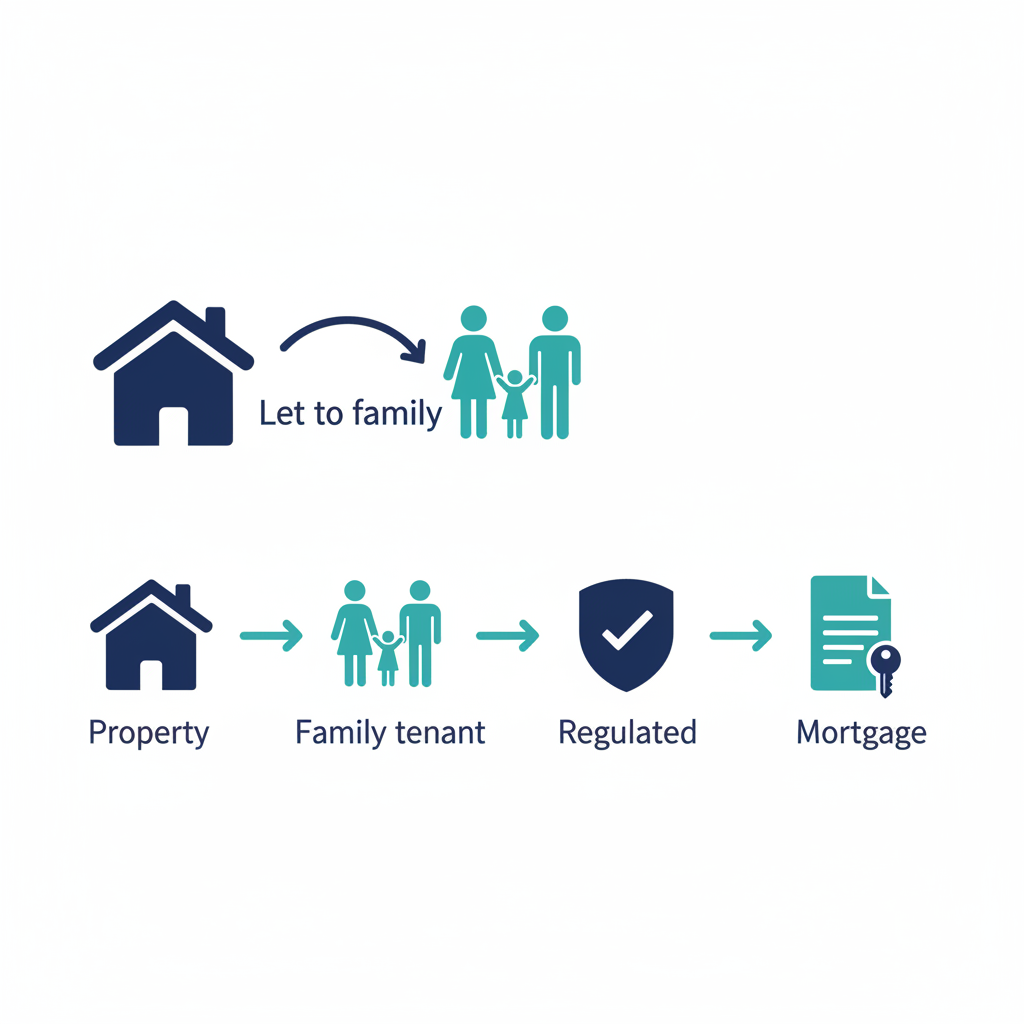
In UK mortgage regulation, a loan secured on a home is a regulated mortgage contract if at least 40% of the property is used as, or is intended to be used as, a dwelling by the borrower or a related person. That single threshold — 40% — is the line between a standard buy-to-let and a product governed by the same FCA rulebook as your own residential mortgage.
A "related person" under the Regulated Activities Order means a spouse or civil partner, a partner living with the borrower as a couple, or a parent, brother, sister, child, grandparent or grandchild. Cousins, second cousins, aunts and uncles will not meet the criteria. If the tenant falls outside that list, a standard BTL may still apply — provided the tenancy is genuinely arm's length and commercial.
A loan to a limited company sits outside the definition altogether, because it is not credit to an individual or to trustees. That matters: a landlord who holds property in a special purpose vehicle cannot access a regulated family BTL on that structure. The product is available to individuals only.
Family members living in the property must be declared upfront; failing to disclose this can be considered mortgage fraud. That is not a technicality. Placing a relative in a property secured on a standard BTL — without the lender's knowledge — is a serious misrepresentation. The declaration has to happen at application stage, not after completion.
What the Numbers Show
Fewer lenders offer this product because of the additional regulatory requirements. The main active names are Mansfield Building Society, Furness Building Society and Family Building Society. High street lenders are largely absent from this niche.
Mansfield Building Society is one of the most transparent about its regulated family BTL pricing. Its 2-year discounted variable rate product (DIB102) currently sits at 4.99% variable, up to a maximum 75% LTV, with an early repayment charge of 2% in year 1 and 1% in year 2, plus a £199 application fee and £1,499 completion fee. Its 3-year discounted variable alternative runs at 5.10% variable — discounted by 2.94% below SVR — up to the same 75% LTV ceiling, with ERCs of 3% in year 1, 2% in year 2 and 1% in year 3, and a maximum loan of £1,000,000. The 3-year deal carries no product fee, which can make it more competitive on larger loans despite the marginally higher headline rate.
Mansfield's rental income stress test on regulated family BTL requires 125% of the monthly mortgage interest, calculated at 5.5% or 2% above the pay rate, whichever is higher. Their individual underwriting approach can also accept earned income or other personal wealth for the affordability assessment — but when using top-slicing, rental income must still be at least 100% of the monthly mortgage payment calculated at pay rate.
Furness Building Society relaunched its regulated BTL range in November 2025. The enhanced range is available up to 80% LTV, with rates starting at 4.65% on a 2-year fixed-rate product up to 75% LTV. All products carry a £995 fee and are available across England, Scotland and Wales. Furness takes a distinctly different affordability approach: regulated buy-to-let applications are assessed strictly on affordability — any rental income received will not be factored into the assessment, though Furness obtains the AST to confirm that, if the property converted to a traditional BTL, the gross rent would be at least equal to 125% of the monthly interest payment at the initial pay rate. Furness also requires applicants to already own their own home, and sets a minimum personal income of £20,000 per annum.
Family Building Society rounds out the active lender trio. Its BTL maximum LTV is 75%, falling to 65% on loans above £1,000,000 and to 60% above £1,500,000. The loan amount is assessed on the basis that monthly rent must equal or exceed 145% of the interest payable per month, calculated at the higher of the product's initial interest rate plus 2%, the Society's managed mortgage rate, or 5.54%. For five-year fixed rate mortgages, the calculation uses the product's initial interest rate. Family Building Society accepts applications from age 18 and up to age 89. The minimum property value it will consider is £75,000 in England and Wales.
What This Means for Landlords
The first practical implication is cost. Interest rates on family BTL products may be slightly higher than standard buy-to-let, reflecting the smaller pool of lenders and the perceived risk. For context, according to Moneyfacts data from September 2025, the average buy-to-let mortgage rate across the wider market sits at 5.01%. Furness's 4.65% 2-year fixed is genuinely competitive against that benchmark — but the qualifying bar is higher, and the lender pool is narrower, so product transfer options at the end of any initial term are limited.
The second implication is how borrowing capacity is calculated. On a standard BTL, the lender leans on rental income and applies an ICR stress test. On a regulated family BTL, the lender assesses your personal income and expenditure — exactly as they would on your own home. The lender must carry out a full affordability assessment, rather than relying solely on projected rental income. A landlord on a lower income may find their maximum loan is constrained by salary, not by what a notional market tenant might pay. Running the numbers before approaching a lender is essential.
Tax sits alongside the mortgage structure. Since April 2020, individual landlords can no longer deduct mortgage interest from rental income before calculating tax; instead, a 20% basic rate tax credit on finance costs applies. That Section 24 restriction applies to family lets in exactly the same way as any other tenancy. A higher-rate taxpaying landlord charging below-market rent to a child or parent will feel the squeeze on both the income and the tax lines simultaneously.
There is also a genuine risk that lenders attach to below-market rents. Lenders recognise that property owners are likely to treat family members differently from other tenants and may charge a lower rent or offer flexible payment schedules. That is partly why the regulatory and affordability overlay exists. If the rent charged is well below market, some lenders will use the market rate in their ICR calculation — confirm this at Decision in Principle stage rather than at formal application.
One structural nuance worth knowing: since 21 March 2016, consumer BTL has been regulated under Part 3 of the Regulated Activities Order, with its own rules on information, creditworthiness and arrears — distinct from the full mortgage conduct rules in MCOB. The protections are real but the product set is genuinely small. With only a handful of active lenders and most mainstream banks declining to participate, placing a family BTL requires a broker who works this end of the market regularly.