One-Year Fixed vs Two-Year Fixed: Which Works for BTL Landlords Right Now?
The single factor that settles this decision is your view on where rates are heading before March 2028. That is not a guess — it is a calculation. Fleet Mortgages has just made it concrete by pricing one-year fixed BTL products from 3.49%, sitting noticeably below the two-year alternatives. If rates fall further before your fix ends, you refinance into a cheaper deal. If they do not, you have paid a 2.5% product fee for the privilege of finding out.
The framework is straightforward: one-year fixes suit landlords who expect rates to keep falling and can absorb a higher fee relative to the fixed period. Two-year fixes suit landlords who want certainty and prefer to spread that fee cost across 24 months rather than 12.
When a One-Year Fix Makes Sense
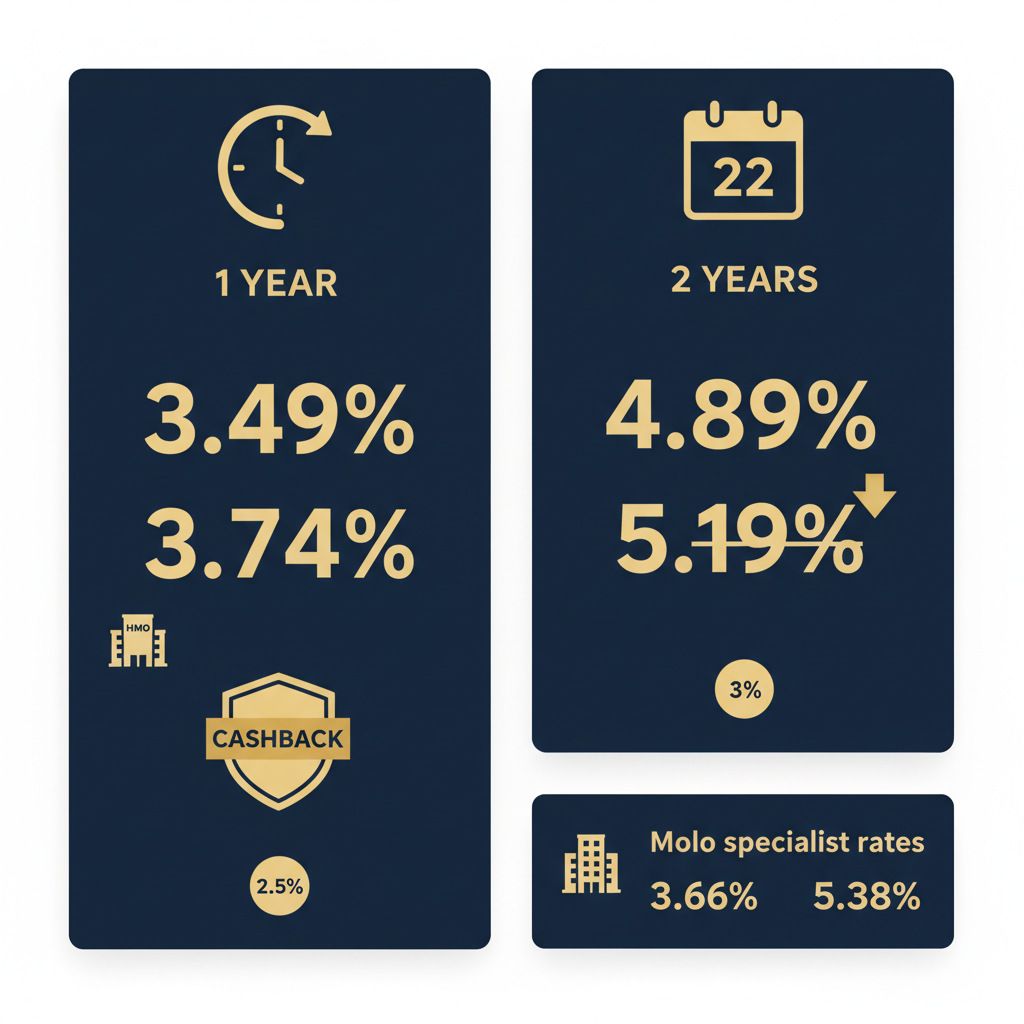
Fleet's Standard and Limited Company one-year products open at 3.49%, available up to 75% LTV, with a free valuation on properties worth up to £500,000. The 2.5% product fee is the same whether you are borrowing against a standard residential investment or an HMO. That parity is deliberate — it means the arithmetic works the same way regardless of asset type.
For HMOs and multi-unit freehold blocks (MUFBs), the one-year rate sits at 3.74%, also at up to 75% LTV. That 25 basis point premium over the standard rate reflects the complexity of the asset class, and Fleet partially offsets it with £1,000 cashback on completion. All one-year products carry an early repayment charge of 3% throughout the fixed period, so exiting early is expensive. You are committing for the year.
The product end dates Fleet currently quotes land at the end of March 2028. That gives you a defined refinance window — useful for planning, less useful if your portfolio review cycle runs on a different schedule.
A one-year fix makes most sense when you believe the rate environment will look materially different in 12 months' time and you have enough free cashflow to absorb the 2.5% fee without stretching your interest coverage ratio.
When a Two-Year Fix Makes Sense
Fleet's two-year HMO/MUFB fix, along with its equivalent EPC A-C and Product Transfer options, has just been cut from 5.19% to 4.89%. The fee on these products is 3%, and they also come with £1,000 cashback at up to 75% LTV. That 30 basis point rate reduction is meaningful across a two-year term — on a £300,000 loan, the saving runs to hundreds of pounds annually.
Compare the two positions: a one-year HMO fix at 3.74% with a 2.5% fee versus a two-year at 4.89% with a 3% fee. The one-year looks cheaper on rate. But you face a refinance in 12 months, another product fee, and the risk that the rate available then is higher than 4.89%. The two-year locks in a known cost across 24 months, which makes cashflow modelling considerably cleaner.
For portfolio landlords running multiple properties, the administrative load of refinancing 12 months sooner matters too. Each refinance carries legal costs, broker time and potential void risk if your attention is divided.
The Calculation That Decides It
Run the blended cost across the full 24-month horizon. Take Fleet's one-year HMO rate of 3.74% plus 2.5% fee, and assume you refinance at month 13 onto a product at whatever rate is then available, with another fee. Compare that total against the two-year HMO rate of 4.89% plus a 3% fee paid once.
For this to work in the one-year's favour, the rate available at your refinance point needs to be low enough that the combined cost of two fees and two rate periods undercuts a single two-year commitment at 4.89%. If rates stay flat, the two-year wins on simplicity. If rates fall by another 50 to 75 basis points, the one-year starts to look attractive.
Molo's rate reductions offer a useful reference point for where the specialist market is moving. Their two-year specialist fix — covering HMOs, MUFBs and new-build — has been trimmed by five basis points and now opens at 3.66%. Their five-year equivalent came down seven basis points to 5.38%. For semi-commercial, Molo's two-year fix starts at 5.91% and the five-year at 6.38%. Notably, Molo applies no additional rate premium to larger properties, including HMOs and MUFBs with 12 or more rooms or units — a meaningful concession on bigger assets where other lenders often load the price.
The direction of cuts across both Fleet and Molo points the same way: lenders are competing on specialist product pricing. Whether that momentum continues into 2027 is the real question your one-year versus two-year decision is betting on.
Fleet's chief commercial officer Steve Cox framed it precisely: these one-year products exist because there is still "considerable focus on the direction of rates and the increased cost of longer-term fixes." That is not marketing language — it is an acknowledgement that landlords are genuinely uncertain, and a one-year product is the structural answer to that uncertainty. It just costs you a 2.5% fee to buy that optionality.
If you know your portfolio, know your cashflow, and have a clear view on where rates are heading, the choice becomes mechanical. If you do not, paying a 3% fee once for 24 months of certainty is the more defensible position.