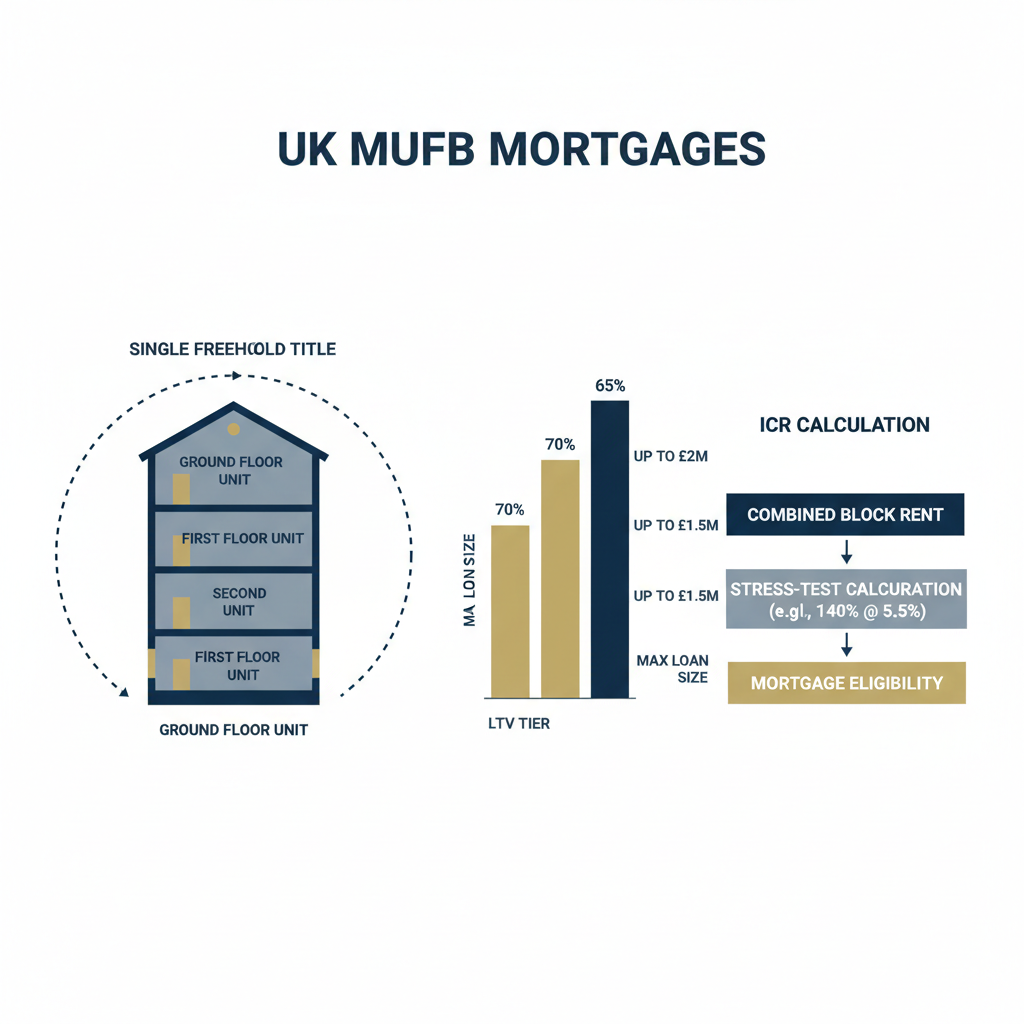
What the Numbers Show
Fleet Mortgages launched a one-year fixed MUFB product priced at 3.74%, up to 75% LTV, with a 2.5% product fee and £1,000 cashback. All one-year products carry a 3% early repayment charge during the fixed rate period. Fleet also cut its two-year HMO/MUFB rate from 5.19% to 4.89%, retaining the £1,000 cashback. That rate cut, announced on 16 October 2026, is the clearest signal of where active MUFB lenders are positioning themselves as swap rates stabilise.
Across the broader market, five-year fixed rates for small MUFBs (up to six units) run from 4.77% to 7.05% on an initial rate basis, with two-year fixes from 3.55% to 7.44%. Those headline figures mask the true cost. Some lenders offer lower headline rates in exchange for higher fees — a 5% arrangement fee is not unusual on the most keenly priced products.
Multi-Unit Freehold Block (MUFB) mortgages: how to finance a block of flats on one title starts with understanding why this product sits in a different tier to standard buy-to-let. An MUFB mortgage is a single buy-to-let loan on a freehold building split into several self-contained flats on one title. Most mainstream MUFB lenders cap a standard block at around six to ten units, want every flat to be self-contained and saleable, and expect landlord experience.
The market for MUFB lenders is smaller than for standard HMOs — typically 10–15 lenders at any time, compared to 30+ for standard HMO finance. That compression matters when you are trying to match a 12-unit Victorian block to a lender whose underwriters actually understand it.
What This Means for Landlords
LTV, deposits and loan sizes
Most MUFB lenders require a 25% deposit, making 75% LTV the standard ceiling. Step up to a larger block or borrow above £1m and that floor often rises. Fleet, for example, lends at 70% LTV for individual MUFB loans up to £1,500,000, and at 75% LTV for loans up to £1,000,000. For larger blocks of ten or more units and pension-trust MUFB ownership, deposits usually start at 30% to 35%.
Paragon operates a tiered LTV structure on its portfolio book. Paragon lends up to 75% on loans to £1.2m, 70% to £1.7m and 65% to £4m, and up to 70% to £6m on its Tailored range. For a £2m-plus block purchase, that shapes the entire equity calculation before you even get to rates.
The ICR arithmetic
This is where many applications fall over. MUFB ICR is calculated at the whole-block level using combined rent. Most lenders require 145% at 5.5%, applied to the total rent across all units.
A block of four flats each let at £750 a month produces £36,000 a year. At a 125% ICR and a 5.5% stress rate, that supports about £523,600 (£36,000 ÷ 1.25 ÷ 0.055). At a 140% ICR, the same rent supports only about £467,500. The ICR tier you fall into is determined by your tax status: Paragon applies a 130% ICR for basic rate and limited company borrowers, and 145% for higher and additional rate taxpayers. That difference of 15 percentage points can reduce your maximum loan by tens of thousands of pounds on a mid-sized block, so running the numbers before choosing a lender is not optional.
Landbay applies a stricter floor. Two-year fixed and tracker products are stressed at pay rate plus 2%, with a minimum of 5.50%. On a five-year fix, Landbay stresses at the pay rate itself — which is more generous when rates are rising.
How many units, and which lender?
The unit count determines your lender pool more than almost any other factor. In October 2026, Fleet and Foundation go to 10 units, Landbay to 12, Keystone and Paragon to 20, and Paragon's Tailored range to 35.
Fleet accepts up to 10 self-contained units of at least 30 sq m each, in England and Wales. First-time landlords cannot use Fleet for a MUFB. Landbay lends on blocks of up to 12 units in England and Wales, at up to 75% LTV. First-time landlords are welcome on smaller blocks. Landbay treats up to 6 units as a small MUFB and 7 to 12 as a large one.
Keystone and Paragon allow up to 20 units; Paragon's Tailored range reaches 35; Aldermore stops at 4. Above 20 to 25 units, the transaction typically moves into commercial mortgage territory. Above 25 to 30 units, the transaction usually moves into commercial mortgage territory with lenders such as Hampshire Trust, InterBay, and the commercial books of the clearing banks.
Paragon asks for at least two years' landlord experience on multi-unit blocks. Landbay requires at least 12 months as a landlord. Experience requirements are one of the more variable criteria in this space — some lenders will flex, others will not.
Valuation method: block vs aggregate
How the surveyor values your block drives the loan size as much as the rate. On a six-unit block where individual flats would sell for £200,000 each, the aggregate value is £1.2m. A 75% LTV mortgage on aggregate produces £900,000 of lending. Block valuation — the single-sale price of the entire freehold — will typically produce a lower figure. Landbay will consider aggregate valuation on request. Paragon typically defaults to block valuation. On anything above six units, a commercial valuer is likely to be instructed, which adds both time and cost.
Minimum income and limited company ownership
A question we see often from portfolio landlords is whether a minimum income requirement applies. Not every MUFB lender insists on one. Lenders such as NatWest and BM Solutions, for instance, do not apply a mandatory minimum income threshold, in contrast to the £25,000 floor that others publish. That flexibility matters when rental income is the primary income source for an experienced landlord.
Limited company MUFB borrowers typically face a maximum LTV of 70% to 75%. The combined premium for a limited company MUFB can reach 1.2% to 1.8% above a standard buy-to-let rate. For higher-rate taxpayers, that extra cost needs to be weighed carefully against the Section 24 benefit of SPV ownership.
How to finance a block of flats on one title: the practical checklist
Understanding Multi-Unit Freehold Block (MUFB) mortgages: how to finance a block of flats on one title comes down to four variables — unit count, loan size, ICR and valuation method — before you even consider rate. Confirm your block's unit count and the minimum floor area of each flat (the 30 sq m requirement from Fleet is a common trip hazard). Know your tax status, because the ICR band you fall into can materially reduce what you can borrow. Check whether the lender will accept aggregate or only block valuation. And run the ICR arithmetic on combined gross rent before committing to a purchase price, not after.
Buying a £2m block at 75% LTV requires £1.5m of lending. Keystone's £3m loan cap and Paragon's £2m maximum exposure are the only mainstream specialist lenders with sufficient headroom at that price point.