How To Get A New Buy To Let Mortgage If You Have 10 Or More Already
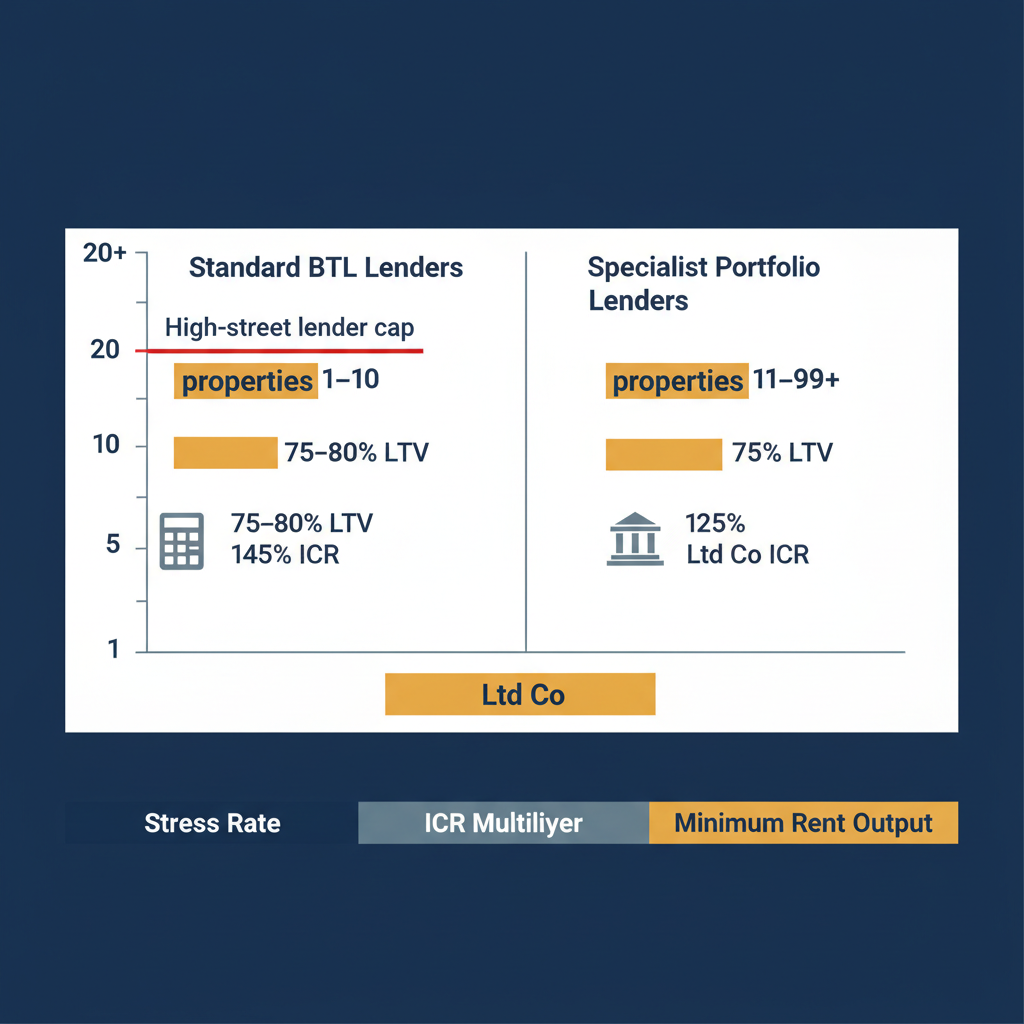
The single factor that determines whether you can borrow again at 10-plus properties is not your credit score, your income or your yield. It is lender selection. Roughly half the mainstream BTL market imposes a hard property count ceiling — and that ceiling is usually 10. Once you know which side of that line each lender sits on, every other decision follows.
NatWest, for example, will only consider portfolio landlords with 10 or fewer BTL or Consent to Let properties at completion — counting all properties whether mortgaged or unencumbered, owned personally or via SPV, including holiday lets and HMOs. Leeds Building Society similarly caps total portfolio size at 10 mortgaged rental properties, irrespective of lender. Coventry Building Society sets the same overall ceiling of 10 mortgaged BTL properties per household across all lenders, with a maximum of 5 held with the CBS Group itself.
If you already have 10 mortgaged properties and want a new loan, you need a specialist. Here is how to decide which route to take — and how to make the numbers work.
When a Specialist Portfolio Lender Makes Sense
Paragon Bank has removed minimum income requirements for portfolio landlords and increased its maximum loan limits across its buy-to-let mortgage range. Its platform introduced a streamlined process for landlords with fewer than 15 properties and a multi-property proposition allowing up to 99 properties in a single application, requiring only one ILA certificate for the entire case.
For landlords with four or more mortgaged assets — including limited companies, HMOs and multi-unit blocks — the maximum loan available from Paragon is £4 million at 65% LTV. Aggregate borrowing above £10 million may be considered on a bespoke basis.
The faster streamlined application process is suitable for individual and limited company landlords with a portfolio of up to 15 properties on single self-contained properties, and most applicants fitting the criteria will not need to upload payslips, tax returns, rental bank statements or company accounts at the outset.
Paragon's current product guide shows a reference rate of 5.50%, a five-year fixed reference rate of 5.00%, and an SVR of 9.60%. Landlords can choose from three fee options — 0.75%, 1% or 1.5% — and ICRs on tracker products are calculated at the initial rate plus 2%. On fixed-rate portfolio products, five-year fixed rates from Paragon's portfolio guide start at 4.85% at 65% LTV with a 5% product fee, with ERC schedules running 2% in year 1, 4% in years 2–4, and 3% in year 5.
Paragon makes sense when your portfolio exceeds 15 properties, you want a single-application process, you hold properties in a limited company, or you have HMOs and multi-unit blocks in the mix.
When The Mortgage Works (TMW) Makes Sense
TMW defines a large portfolio landlord as one with 11 or more distinct mortgaged BTL rental properties in the UK, and has specific large portfolio products available for portfolios of this size.
TMW accepts portfolio landlords with no stated limit on the number of properties and has no minimum personal income requirement, as lending is based on rental income. Maximum loan per property is £2 million for BTL and limited company applications, and maximum overall borrowing is £7.5 million.
TMW now applies a split background ICR policy: 125% for properties in the portfolio owned within a limited company structure, while personally owned properties remain subject to 145%. The portfolio stress rate of 4.75% and maximum aggregate LTV of 75% remain unchanged.
For landlords with 10 or fewer properties, TMW's standard BTL range offers one-year fixed rates from 3.24%, two-year fixed rates from 3.44%, five-year fixed rates from 4.22%, and a maximum LTV of 80%. For the large portfolio (11-plus properties) range, two-year fixed rates start from 3.89% and five-year fixed rates from 4.69%, both up to 75% LTV.
On the large portfolio range, ERC schedules include 2% until the end of the fixed period, then 1% for the following year on two-year products; five-year deals carry 5% in year 1, stepping down annually.
TMW makes sense when your portfolio sits between 11 and around 20 properties, when you have a mixed personal-name and limited-company structure that benefits from the split ICR, and when you want access to Nationwide group's funding depth.
The Calculation That Decides It
The ICR test is the gatekeeper. Every new application triggers a review of your entire background portfolio — not just the property you are buying.
How the ICR calculation works
Minimum monthly rent required = (Loan × Stress Rate × ICR) ÷ 12
Or viewed from the other direction:
Maximum loan = Annual Rent ÷ (ICR × Stress Rate)
Worked example — personally owned property, higher-rate taxpayer
- Property value: £300,000; loan at 75% LTV = £225,000
- Stress rate: 5.50%; ICR: 145%
- Minimum annual rent = £225,000 × 5.50% × 1.45 = £17,954
- Minimum monthly rent = £17,954 ÷ 12 = £1,496
Same property via a limited company (using TMW's 125% ICR)
- Minimum annual rent = £225,000 × 4.75% × 1.25 = £13,359
- Minimum monthly rent = £13,359 ÷ 12 = £1,113
That £383-per-month difference in the required rent is why corporate structure changes the decision entirely at higher property counts. Limited company structures are tested at 125% regardless of personal tax band, which is why many higher-rate taxpayers have moved towards corporate ownership.
Beyond the subject property, some lenders use portfolio-level testing — where total portfolio rent must cover total stressed mortgage payments — which is more flexible and allows strong properties to offset weaker ones. Others use property-level testing, where a single underperforming property can block the entire application.
Top-slicing allows a landlord's personal income to fill any shortfall where rental income alone does not meet the ICR at the lender's stress rate. This is available from a narrower lender panel — including Aldermore and selected specialists — and widens borrowing capacity for portfolio landlords with strong personal income.
The decision rule is straightforward: if your whole-portfolio ICR clears 125%–145% at a 4.75%–5.50% stress rate using the lender's preferred method (portfolio-level or property-level), you borrow. If it does not clear, you either restructure, top-slice where available, or shift the new loan into a limited company to attract the lower 125% ICR threshold. Run the numbers on both before you apply.