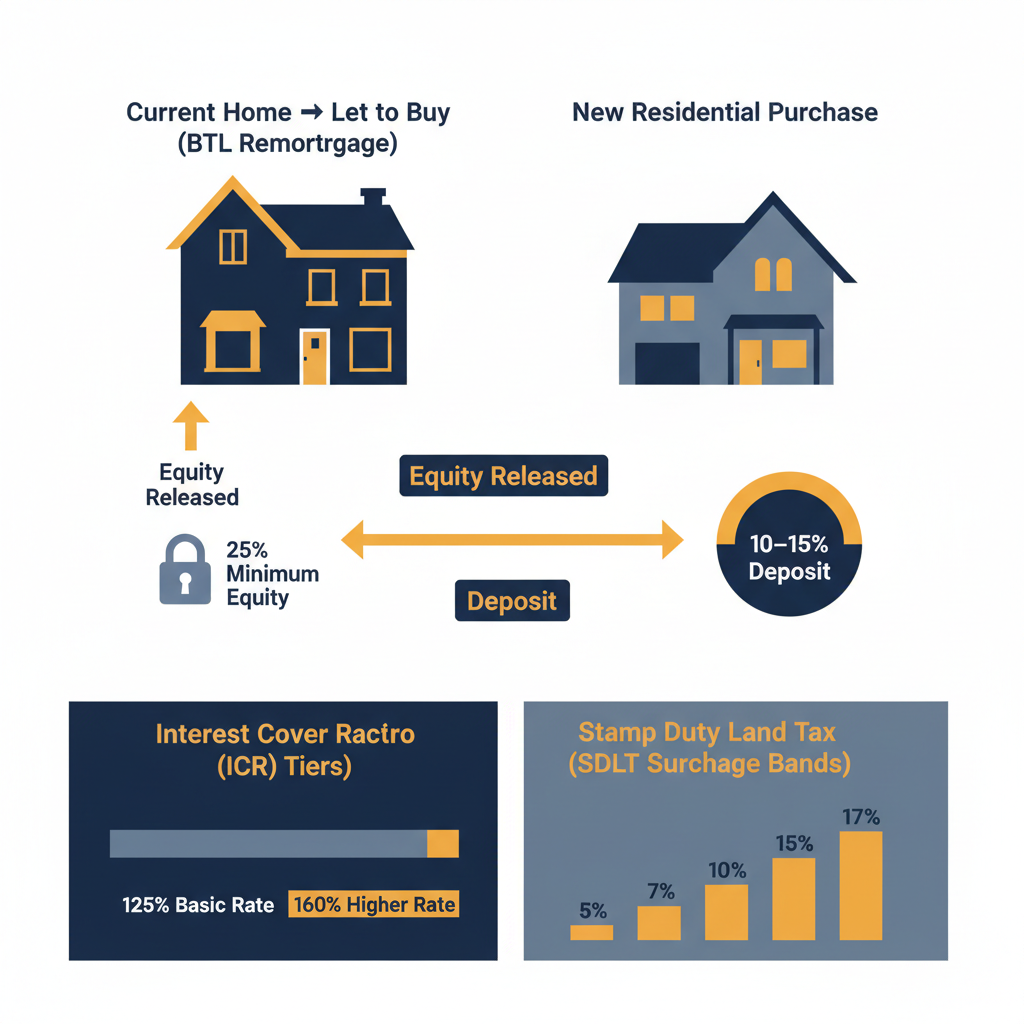
The Mortgage Works raised its maximum let-to-buy loan to £1 million in December 2025, up from a previous cap of £500,000. That single criteria change opened the strategy to a wider range of homeowners whose current property equity was simply too large to fit the old limit. If you have been sitting on a home you would rather keep than sell, let to buy: how to keep your current home as a rental and buy your next one is now a more accessible route than it was twelve months ago.
What the Numbers Show
The mechanics start with your existing home. You need at least 25% equity in your property after you release any deposit money for your onward purchase — the figure is taken from a surveyor's valuation, not the price you paid. That 25% equity requirement translates directly to a maximum loan-to-value of 75% on the property being converted to a rental. The Mortgage Works will consider up to 80% LTV for let-to-buy mortgages, making it one of the more generous lenders on this point, though 75% is the standard ceiling at most high-street names.
The interest cover ratio (ICR) is where let to buy: how to keep your current home as a rental and buy your next one gets more nuanced than a vanilla buy-to-let. The Mortgage Works applies a 125% ICR for lower-rate taxpayers who meet its conditions, and 160% for everyone else on a personal let-to-buy application. That gap matters. A higher-rate taxpayer with a £750,000 let-to-buy loan needs substantially more monthly rent to pass the stress test than a basic-rate payer does on the same property.
The stress rate compounds this. The Mortgage Works excludes remortgages changing from residential to buy-to-let from like-for-like treatment. For a two-year fixed let-to-buy product, the stress rate used is 5.50% or the pay rate plus 2.00%, whichever is higher. Run that through the ICR maths: on a £500,000 let-to-buy loan, the minimum annual rent for a higher-rate taxpayer at a 5.50% stress rate and 160% ICR works out to £44,000 — roughly £3,667 per month. At 125% for a basic-rate payer, the same loan needs £34,375 annually, or approximately £2,865 per month. Know your tax band before you pick a lender.
On the new residential purchase, the deposit requirement is lighter. At least 10–15% deposit is needed for the new home, though more is preferable. Applicants must have owned and lived in their residential property for at least six months at the time they apply. The two transactions are linked: The Mortgage Works will only accept applications where there is a simultaneous onward purchase of a new residential property with another lender, with the address supplied on application and confirmed by the acting solicitor prior to completion.
Minimum income thresholds also apply at many lenders, even where rental income does the heavy lifting. You will often need to provide evidence of a minimum personal income, typically in the range of £15,000–£25,000. Where the applicant is using the lower 125% ICR at The Mortgage Works, proof of personal income is required.
What This Means for Landlords
The average interest rate across all new buy-to-let loans in the UK was 5.0% in Q2 2025. That is the benchmark against which let-to-buy product rates should be measured. The Mortgage Works decreased rates on selected buy-to-let products in December 2025 by up to 0.2%. A one-year fixed rate came down to 2.49% with a 2% lender fee, and a two-year fix dropped to 2.71% with a 3% lender fee — both available for purchase and remortgage up to 75% LTV. Those percentage fees added to the loan alter the true cost significantly on larger balances; on a £500,000 let-to-buy, a 3% fee is £15,000.
The SDLT position on let-to-buy catches investors off-guard. If you complete on a new main residence before selling your previous one, you will normally pay the higher SDLT rates because you own more than one residential property at completion. If you sell your previous main residence within 36 months, you may be able to claim a refund of the additional SDLT paid. In a let-to-buy scenario, you are keeping the first property — not selling it — so the 36-month refund window is irrelevant. The higher rates of SDLT on additional residential properties stand at 5 percentage points above the standard residential rates, effective from 31 October 2024. On a £300,000 new residential purchase, that additional 5% costs £15,000 in SDLT before you have made a single mortgage payment.
From 1 April 2025, the standard residential SDLT thresholds reverted, giving buy-to-let rates of 5% up to £125,000, 7% from £125,001 to £250,000, 10% from £250,001 to £925,000, 15% from £925,001 to £1.5 million, and 17% above that.
Capital gains tax sits downstream, but it shapes exit planning from day one. In the 2026/2027 tax year, the annual CGT allowance is £3,000. Gains above that threshold are taxed at 18% or 24%, depending on the taxpayer's income and total gains.
One lender reduced selected buy-to-let and let-to-buy fixed rates in December 2025 by up to 0.29%, with rates starting from 2.60%. The direction of travel on rates is favourable, but lenders apply tiered fees that make headline rates a poor guide to actual cost. The Mortgage Lender offered two-year fixed limited-edition rates at 75% LTV with a £2,495 lender fee, a 3% lender fee, and a 5% lender fee — producing initial rates of 5.14%, 4.25% and 3.29% respectively. Lower rate, higher fee. Always calculate total cost over the initial period.
The Mortgage Works lends on standard buy-to-let, limited company buy-to-let, portfolio, large portfolio, let-to-buy, houses in multiple occupation and further advances. Let-to-buy, however, is not available through a limited company structure at The Mortgage Works — let-to-buy and regulated buy-to-let are not available through a limited company there. Portfolio landlords who operate primarily through a limited company will need a lender whose criteria accommodate simultaneous personal and corporate lending.
Several of the UK's biggest home loan providers lend to landlords through a separate brand: Nationwide through The Mortgage Works, Lloyds Banking Group through BM Solutions, and Yorkshire Building Society through Accord. Each brand carries its own ICR, stress rate and LTV criteria, and those numbers change regularly. The December 2025 rate cuts are a snapshot. Product guides are updated without notice, and a figure verified one week may be superseded the next.