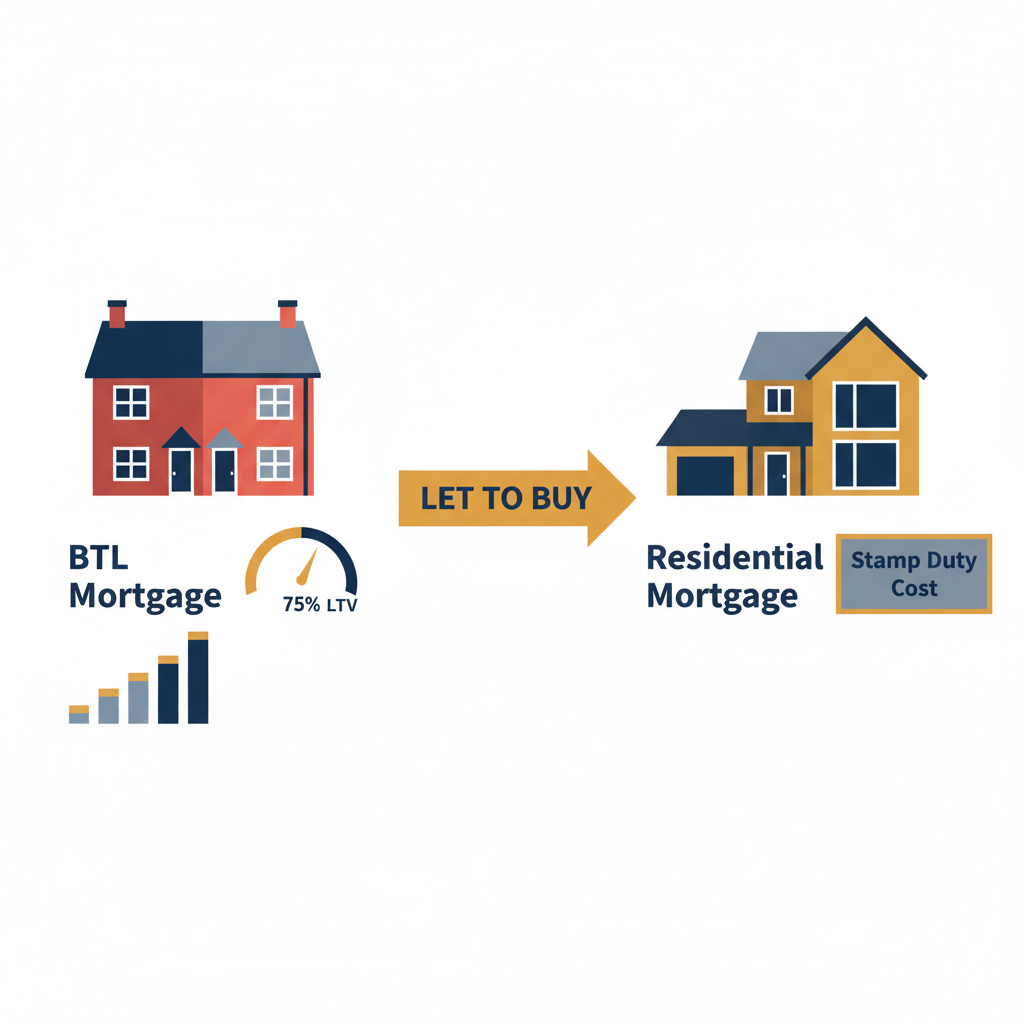
A £300,000 new residential purchase, made while you still own your existing home, carries a £20,000 stamp duty bill the moment you complete. That is the reality of a let to buy arrangement, and it is the figure most homeowners fail to price in before they pick up the phone.
A let to buy arrangement means you keep your existing home as a rental, converting it to a buy-to-let mortgage, while taking out a residential mortgage on a new main home. You will be running two linked mortgage applications at once. Both applications must be stress-tested separately, and both lenders will want to see the full picture of what you earn and what you owe. This is not a single product — it is two distinct mortgage transactions that need to be coordinated carefully.
What the Numbers Show
The equity threshold is the first gate. Most lenders require at least 25% equity in your current home, which means the let to buy side of the deal is capped at 75% LTV. Aldermore's criteria guide, effective 1 July 2026, sets exactly that: a maximum LTV of 75% and a maximum loan of £1 million for an experienced landlord doing a let to buy remortgage. First-time landlords face tighter constraints from the same lender — a minimum personal income of £25,000, a minimum age of 25, and a requirement to have been an owner-occupier for at least 12 months, with the maximum loan dropping to £500,000.
The rental income test on the existing property is where many applicants come unstuck. Rental income usually needs to cover 125–145% of mortgage payments at a stressed interest rate. On a two-year fixed or variable deal, Aldermore stresses the ICR at the higher of the pay rate plus 2% or 5.5%. On a five-year fix, the floor drops to 4.0% or the pay rate, whichever is greater — a meaningful difference that can increase your maximum borrowing substantially.
To put numbers on it: if your current home could achieve £1,100 per month in rent, and you are a basic-rate taxpayer requiring a 125% ICR tested at 5.5%, the maximum interest-only loan the rent will support is approximately £192,000. The calculation is: (£1,100 ÷ 1.25) × 12 ÷ 0.055 = £192,000. Many lenders test five-year fixes at, or close to, the actual rate, which can let you borrow more — so choosing the fix length on the let to buy side has a direct effect on what equity you can release for the new purchase.
Higher-rate taxpayers typically face a 145% ICR requirement, reflecting the Section 24 finance-cost restriction, which raises their real tax cost on the interest. At 145% ICR with a 5.5% stress rate and the same £1,100 rent, the maximum loan falls to around £165,700. That gap — roughly £26,000 — could be the difference between having enough deposit for the onward purchase or not.
The onward residential mortgage is assessed on income, not rent. For the new residential purchase, lenders check affordability by reviewing income, outgoings, debts, and credit profile. The existing let to buy mortgage will appear as a commitment. Most lenders will net off rental income against that commitment, but the methodology differs between lenders, so the order in which you submit both applications matters.
What This Means for Landlords
The stamp duty position requires a specific conversation before you proceed. SDLT rules impose an additional surcharge of 5% on top of standard rates for second homes and buy-to-let properties. On a £300,000 new residential purchase, that produces a total SDLT bill of £20,000 — comprising £5,000 under standard bands and a £15,000 surcharge at 5% of the full purchase price. SDLT must be paid from your own funds within 14 days of completion; it cannot be added to a buy-to-let mortgage, so your cash requirement is deposit plus SDLT plus fees.
If you bought a new home before selling the old one and paid the 5% surcharge because of it, you can claim it back once the old home sells, provided that happens within 36 months. Most let to buy borrowers intend to hold the original property long-term as a rental investment, so this refund route is typically not available to them. Factor the surcharge in as a permanent cost.
The alternative of consent to let is worth understanding before you commit to a full let to buy remortgage. Lenders typically grant consent to let on a temporary basis, often for 6–12 months. Consent to let is appropriate if you are renting out for 12–24 months and your lender is flexible; a full let to buy remortgage is the right route if you are keeping the property as a BTL for two or more years, or your lender will not grant consent. If you are mid-fix on the existing residential mortgage, exiting early to convert to a BTL deal will trigger early repayment charges. Those can be significant: on a five-year fix with The Mortgage Works, ERCs typically step down over time from around 5% of the balance in the earlier years to 1% by the final year. Check the current product guide for the exact schedule on your deal before instructing a broker.
On the new BTL mortgage itself, product fee structures vary. The Mortgage Works product guide dated 17 September 2026 shows a 1-year fixed remortgage at 75% LTV priced at 3.99% with a 2% product fee, and an ERC of 1% until 30 November 2027. A 2-year fixed deal from the same guide carries ERCs of 2% until 30 November 2027, then 1% until 30 November 2028. BM Solutions (part of Lloyds Banking Group) lends up to 75% LTV on standard let to buy cases, and for portfolio landlords, requires a minimum personal income of £30,000, a maximum 75% aggregate LTV across the portfolio, and a minimum 145% rental cover at a 5.5% stress rate.
Borrowers should plan for a 6 to 12-week process to coordinate both mortgage applications and aligned completion dates, including a two-week buffer for delays. The sequencing matters: if either mortgage application expires before the other completes, you face re-application and potentially different rates. Lenders on both sides will want to see evidence of the linked transaction — for the let to buy, lenders' main focus is the expected rental income, but they typically also want a copy of your onward residential purchase offer as confirmation that you can afford and intend to move out.
The base rate currently stands at 3.75%, per figures published in September 2026. At 75% LTV, typical buy-to-let rates currently range from 4.8% to 5.5%. On an interest-only basis, a £200,000 let to buy mortgage at the lower end of that range costs around £800 a month. That payment, alongside a new residential mortgage, needs to be sustainable from day one — not just on paper, but against the real cashflow of two mortgages running simultaneously.