The Single Factor That Determines Everything
Making Tax Digital for Landlords: Are You In Scope and What Changes? The answer to that question hinges on one number: your gross qualifying income. Not profit. Not taxable income. Gross rent — plus any self-employment turnover — before a single expense is deducted.
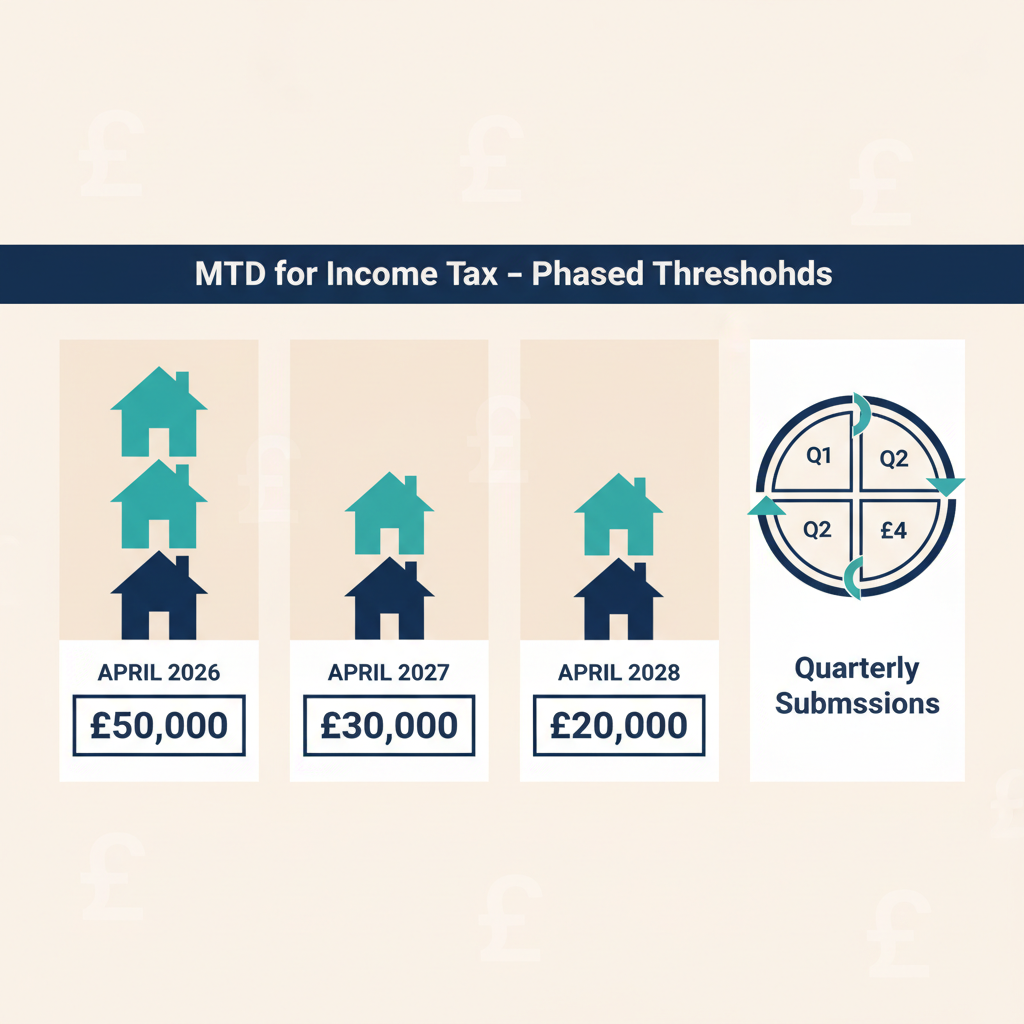
Since 6 April 2026, landlords and sole traders whose qualifying income was above £50,000 in 2024/25 must keep digital records and send HMRC an update each quarter. The limit drops to £30,000 from April 2027 and £20,000 from April 2028. That phased schedule is not a grace period — it is a rolling recruitment programme that will pull most unincorporated landlords into the regime within two years.
The threshold is based on gross income before expenses are deducted. A landlord receiving £55,000 in annual rent can fall within Making Tax Digital even if taxable profit is considerably lower once repairs, management fees and other allowable expenses are accounted for. Three buy-to-let properties generating average gross rents of around £10,000 to £12,000 each can breach the £30,000 trigger without you realising it.
When Staying Personal (and Going Digital) Makes Sense
If your portfolio sits in your own name and your 2024/25 gross rental and self-employment income exceeded £50,000, MTD is already mandatory for you. Landlords who fall within the scope of MTD for ITSA must keep digital records, use MTD-compatible software, and send quarterly updates to HMRC.
The quarters run to 5 July, 5 October, 5 January, and 5 April, although taxpayers can report to calendar quarters instead — 30 June, 30 September, 31 December, and 31 March. The first quarter runs from 6 April to 5 July, with the quarterly update needing to be submitted to HMRC by 7 August. The due dates for quarterly updates aren't affected — the second is due 7 November, and so on.
Taxpayers within MTD ITSA must submit a summary to HMRC of their income and expenses each quarter, fed from their digital records. These are not 'mini tax returns' — accounting and tax adjustments are optional. They represent the total of each category of income and expense for that quarter.
Landlords within MTD for ITSA must submit quarterly reports of income and expenses to HMRC using MTD-compatible software. They must also submit a final declaration, which finalises the tax position for the year and is the stage at which reliefs and allowances are claimed.
Staying personal makes financial sense for many landlords — particularly those who have already structured allowable expenses, mortgage interest deductions, and Section 24 tax credit correctly. The MTD obligation does not change your underlying tax calculation; it changes how and how often you report it.
When the Limited Company Route Makes Sense
Limited company landlords are outside MTD for ITSA scope. Companies file Corporation Tax returns, not Self Assessment, so MTD for ITSA doesn't apply to property income held within a company structure. HMRC confirmed in its Transformation Roadmap of 21 July 2025 that it will not introduce Making Tax Digital for Corporation Tax, and it has set no future date.
That means a special purpose vehicle (SPV) landlord with £200,000 of gross annual rent has zero quarterly MTD reporting obligations under the current rules. Properties held through a limited company (SPV) are subject to corporation tax, not income tax. MTD ITSA applies only to personally held rental income. If you hold some properties personally and some through an SPV, only the personal rental income counts.
Landlords considering incorporation specifically to avoid MTD should think carefully. While incorporation eliminates MTD for ITSA, it creates other complexities: Corporation Tax compliance, director's loan account management, dividend extraction planning, and potential Capital Gains Tax on future property sales or company wind-up. Incorporation is a 10-year structural decision, not a workaround for a quarterly reporting obligation.
Employment income taxed through PAYE and pension income do not count towards the threshold. A landlord with a £40,000 salary and £35,000 gross rent is not yet in scope for April 2026, but breaches the £30,000 property-income trigger for April 2027 on the rental side alone.
The Calculation That Decides It
Here is the in-scope test, applied in three steps.
Step 1 — Identify qualifying income. The rules apply to landlords whose combined gross income from property and self-employment exceeded £50,000 in the 2024-25 tax year. Add your gross rent to any self-employment turnover. PAYE and pension income do not count.
Step 2 — Apply the right threshold. MTD starts at £50,000 for the 6 April 2026 phase, measured on the 2024/25 tax return; at £30,000 for 6 April 2027, measured on the 2025/26 tax return; and at £20,000 for 6 April 2028, measured on the 2026/27 tax return.
Step 3 — Check structure. MTD ITSA only applies to unincorporated landlords filing Self Assessment. If 100% of your portfolio sits inside a limited company, you have no MTD for ITSA obligation today.
On penalties: the regime is now live, but HMRC has confirmed late submission penalties will be waived for the 2026/27 transitional year for those required to join MTD in the first wave. That is not an invitation to ignore the deadlines. HMRC's Making Tax Digital for Income Tax launched on 6 April 2026, introducing a new points-based penalty system. Under this approach, you accumulate a penalty point for each late submission, with a £200 financial penalty only kicking in once you reach the threshold of 4 points. Points expire after 24 months of compliant filing. From 2027/28, the soft landing is gone and the clock starts immediately.
The question Making Tax Digital for Landlords: Are You In Scope and What Changes? has a binary answer at any given moment. Add up your 2024/25 gross qualifying income. If it clears £50,000, you are already in scope. If it sits between £30,000 and £50,000, you enter the regime on 6 April 2027. Below £30,000 today still means below £20,000 from April 2028 is your last possible exemption line — and a landlord with £35,000 of rent and £25,000 of costs has qualifying income of £35,000, not £10,000. Three or four buy-to-lets can push gross rent past £30,000 without much difficulty.
The software decision — dedicated property accounting platform, bridging software that sits on top of a spreadsheet, or accountant-led filing — is secondary. The primary question is structure and threshold. Get those right first.