Get the Interest Cover Ratio wrong on a Paragon BTL application and you will not borrow as much as you expect — or your case will simply fail. The ICR is the mechanism that converts your loan amount into a minimum rental income figure. Misjudge it and you could be sitting in front of a client explaining why the numbers no longer work.
So what exactly is an Interest Cover Ratio? It is the multiple by which your gross rental income must exceed the interest on the mortgage, as assessed by the lender. Paragon does not use a single flat ratio. The figure it applies depends on two things: the tax band of the highest-earning applicant, and the property type.
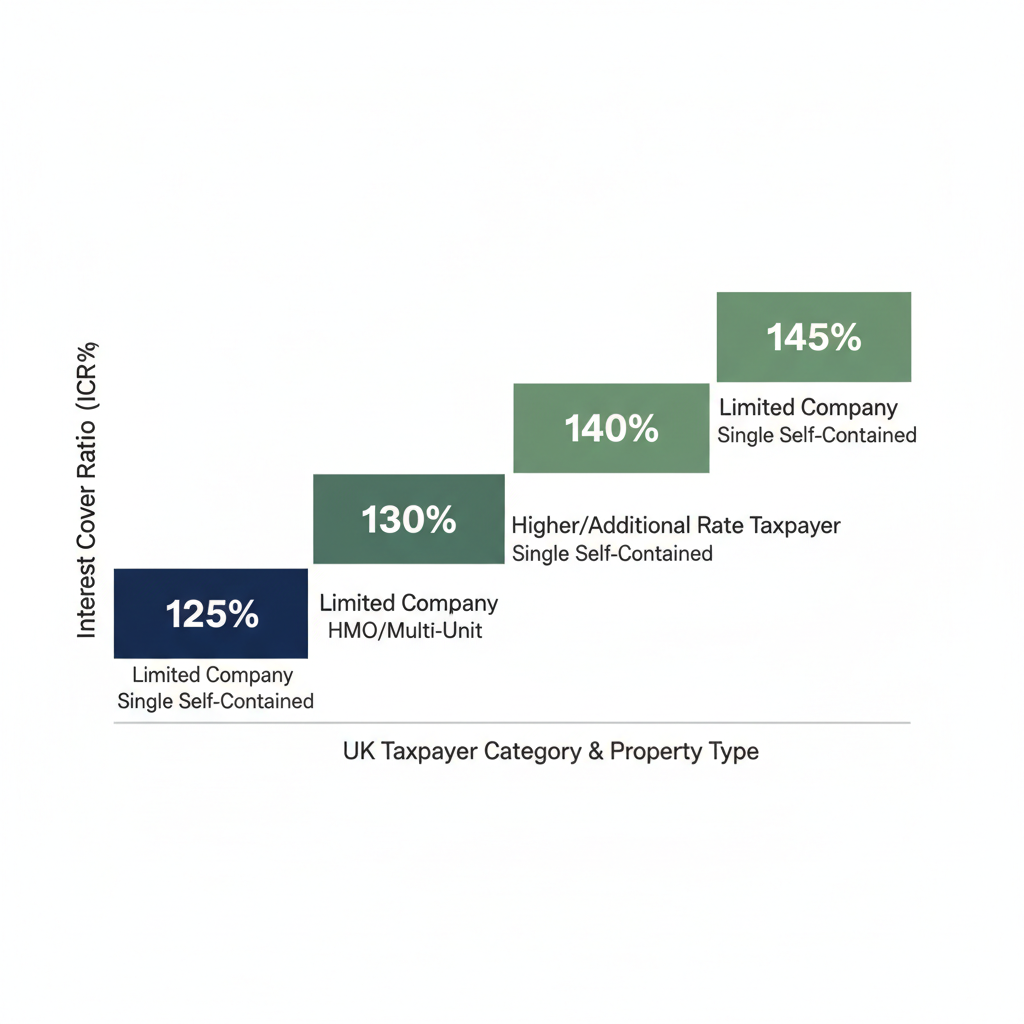
The four ICR tiers Paragon uses are: 125% for basic rate taxpayers (20%) on single self-contained properties; 125% for limited companies on single self-contained properties; 130% for both of those categories on HMOs, multi-unit blocks and all other property types; 140% for higher rate taxpayers (40%) on single self-contained properties; 145% for higher rate and additional rate taxpayers (45%) on HMOs, multi-unit blocks and all other property types.
That gap between 125% and 145% is not trivial. On a £500,000 loan it means the minimum rental income figure Paragon needs to see is materially higher for a 45% taxpayer with an HMO than for a limited company with a standard single let.
How It Works in Practice
The formula Paragon applies is straightforward:
Amount of loan × ICR calculation rate × ICR tax band percentage = minimal rental income required to borrow the requested amount of loan.
The ICR calculation rate itself is not simply the product rate. For most products, Paragon uses whichever is greater: the current reference rate published on its website and product guides, or the product charging rate plus 2%. That stress-tested rate is then multiplied by the ICR tax band percentage. The result is the minimum annual rental income the property must generate.
There is an exception worth noting. For five-year fixed rate products, the stress rate is whichever is greater between the current five-year fixed reference rate and the product charging rate — without the additional 2% loading. If you are advising a client on product selection, this distinction can meaningfully change the maximum loan available.
Paragon also runs a future affordability check, not just a current one. That means even if rental income clears the ICR today, a projected shortfall after a fixed or discounted period expires can cap the loan. The lender may also request evidence of contingency funds to demonstrate the applicant can absorb voids or rate increases.
For limited liability partnerships, Paragon uses the tax band of the member with the highest income — not an average across all members. That is the same approach applied to individual applicants.
Any fees added to the loan are included in the loan amount used for both the current and future affordability assessments. Fees are not excluded from the ICR calculation for standard BTL products.
Separately, Paragon also requires applicants with three or fewer mortgaged buy-to-let properties to demonstrate a minimum combined gross annual income of £25,000. For applicants with four or more, there is no minimum income requirement, but all income must be declared and applicants must show they can cover existing expenditure. The useable Land and Property income figure is calculated by deducting total residential finance costs from the taxable profit for the year — in line with current tax calculation requirements.
Common Mistakes
The most frequent error is applying the wrong ICR tier. Portfolio landlords who own their properties personally and fall into the 40% band often assume the 125% ratio applies. It does not. They are subject to 140% on a standard let and 145% on any HMO or multi-unit block. If you present a case using the wrong tier, the rental income will look sufficient when it is not.
A second mistake is ignoring the stress rate. Landlords sometimes focus on the headline product rate, assuming the ICR is calculated on that figure. Paragon calculates using the reference rate or the product rate plus 2%, whichever is higher — except on five-year fixes. Using the product rate alone will produce a lower minimal rental income figure than Paragon will actually require.
Third: fees. Adding an arrangement fee to the loan increases the amount used in the ICR calculation. On higher LTV applications, fees added to the loan are also included within both the maximum loan and LTV calculations, and the total cannot exceed 80% LTV on standard products. Overlooking this can put the numbers just over the threshold.
Fourth: assuming the limited company ICR always provides an advantage. A limited company is assessed at 125% on a single self-contained property — the same as a basic rate individual. It is not a guaranteed route to a lower stress test, and on HMOs and multi-unit blocks the limited company rate rises to 130%.
Finally, some landlords misunderstand the minimum property valuation threshold. Paragon will not consider any property valued below £75,000 for standard BTL applications. For refurb-to-let, that floor drops to £50,000 — but the maximum loan on a refurb-to-let purchase or remortgage is capped at £1,000,000, with a maximum LTV of 75% where interest is rolled up on the end loan balance.
The ICR is the central underwriting variable on any Paragon BTL application. Get the tier right before you run the numbers.