Paragon has removed the £25,000 minimum income requirement for portfolio landlords — and that single change rewrites the affordability conversation for a sizeable chunk of professional investors. If rental income is your primary source of earnings, this matters more than any rate move. Every competent Paragon mortgage broker should be leading their client review with this shift.
What the Numbers Show
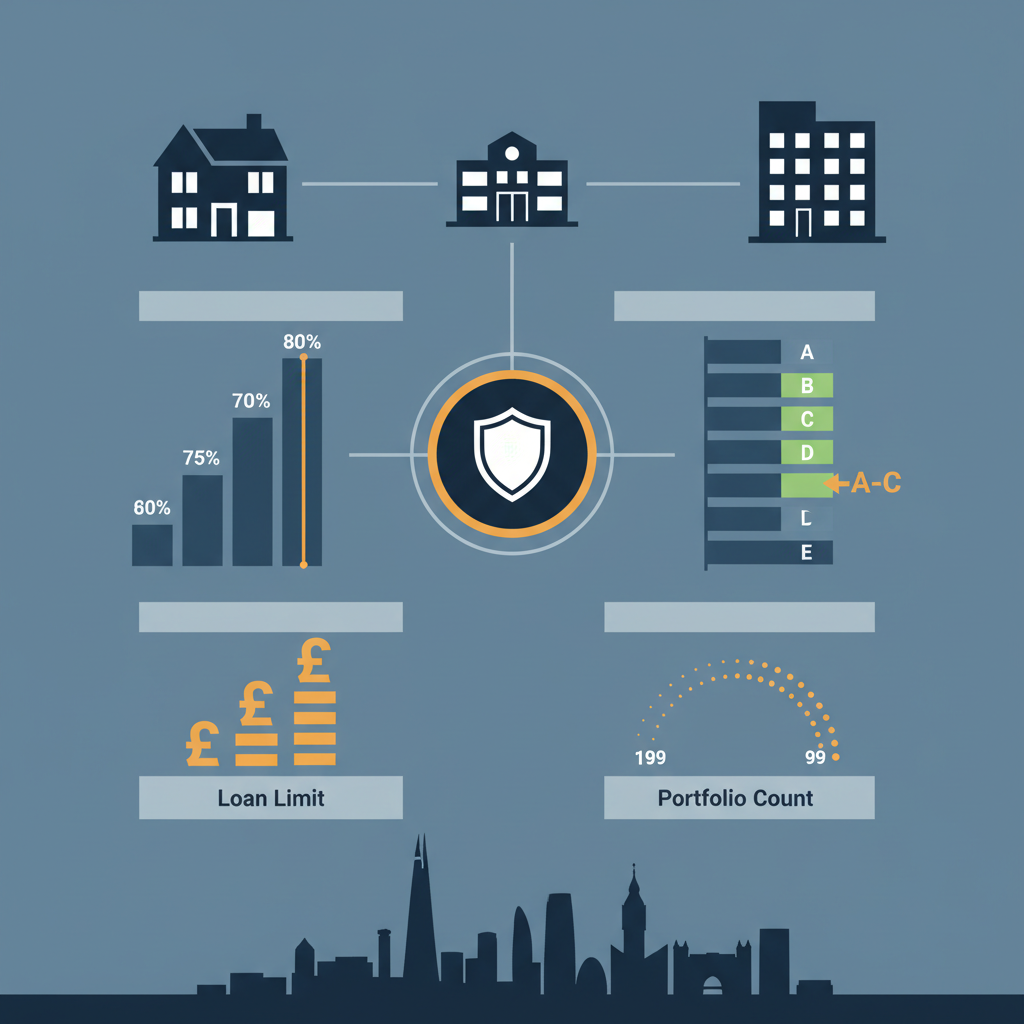
The updated loan limits mean landlords can now borrow up to £800,000 at 80% LTV, up from £750,000; £1.2m at 75% LTV, up from £1m; and £1.7m at 70% LTV, up from £1.5m. These are not marginal tweaks. At 75% LTV, the ceiling has risen by £200,000 — enough to fund an additional property purchase or a meaningful further advance without crossing into a higher LTV bracket.
For individuals with three or fewer mortgaged BTL properties, there is a maximum loan of up to £2m at 65% LTV. For individuals with four or more mortgaged BTL properties, limited companies and applications for HMOs or multi-unit blocks, the maximum at 65% LTV remains unchanged at £4m. Portfolio landlords operating through a limited company therefore retain access to that £4m ceiling from the outset.
A total mortgage exposure per borrower of £10m may be advanced on a property portfolio. Where exposure above £5m is requested and agreed, a maximum aggregated LTV of 75% will apply. All borrowing above a £5m mortgage exposure is subject to a maximum LTV per property of 70%. Those thresholds are hard stops, not guidelines — a broker needs to map total group exposure before submitting at higher LTVs.
The LTV-to-loan-size matrix for portfolio cases is precise. At up to 65% LTV the maximum loan per property is £4m; at up to 70% LTV it is £1.5m; at up to 75% LTV it is £1m; at up to 80% LTV it is £750,000. Note that these per-property ceilings in the portfolio lending guide reflect earlier data — the December 2025 increases cited above now supersede several of these figures, so always verify the current guide.
On ERC structure, a 2-year fixed product carries an ERC of 3% for year 1 and 3% for year 2. That symmetry — same charge in both years — is worth flagging to any landlord considering an early exit. The ERC is calculated on the outstanding balance at the point of redemption.
SSC products are available with no application fee, while HMO and MUB loans carry a £150 application fee. Interest coverage ratios are calculated at the initial rate plus two percentage points. That stress-test margin is the critical number driving maximum loan size on any given rental income — confirm the ICR calculation rate shown on the specific product before running affordability.
For properties requiring a valuation, the application fee is a non-refundable charge on all submissions unless otherwise stated, set at £299. A re-inspection fee of £100 applies if a re-inspection of the property becomes necessary after the original valuation. Valuation fees themselves scale with property value: for a property valued between £75,000 and £100,000, the valuation fee for a single self-contained unit is £280, rising to £500 for an HMO in the same band.
What This Means for Landlords
The multi-property proposition is the structural change that any serious Paragon mortgage broker should understand before approaching a portfolio review. Paragon's multi-property proposition allows up to 99 properties per application and includes one ILA certificate for the whole application, designed to make portfolio growth simpler, faster and more efficient. Previously, every property needed its own legal advice certificate — across a 20-property portfolio, that alone represented meaningful cost and delay.
All products qualify for Paragon's multi-property proposition, which applies to applications of between 4 and 99 properties. This lets landlords submit a single application covering multiple properties, with no application fees and reduced legal requirements, with only one legal advice certificate required across the overall application rather than one per property.
The streamlined process operates on a separate threshold. The process is suitable for individual and limited company landlords with a portfolio of up to 15 properties, single self-contained properties, those up to 75% LTV and up to £2m exposure with the lender. Cross that £2m exposure line and additional underwriting kicks in automatically.
The system uses a new origination platform that can pre-fill much of the application using data from sources including Companies House, Experian and Hometrack. For a limited company landlord with a clean structure, that pre-population materially cuts submission time. The updated process removes the need for most applicants who fit the criteria to upload documents such as payslips, tax returns, rental bank statements and, for limited companies, two years of accounts.
However, all applications will continue to be 100% underwritten and further documentation may still be requested where it supports the decision to lend. That caveat matters. "Streamlined" describes the front end, not the underwriting standard. A complex income structure or adverse credit history can still generate document requests at any stage.
EPC rating now shapes product access, not just pricing. Within the SSC range at 75% LTV, green mortgage products are available on properties with EPC ratings of A to C. Landlords holding D- or E-rated stock can still borrow, but they access a different product set. With EPC compliance regulation still evolving, the landlords best placed with Paragon are those already investing in energy upgrades — or factoring improvement costs into their acquisition figures at the outset.
Paragon lends to private individuals and limited companies and provides mortgages suitable for single, self-contained properties, as well as HMOs and multi-unit blocks. Paragon can accommodate higher aggregate lending limits and more complex letting arrangements including local authority leases and corporate leases along with standard ASTs. That breadth — from a vanilla single let to a corporate-leased HMO — is what makes Paragon distinctive among specialist BTL lenders and why routing complex cases through an experienced Paragon mortgage broker consistently produces better outcomes than direct submission.
The minimum property valuation is £75,000 across both portfolio and non-portfolio routes. The minimum loan amount for purchase or remortgage is £30,000, and for a further advance it is £5,000. At the other end of the scale, a maximum aggregate borrowing above £10m may be considered on a bespoke basis. Paragon's range covers the full spectrum — from a single terraced house to an institutional-scale portfolio — which is precisely why criteria literacy is non-negotiable before placing any case.