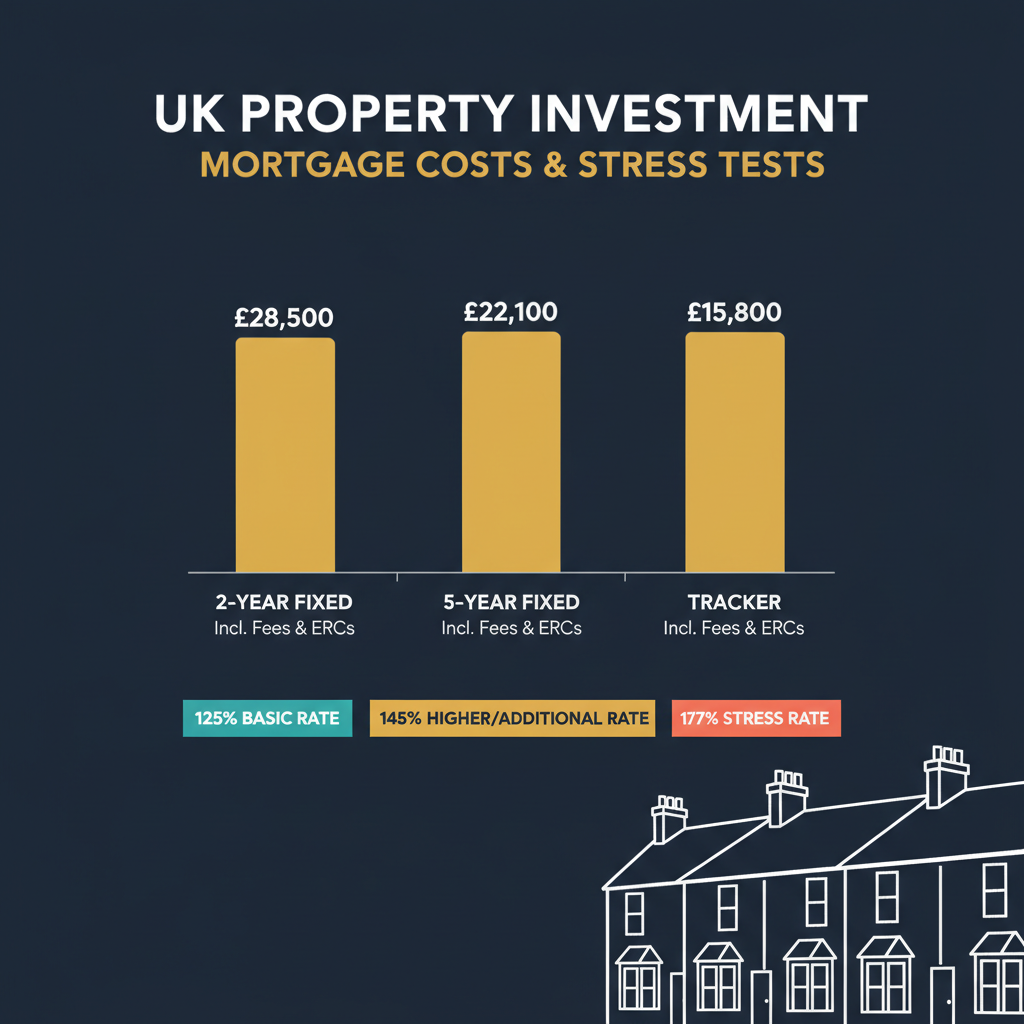
NatWest cut its two-year fixed BTL purchase rate at 75% LTV by 0.43% in October 2026, landing at 4.16% with a lender fee of £3,999. That single move illustrates the core problem with headline rates: the number in the press release is rarely the number that matters. The fee adds roughly £133 per £100,000 to the annual cost of a two-year product. Ignore it and your yield calculation is wrong before you've even started.
Getting precise mortgage rates on a BTL property is not about finding the lowest number on a comparison site. It is about understanding what each combination of rate, fee, term, LTV and stress-test produces for your property, your tax position and your portfolio. That is what this article works through.
What the Numbers Show
The Bank of England base rate stands at 3.75% in October 2026, held at the 17 September Monetary Policy Committee meeting, with six members voting to hold and three voting to raise it to 4%. The next rate decision falls on 5 November 2026. Markets are not pricing in cuts — market pricing on 12 October 2026 implied the base rate could rise from 3.75% to around 4.5% by April 2027. That trajectory matters when you choose your fix length.
The rate range in the live market is wide. Moneyfacts currently shows a lowest 2-year fixed BTL rate of 3.59% at 65% LTV, with average rates of 4.91% (2-year) and 4.89% (5-year) at 60% LTV, and 5.27% (2-year) and 5.66% (5-year) at 75% LTV. The very lowest 2-year rates — such as 3.64% from Kensington Mortgages or Zephyr Homeloans at 75% LTV — come with arrangement fees that can exceed £10,000. A fee of that size on a £200,000 loan adds the equivalent of around 1% per year to the cost of a two-year deal. On a five-year fix, the same fee amortises to roughly 0.2% per year. The fix length changes the arithmetic completely.
Paragon Bank launched new BTL fixed rates in October 2026, with two-year fixed rates starting from 3.80% and five-year fixed rates from 4.80%. Selected five-year products carry no early repayment charge in year one, then 3% in years two through five. Aldermore Bank increased selected BTL fixed rates by up to 0.17%, with two-year fixed rates now starting from 4.11%. Santander decreased selected BTL purchase and remortgage rates to start from 4.89% with a £1,749 lender fee.
Early repayment charges are where landlords regularly get caught out. The Mortgage Works (TMW) applies ERCs during the product term, with their 5-year fixed range carrying charges of 5% until November 2028, dropping to 4% until November 2029, 3% until November 2030, and 1% until November 2031. On a £300,000 loan exited in year one of a five-year fix, that is a £15,000 charge. Factor it in before you commit.
BTL products typically carry ERCs lasting 2–5 years, and these can run to 1–5% of the loan. Arrangement fees for BTL remortgages typically fall between £1,000 and £2,000 as a flat fee, though percentage-based fees are common at lower headline rates.
Tracker products offer a different structure. Landbay's new premier like-for-like tracker products at 75% LTV start from base rate plus 0.34%, carry no early repayment charges, and benefit from a reduced stress rate of 4.5% or pay rate, which can improve affordability. At the current base rate of 3.75%, that puts the pay rate at 4.09% — with full flexibility to exit without penalty.
What This Means for Landlords
The precise mortgage rate you can access is only half the equation. The other half is whether a lender will approve the loan at that rate in the first place — and that depends entirely on the ICR stress test.
The headline rule is that rental income must cover the stressed mortgage interest by at least 125% for a basic-rate taxpayer or limited company borrower, and 145% for a higher- or additional-rate taxpayer borrowing in personal name. The typical stress rate is 5.5%, or product rate plus 2%, whichever is higher.
Because the PRA allows five-year products to be stress-tested at the pay rate rather than the pay rate plus 2%, a five-year fix routinely supports a materially larger loan than a two-year one. Here is what that means in practice. Take a property generating £1,400 per month (£16,800 per year). A higher-rate taxpayer using a two-year fix stress-tested at 5.5% with a 145% ICR has a maximum loan of £16,800 ÷ (1.45 × 5.5%) = £210,650. The same landlord on a five-year fix with a 4.80% pay rate, stress-tested at 4.80%, can borrow up to £16,800 ÷ (1.45 × 4.80%) = £241,379. That is a £30,729 difference — from the same rent, the same LTV, and the same lender criteria framework. The fix length, not the headline rate, determines the loan size.
ICR thresholds vary further for specialist property types: 125% for limited companies and basic-rate individuals, 145% for higher-rate, 165% for additional-rate, and up to 175% for some HMO lenders. Limited company BTL products run approximately 0.3% to 0.8% higher in rate than equivalent personal-name products, but for higher-rate taxpayers the tax treatment of mortgage interest as a full business expense often outweighs that difference over a five-year hold.
Precise mortgage rates do not exist in isolation. The rate drives your monthly payment. The fee drives your true cost. The stress rate drives your maximum loan. The ERC drives your exit cost. Miss any one of these and you are not comparing products — you are comparing noise. Working with a broker who can run all four inputs simultaneously, across the lenders currently active in the market, is how a portfolio landlord consistently gets better outcomes than applying direct. The current market has over 299 products from BTL lenders — lower rates sometimes come with higher lender arrangement fees, so always compare the true cost — including fees — across the full product term, not just the headline rate.