Precise Mortgages currently lists a 5-year fixed buy-to-let rate of 3.49% at 65% loan-to-value, with a £1,995 arrangement fee attached to its standard product tier. That single figure tells you more about how Precise positions itself in the market than any brochure does. It is priced for landlords who can bring equity to the table and want long-term certainty — not for the borrower hunting the cheapest two-year tracker at 75% LTV.
What the Numbers Show
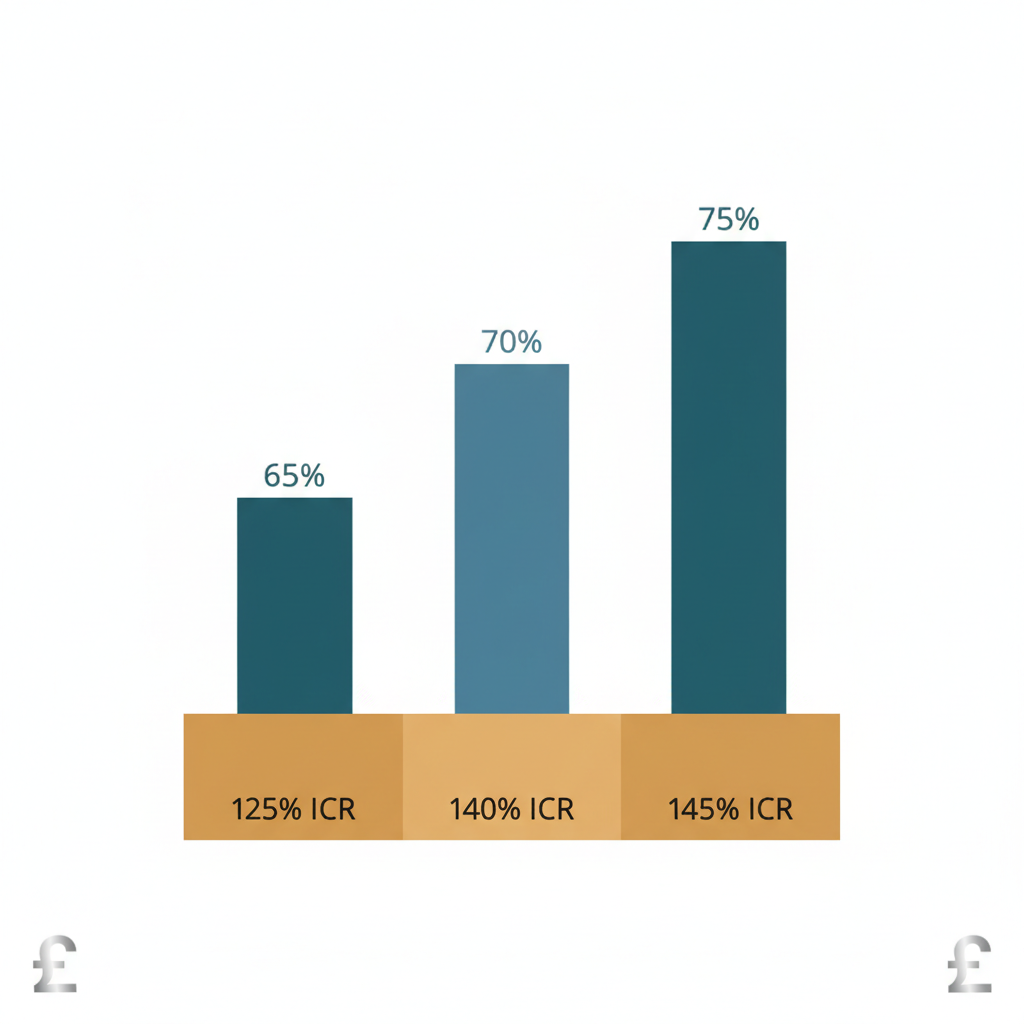
Pull up the Precise rate sheet and you see a lender that has built its product architecture around three LTV bands: 65%, 70%, and 75%. The spread between those bands is not trivial. Move from 65% to 75% LTV on a comparable 5-year fixed product and the rate steps up by approximately 0.40 percentage points, which on a £250,000 mortgage translates to roughly £83 per month in additional interest cost. Over a 5-year term that is £4,980 — more than double the arrangement fee on the lower-rate product.
The interest coverage ratio (ICR) requirement at Precise sits at 125% for basic-rate taxpayers and 145% for higher-rate and additional-rate taxpayers. At a stress rate of 5.50%, a £200,000 loan requires monthly rental income of at least £916 for a basic-rate taxpayer and £1,058 for a higher-rate taxpayer. These are not the most aggressive ICR thresholds in the specialist market — some lenders stress at 5.50% with a 145% ICR applied universally — but they do mean that a property yielding 5.5% gross will be borderline on affordability at 75% LTV for a higher-rate taxpayer.
Precise applies a minimum property value of £75,000 and a minimum loan size of £25,001. Maximum loan exposure per property sits at £1 million, and portfolio landlords can borrow up to £3 million across all properties held with Precise simultaneously. That £3 million aggregate cap is a practical ceiling worth knowing. A landlord with 8 properties each mortgaged at £375,000 would breach it.
The two-year fixed range opens at a higher rate than the 5-year equivalent, which is the opposite of the typical high-street pattern where short-term fixes are cheaper. Precise prices the 2-year fix higher because the reversion risk falls back to them sooner. The current 2-year fix at 75% LTV sits around 4.20%, compared to the 5-year equivalent at approximately 3.89%. For a portfolio landlord with stable long-term tenants, the 5-year product wins on both rate and predictability.
As a Precise Mortgage Broker, the first question to ask any client is: what is the property's current rental income and what tax band does the landlord sit in? Those two variables determine whether Precise can even table a competitive offer before a rate comparison is meaningful.
What This Means for Landlords
The product architecture at Precise is designed to serve four borrower profiles: individual landlords, limited company applicants, first-time landlords with a residential mortgage elsewhere, and portfolio landlords with 4 or more mortgaged properties. That final group triggers Precise's portfolio underwriting process, which requires a business plan, asset and liability statement, and a portfolio summary spreadsheet. Lenders applying this level of scrutiny after the PRA's 2017 underwriting changes do so to a consistent standard — Precise's documentation requirement runs to 6 separate documents for portfolio cases, compared to 3 for standard single-property applications.
Limited company buy-to-let borrowers get access to the same rate tiers but the ICR calculation changes. Precise applies a 125% ICR stress at 5.50% for limited company cases regardless of the director's personal tax position. That is a meaningful advantage for higher-rate taxpayers using a Special Purpose Vehicle. The saving on a £300,000 loan over a 5-year term compared to the personal ownership ICR calculation can open up properties that would otherwise fail to meet rental stress thresholds by £100 to £200 per month.
EPC requirements are becoming operational, not just regulatory. Precise already flags properties with an EPC rating of F or G at point of application. While they will currently lend on these properties in some circumstances, the arrangement fee for sub-D rated properties in certain product ranges has moved to £2,495 — £500 more than the standard tier. That premium is a pricing signal, not a penalty in isolation. It reflects the increased risk Precise attributes to assets that may face compulsory retrofit costs under future minimum energy efficiency standards.
HMO and multi-unit freehold block (MUFB) products sit on a separate rate card at Precise. The minimum loan on an HMO product is £50,000, the maximum is £750,000, and the arrangement fee runs to £1,995 on a like-for-like basis with standard BTL. The key difference is the maximum LTV, which is capped at 70% for HMOs — 5 percentage points lower than the standard product maximum. That 5% gap means a landlord purchasing a £400,000 HMO needs to find £120,000 deposit rather than the £100,000 they would need on a standard single-let at 75% LTV.
Working with a Precise Mortgage Broker matters most at the document-preparation stage. Precise declines to renegotiate terms after a valuation on the basis of affordability recalculation unless there has been a material change to rental income or purchase price. Getting the ICR modelling right before submission avoids a declined valuation report sitting on the Land Registry with associated costs of £150 to £350 for the search and valuation fees already spent.
Tracker products from Precise are linked to the Bank of England base rate with a margin of typically 2.99% over base at 65% LTV. With the base rate at 5.25% as of the most recent MPC decision, that puts a tracker product at 8.24% — sharply higher than the fixed rate equivalent. Trackers at Precise are for investors who are certain rates will fall within 12 months and want no early repayment charge to remortgage quickly. The ERC on Precise 5-year fixed products runs from 5% in year one, stepping down by 1 percentage point per year to 1% in year five.