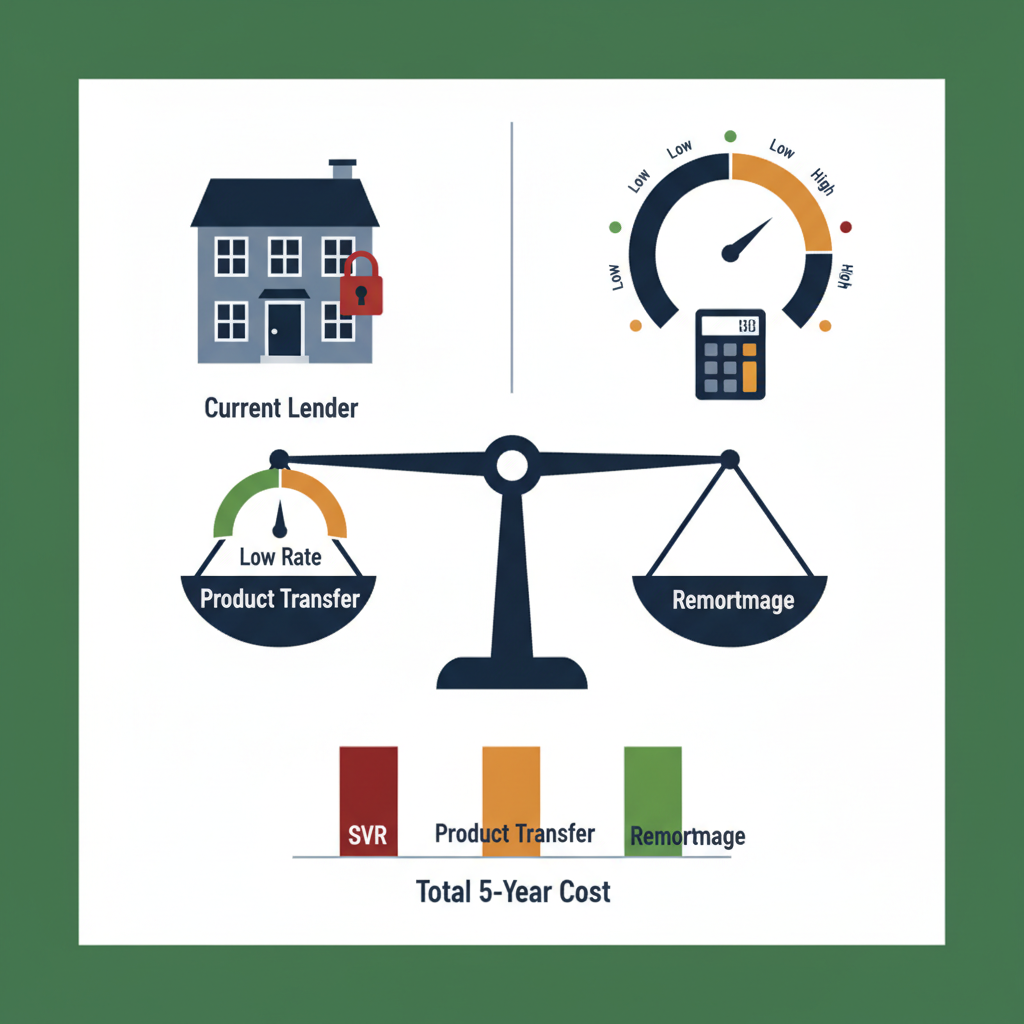
The Single Factor That Decides Everything
The question of Product Transfer or Remortgage: Which Is Better When Your BTL Fix Ends? comes down to one number: the total cost gap between your lender's retention rate and the best available external rate, measured over the full deal period after all fees are deducted. That gap — not the headline rate, not the arrangement fee in isolation — is the only figure that matters.
The worst outcome by some distance is drifting onto your lender's Standard Variable Rate. SVR on BTL typically sits 1.5–2.5% above prevailing fixed rates, costing landlords an extra £3,000–£5,000 per year on a £200,000 mortgage. Paragon's SVR currently stands at 8.60%, which on a £200,000 interest-only loan means monthly interest of £1,433 — before you've compared a single deal.
Both routes — a product transfer and a remortgage — beat the SVR. The question is which beats it by more once you account for every cost.
When a Product Transfer Makes Sense
A product transfer means staying with your existing lender on a new fixed rate. It keeps you with your existing lender on a new rate — fast and paperwork-light. If your lender's rate is competitive, you avoid a full remortgage application and its associated costs.
Product transfers typically have no fees or only a small admin charge. There is no need for a solicitor because you are not changing lender. If you are remortgaging with the same lender, no legal work is required at all, which eliminates this cost entirely.
The affordability check is lighter when you stay with your existing lender — full stress testing is not always reapplied. This matters for landlords whose rental income sits close to the ICR threshold. On a full remortgage, most lenders require rent to cover 125% of stressed interest for basic-rate taxpayers and 145% for higher-rate taxpayers. The standard stress floor rate in 2026 is 5.5%. Even if the actual product rate is 4.5%, the application is assessed as though the rate were 5.5%.
With Barclays, customers rate-switching can secure a new rate up to 90 days before their existing mortgage rate ends — giving you time to compare without being under pressure. Processing typically completes in 2–4 weeks on a product transfer versus 4–8 weeks on a full remortgage.
A product transfer is the stronger choice when: your lender's retention rate is within 0.20% of the market's best; your loan balance is below £100,000; your rental income barely clears the ICR at the stress rate; or the speed of completion is critical.
When a Remortgage Makes Sense
A remortgage gives you access to the whole market. It moves you to a new lender, with more admin but usually a meaningfully lower rate.
If market rates are 0.3% or more cheaper than your product transfer quote, the savings over a five-year term on larger mortgages likely exceed any fee difference. For balances above approximately £100,000, the rate gap typically pays for the switching costs several times over.
Arrangement fees on buy-to-let remortgages currently range from around £999 to £3,999 as a fixed amount, or up to 3–7% of the loan value on percentage-based products. On top of that: a valuation fee typically costs between £150 and £1,500 depending on property value, though many lenders offer free valuations as part of their remortgage packages. Legal conveyancing is required when switching lenders. Expect to pay between £300 and £600 for a straightforward remortgage, though many lenders offer free legal work as an incentive.
A remortgage also unlocks a wider range of structures. Limited-company SPV borrowers and five-year fix takers face the most forgiving affordability stress — 125% ICR — and on a five-year fix some lenders can use the pay rate rather than 5.5%. As of October 2026, most lenders tested two-year fixes at roughly 6–7.5% and five-year fixes at approximately 4.5–6%. Switching lender opens the door to whichever lender's stress test your property passes most comfortably.
Remortgaging also creates the opportunity to restructure — moving from personal name to a limited company SPV, changing repayment type, or releasing equity for further acquisitions — none of which is possible inside a product transfer.
A remortgage is the stronger choice when: your loan balance exceeds £150,000; the rate gap versus your lender's retention offer is 0.30% or more; you want to change structure; or you are trapped by an unfavourable stress test at your current lender.
The Calculation That Decides It
Product Transfer or Remortgage: Which Is Better When Your BTL Fix Ends? The answer is arithmetic, not preference.
Here is the framework. Take your outstanding loan balance. Multiply by the annual rate difference between the product transfer and the remortgage. Multiply by the deal term in years. That gives you the gross interest saving from remortgaging. Subtract the total remortgage costs (arrangement fee plus any legal and valuation fees not waived). The result is your net saving from switching lender.
Example — £200,000 interest-only BTL, 5-year fix
Suppose your lender's product transfer offers 5.45% at 75% LTV. The best external remortgage is available at 5.00% with a £1,999 arrangement fee and free legal and valuation.
- Annual interest, product transfer: £200,000 × 5.45% = £10,900
- Annual interest, remortgage: £200,000 × 5.00% = £10,000
- Annual saving: £900
- Over 5 years: £4,500 gross saving
- Less arrangement fee: £1,999
- Net saving by remortgaging: £2,501
The remortgage wins clearly. But compress that balance to £80,000 on the same rate differential: the gross five-year saving is £1,800, the arrangement fee is £1,999, and the product transfer actually comes out cheaper by £199 before you even count your time and legal work.
Fees in particular skew comparisons heavily. A slightly higher rate with no arrangement fee can sometimes work out cheaper than a lower rate with a £2,000 fee, particularly if your mortgage balance is relatively small or you plan to remortgage again in two years.
Always run the five-year total — interest plus all fees — not the monthly payment in isolation. A 0.45% rate gap on £300,000 over five years is £6,750 gross. After a £1,999 fee, you are still £4,751 better off by switching. The maths on a £90,000 loan tells the opposite story.
One additional feature worth noting from Paragon: from June 2026, all new tracker products benefit from a Track to Fix feature, meaning landlords can switch to a fixed rate at any point during the initial term without incurring an early repayment charge. This gives tracker-holders flexibility that fixed-rate borrowers do not have. If you are on a switch product with ERCs still running, factor those in before making any move — on Paragon's current 2-year switch fixed at 65% LTV (5.20%), ERCs are 3% in year one and 3% in year two.
The number that stops most landlords from doing this analysis is inertia — not fees and not rates. Run the five-year total cost on both options before your fixed rate expires, not after.