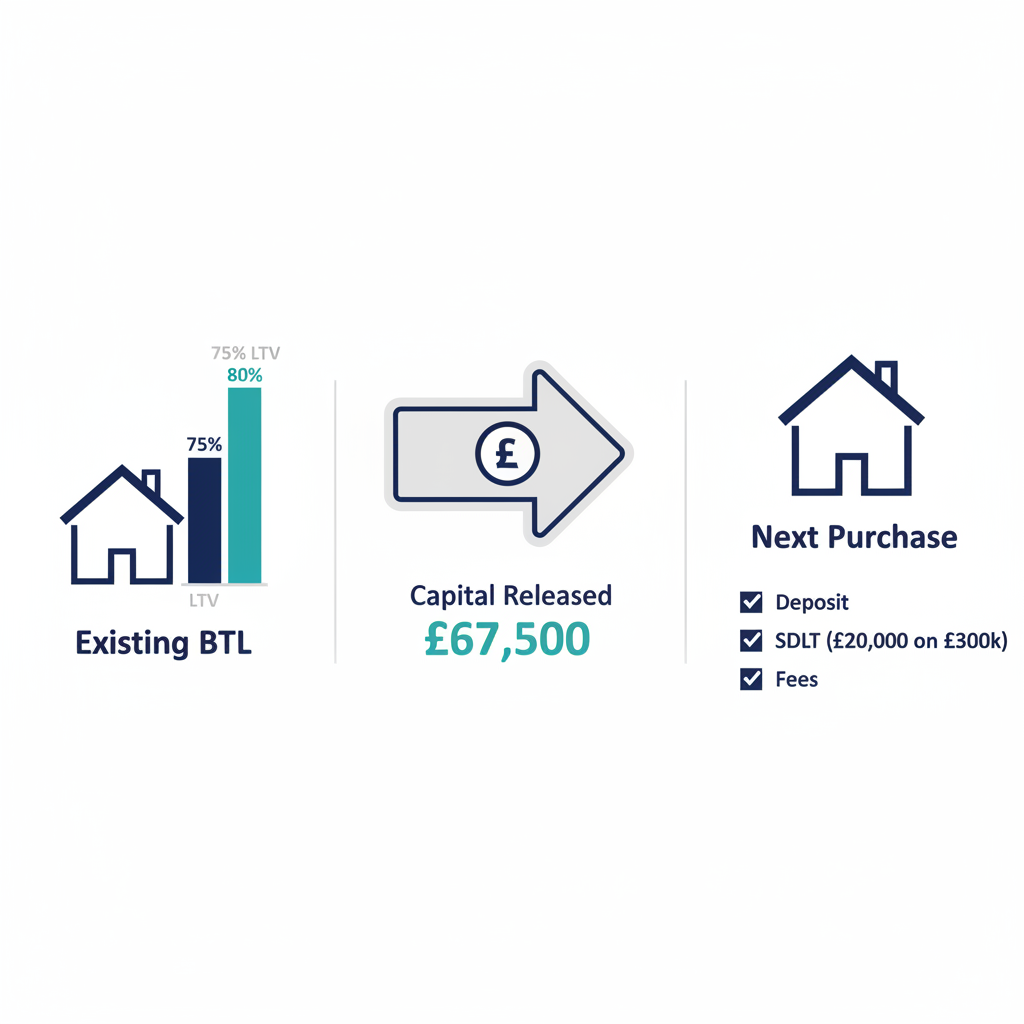
The additional-dwellings SDLT surcharge on a £300,000 buy-to-let purchase is £20,000 — every penny due in cash within 14 days of completion. That single number explains why most landlords who want to buy their next property start by looking at the equity sitting in the one they already own.
What the Numbers Show
Many buy-to-let lenders offer remortgages up to around 70–75% loan-to-value, although exact limits differ between lenders and mortgage products. A small number go further. Most buy-to-let remortgages are capped at a maximum of 75% LTV, meaning you'll need at least 25% equity in the property. A smaller number of lenders will stretch to 80% LTV, though usually with a stricter rental stress test and a smaller pool of products to choose from.
Leeds Building Society's criteria, effective 21 October 2026, illustrates the tiering that operates across the market. Buy-to-let lending up to £500,000 is available to 80% LTV; between £500,001 and £750,000 the cap drops to 75%; and between £750,001 and £1,000,000 it falls to 70%. Aldermore's buy-to-let criteria guide dated 1 July 2026 shows a similar structure: 80% LTV to a maximum loan of £500,000, and 75% LTV to £1m for residential investment properties and £1.5m for HMO and multi-unit freehold.
The rate you pay depends heavily on the LTV band you land in. Aldermore BTL two-year fixed rates now start from 4.11% and five-year fixed rates now start from 5.21%, following increases of up to 0.17% on selected products in October 2026. BM Solutions — Lloyds Banking Group's broker-only buy-to-let lender — updated its personal ownership BTL and let-to-buy range in October 2026, combining 65% and 75% LTV into a single 0–75% band, with rates decreasing by up to 0.07% on two-year fixes and up to 0.04% on five-year rates for landlords with at least 25% equity. BM Solutions also launched a limited-edition five-year fixed remortgage-only product at 75% LTV, at a rate of 5.84%, with a 5% lender fee, one free standard valuation, £250 cashback and no application fee.
Arrangement fees are a material cost on capital-raising remortgages. Products with fees of 3% of the loan are common across BM Solutions and Aldermore's ranges. On a £187,500 loan, a 3% fee is £5,625 — roughly double the headline cost of a £1,500 flat-fee alternative. Always compare total cost over the fixed period, not headline rate alone.
What ICR means for how much you can borrow
The rental stress test is the second ceiling after LTV, and on a capital-raising remortgage it often bites harder than the LTV limit. Most lenders apply a stress rate of approximately 5.5% when calculating affordability, regardless of the actual mortgage rate. Tax status directly affects the ICR requirement — basic rate taxpayers usually need 125% coverage, whereas higher rate taxpayers require 145% coverage.
In practice, individual lenders frequently apply higher ICR thresholds, often 145% for higher-rate taxpayers and 160% to 175% for additional-rate taxpayers, HMO cases and limited companies, with rates varying by lender.
Aldermore's July 2026 criteria confirm a minimum ICR of 140% for individual landlords on single residential investment properties. For two-year fixed and discount products, the stressed rate is the higher of the pay rate plus 2% or 5.5%; for five-year fixed products, it is the higher of the pay rate or 4.0%. That five-year differential matters: qualifying for a five-year fix at 4.0% stress rather than 5.5% can meaningfully increase the maximum loan your rent will support.
BM Solutions requires rent to cover 125% of the stressed interest for basic rate taxpayers and limited companies, or 145% if any applicant is a higher or additional rate taxpayer. The stress rate is the higher of 5.5% or the pay rate plus 2% on products under five years, and the higher of 4.5% or the pay rate plus 0.5% on five-year fixes.
Worked example: releasing a deposit
Take a property valued at £250,000 with an existing mortgage of £120,000 (48% LTV). The maximum loan at 75% LTV is £187,500, releasing around £67,500. Monthly rent of £1,150 is required to clear a 125% ICR at 5.5% stress on the £187,500 loan — that requires circa £1,074 per month, leaving roughly £76 of monthly headroom.
That £67,500 does not go directly to a deposit. Lenders use it for the purchase, but the acquisition costs must be planned in full. SDLT cannot be added to a buy-to-let mortgage: the full bill is due within 14 days of completion, so it must come from cash reserves. On a £200,000 BTL, stamp duty is £11,500. On a £300,000 BTL, it is £20,000. The additional-dwellings surcharge of 5% rose from 3% on 31 October 2024 and applies to the whole purchase price from pound one above £40,000.
What This Means for Landlords
Timing the remortgage correctly is the first practical question. Some remortgagers are still within a fixed-rate tie-in and face Early Repayment Charges. The ERC might be 1–5% of the outstanding mortgage, depending on the deal and how long it has been held. BM Solutions charges 1% ERC on one-year fixes, 2% on two-year fixes, 4% on five-year fixes and 6% on ten-year fixes. On a £200,000 loan, a 4% ERC is £8,000 — which may eliminate a large proportion of the equity released. Check your current mortgage documentation before applying.
A capital-raising remortgage typically takes 4 to 8 weeks from application to funds, assuming a clean file. That timeline matters if you are trying to co-ordinate with a purchase. Most lenders will issue a mortgage offer that is valid for 3 to 6 months, giving reasonable room to find a suitable property after the remortgage completes.
Portfolio landlords — those with four or more mortgaged properties — face an additional layer of underwriting. BM Solutions requires the whole portfolio to cover 145% of the interest at a 5.5% stress rate, an overall LTV no higher than 75%, and minimum income of £30,000. United Trust Bank requires the portfolio ICR to be at least 125% at a stressed rate, providing assurance over mortgage serviceability for highly geared portfolios.
The remortgage process itself involves a fresh valuation, new affordability assessment and legal work. Legal fees on a full remortgage typically run £500–£1,500, and valuation fees £150–£400 — though many remortgage products include a free valuation and assisted legals. Aldermore's current product guide confirms free valuations on purchase, remortgage and incorporation products. Factor these costs when modelling whether the deal stacks up before you apply.
One planning point that catches landlords out: the released capital is not treated as income, so there is no immediate income tax charge on receiving it. However, ongoing mortgage interest only qualifies for a 20% basic-rate tax credit under Section 24, not a full deduction. Higher and additional rate taxpayers borrowing at 5%+ need to model the after-tax cost of the enlarged mortgage carefully before committing.
The sequence that works: value the existing property, calculate the maximum release after ICR stress testing, deduct the remortgage fees and ERCs, then check whether what remains — after SDLT and purchase costs — covers the deposit on the target property. Do that before speaking to any lender.