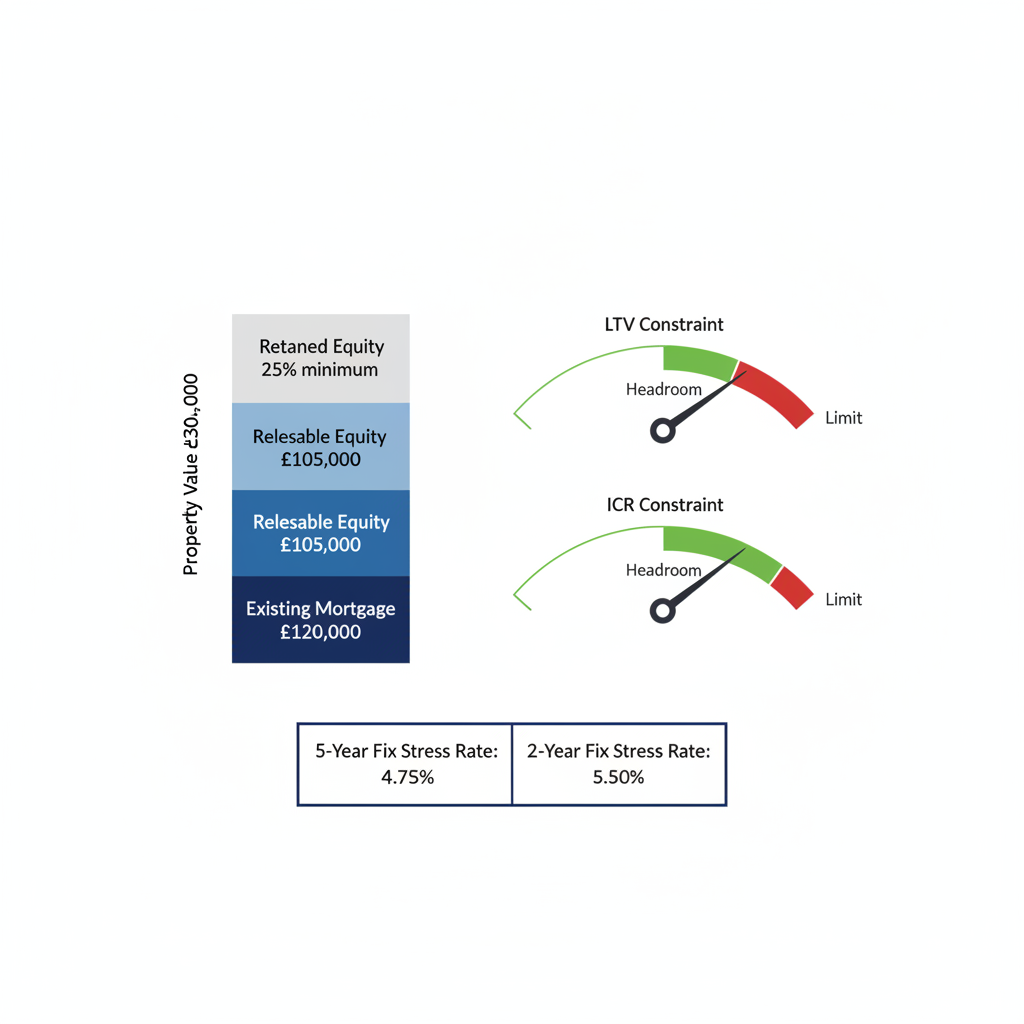
The Single Factor That Decides This
Remortgaging to release equity for your next buy-to-let deposit comes down to one number before anything else: your post-remortgage ICR. Most BTL lenders require an Interest Coverage Ratio of 125% for basic-rate taxpayers and limited companies, and 145% for higher-rate taxpayers. The LTV headroom in your existing property does not matter if the rent cannot clear the stress test on the enlarged loan. Run the ICR calculation first. Everything else is secondary.
Whichever ceiling bites first — LTV headroom or rental cover — sets the real limit on the money you can pull out. Those two constraints interact differently depending on whether you are pulling equity from a BTL you already own or from your residential home via a let-to-buy arrangement. That choice is the structural decision this article addresses.
When Remortgaging a BTL You Already Own Makes Sense
A BTL equity-release remortgage raises capital against your rental property — typically to fund another purchase. Lenders look at ICR, LTV and the purpose of funds. This route works best when the property has grown in value since purchase, leaving LTV well below 75%, and the rent covers the new, larger loan at the lender's stress rate.
Most lenders will allow you to release up to 75% loan-to-value on a buy-to-let property. Some specialist lenders offer borrowing up to 80% or 85% LTV for portfolio landlords or specific property types, such as houses in multiple occupation. On a property worth £300,000 with a £120,000 outstanding balance (40% LTV), remortgaging to 75% LTV gives a new loan of £225,000 — releasing £105,000 gross before costs. That is enough for a 25% deposit on a further £400,000 acquisition.
The stress test on that £225,000 loan is where it can break down. The Mortgage Works stresses a capital-raising remortgage on a 1- or 2-year fix at 5.50% or pay rate plus 2.00% across all LTVs. On a 5-year fix above 65% LTV, the stress rate is 4.50% or pay rate. At 125% ICR and a 4.50% stress rate, the minimum monthly rent to support £225,000 is: £225,000 × 4.50% × 125% ÷ 12 = £1,055/month. Many standard residential lettings in provincial markets clear that threshold comfortably.
The Mortgage Works explicitly accepts capital raising for the deposit or purchase of a buy-to-let property, making it one of the cleaner routes for portfolio growth. Its published criteria include lending up to 80% LTV, no minimum personal income and up to £10 million of buy-to-let borrowing across the Nationwide Group.
For landlords purchasing or remortgaging with capital raising, Accord Mortgages now assesses 5-year-plus products at an ICRR of 4.75% or the product rate plus 0.50%, whichever is higher. For shorter-term products of less than five years, the ICRR remains at 5.5% or the product rate plus 2%. Accord's ICR remains at 125% for basic-rate taxpayers and 145% for higher-rate taxpayers. Fixing for five years specifically to access the lower stress rate is a legitimate strategy when you are close to the ICR ceiling.
Lenders will also require you to have owned the buy-to-let property for at least six months before they will consider a remortgage application. Do not plan a capital-raising remortgage on a property you completed on three months ago.
When Releasing Equity from Your Residential Home Makes Sense
Let-to-buy — converting your home to a BTL, releasing equity, and using the proceeds as a deposit on a new residential purchase — works differently. Most lenders go to 75–85% LTV on a residential remortgage with equity release, so on a £500,000 property with a £200,000 existing mortgage you could typically release £175,000–£225,000, subject to the affordability test on the new payment.
The best rates come at 60% to 75% LTV, so most borrowers release less than the maximum to stay in competitive pricing bands. Releasing to 85% LTV on your home saves the deposit but puts you into a higher residential rate tier — the net cost on the residential side can wipe out much of the saving.
The critical difference is the affordability test. On the residential side, your salary drives the borrowing limit. On the BTL side, it is entirely the rent. Remortgaging your current home onto buy-to-let is assessed in a similar way to a standard buy-to-let mortgage. If your client is remortgaging their current residential property as a buy-to-let with The Mortgage Works, they can apply for their onward residential mortgage with Nationwide for Intermediaries. That joined-up processing matters: simultaneous underwriting cuts completion risk.
This route suits landlords whose residential property carries substantial equity relative to expected rent, and whose next purchase is a primary residence rather than a further investment. If the target is another BTL, the double-BTL route — remortgaging an existing rental and buying again — typically avoids the residential affordability assessment entirely.
The Calculation That Decides It
Run these two figures before you proceed.
Maximum loan by LTV: Property value × 0.75, minus existing balance. That is your gross release ceiling. On a £350,000 BTL with £150,000 outstanding: £262,500 − £150,000 = £112,500 maximum release.
Maximum loan by ICR: Annual rent ÷ (ICR × stress rate). At 125% ICR and a 4.75% stress rate (Accord, 5yr+ capital-raising fix): £18,000 annual rent ÷ (1.25 × 0.0475) = £303,158 maximum loan. At the same rent but on a 2-year fix using TMW's 5.50% stress rate: £18,000 ÷ (1.25 × 0.055) = £261,818 maximum loan. The fix term alone shifts the ceiling by over £40,000 on a £1,500/month rental.
Whichever of the two results is lower is your actual release. Run both numbers before choosing your product term.
Then price the total transaction cost. Total transactional cost on a typical capital-raise BTL remortgage runs to £2,000–£5,500. BTL mortgages typically cost 0.5%–1.5% more than residential deals of the same LTV, with arrangement fees often 1.5%–3% of the loan. On a £200,000 remortgage, a 2% arrangement fee is £4,000. Compare that against a flat-fee product: The Mortgage Works currently offers a remortgage rate of 3.69% with no product fee on a 2-year fix, against higher-fee alternatives. The low-rate/high-fee versus higher-rate/low-fee decision is not obvious — total five-year cost (interest plus fee) is the only honest comparison.
Early repayment charges matter here too. Breaking a 5-year fix carries significant ERCs. A TMW 5-year fixed product carries ERCs of 5% until year one, 4% until year two, 3% until year three, then 1% until expiry. On a £200,000 loan in year two, that is £8,000 to exit — a figure that easily outweighs any rate saving on the new deal.
The calculation that decides it is not the rate. It is: gross release minus transaction costs minus ERC (if any), compared against the yield and growth case on the property you are buying. If the net release clears 25% of the target property's value and the yield covers the uplifted debt service with at least 125% headroom, you have your answer.