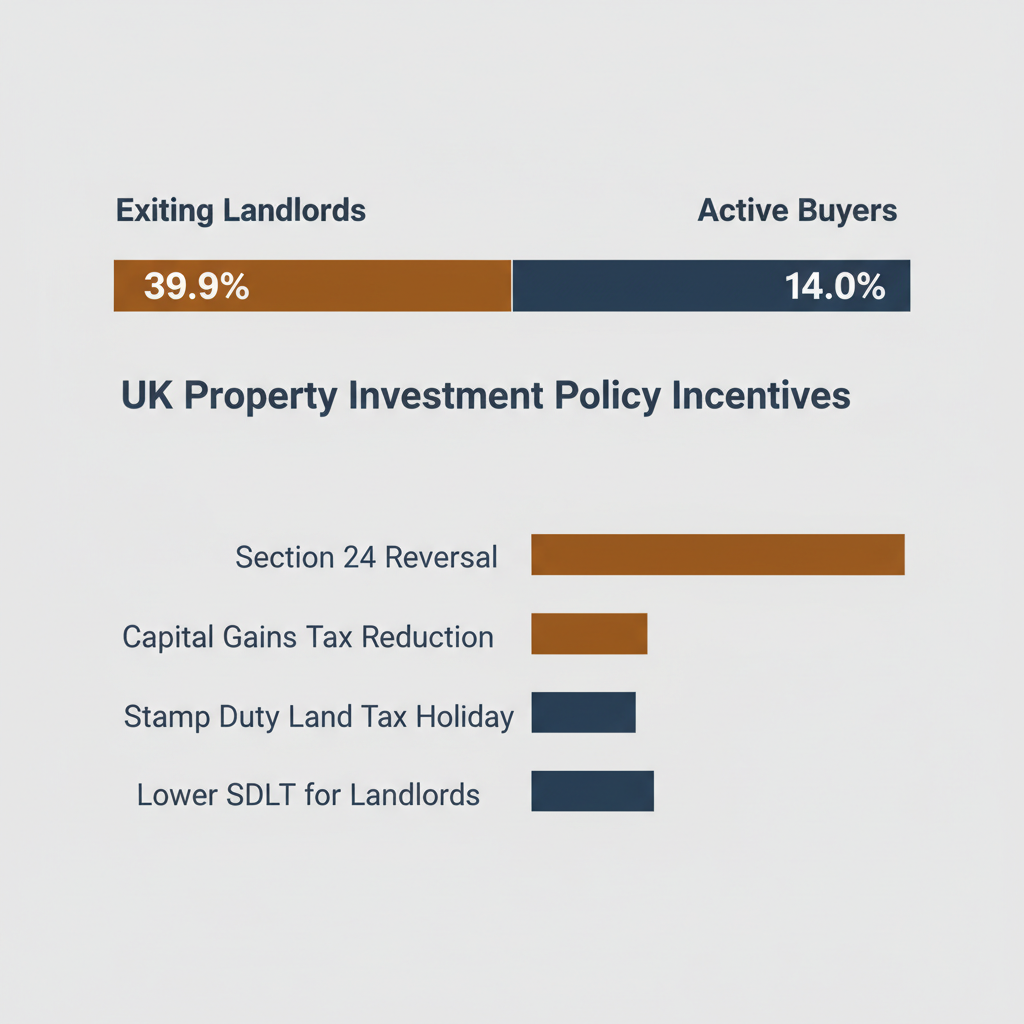
A figure of 39.9% sits at the centre of the most striking finding from the Q3 2026 Landlord Sentiment Survey: that is the share of landlords planning to leave the sector entirely who rank repeal of the Renters' Rights Act as the incentive most likely to bring them back into buying. Run it against the equivalent figure for landlords who are still actively purchasing and the gap is stark — just 14.0% of that group put repeal first. Nearly half of active buyers, 49.5%, rank it last of the four options on the list.
The survey ran from 1 to 8 October 2026. A total of 1,654 landlords took part, and 1,472 completed every page.
What the Numbers Show
The four incentives tested — reversal of Section 24, falling interest rates, lower Stamp Duty Land Tax and repeal of the Renters' Rights Act — have appeared in all three quarterly surveys this year, so the trend is genuinely comparable. Across the full base of 1,468 landlords who answered the ranking question, 29.9% put repeal first. That places it level with Section 24 reversal on 29.6%. But repeal is also ranked last by 36.0% of respondents, a higher "bottom rank" share than any other factor. Lower SDLT is the next most likely to sit at the bottom, at 27.6%. Section 24 reversal, by contrast, is ranked last by only 13.7%.
That combination — high share first, even higher share last — explains why repeal comes third of four on a weighted score where 4 is the maximum. Section 24 reversal scores 2.82, falling interest rates 2.58, repeal 2.40, and lower SDLT 2.21. No other incentive on the list splits landlords this cleanly.
The direction of travel is worth noting. The share ranking repeal first has been broadly flat across the three surveys: 31.1% in Q1 (base 2,190), 30.8% in Q2 (base 2,096) and 29.9% in Q3. The share ranking it last, however, has moved in one direction — 32.1%, then 34.7%, now 36.0%. Its weighted score has slipped from 2.48 to 2.44 to 2.40. Small moves, but consistent.
The pattern by portfolio size is just as clear. Among landlords with three or fewer properties, 36.6% rank repeal first (base 489). Among those with four or five properties that figure is 29.3% (base 232), then 25.6% for those with six to ten (base 316), and 24.9% for those with 11 or more (base 358). Smaller portfolios, greater concern. This held in Q2 as well.
Geography also shapes the picture. Among landlords who own only in England, 31.3% rank repeal first (base 1,287). Among those whose portfolios are entirely in Scotland, Wales or Northern Ireland — where most of the Act does not apply — only 16.7% rank it first (base 72), and 48.6% put it last.
What This Means for Landlords
Start with the exiting landlords. Among those planning to leave the sector completely over the next three years, 39.9% rank repeal as their top incentive and only 24.9% rank it last (base 361). Compare that with landlords planning to stay at the same level, where 25.5% rank it first and 41.5% rank it last (base 400). The gap between leavers and buyers held in Q2 as well: 39.6% of would-be leavers ranked repeal first (base 568) versus 15.1% of would-be buyers (base 199).
This divergence matters practically. Active buyers are concentrating on the cost of borrowing and the cost of purchase. The Act, for them, is already factored in. Repeal would not, on this evidence, unlock significant new investment from landlords already writing offers. What it might do is slow the exit of landlords currently heading for the door — and those landlords are disproportionately the smaller ones.
Two concerns sit directly behind the repeal argument. Difficulty removing tenants who do not pay or who cause damage was cited as a reason to sell by 59.8% of respondents (base 1,486). Selective and additional licensing and council enforcement came third at 53.4%, behind the higher income tax rates on rental income due from April 2027 at 59.7%. These are multi-select responses, so totals exceed 100%. Nearly three in four landlords — 73.7% — chose at least one of the two Act-related concerns, and 39.6% chose both.
The split by plans is consistent. Among landlords planning to exit, 65.4% cite difficulty removing tenants and 61.0% cite licensing (base 367). Among those planning to buy, those figures fall to 43.2% and 42.1% respectively (base 95). Landlords who rank repeal first as an incentive to buy are also the most likely to name both concerns: 72.7% cite difficulty removing tenants and 66.9% cite licensing (base 414). Among those who rank repeal last, it is 48.9% and 43.0% (base 481).
Licensing carries a specific geography. Landlords with property in London are the most likely to cite it as a reason to sell: 61.8% do so (base 356), compared with 52.0% of landlords who own elsewhere in England but not in London (base 1,040). In Scotland the figure is 43.5% (base 69) and in Wales 40.3% (base 77). Licensing as a concern also scales with portfolio size: 43.8% of landlords with no properties or one cite it (base 185), rising to 62.6% of those with 21 or more (base 171).
When landlords were asked to rank six factors in their decision to sell, the Renters' Rights Act came third overall, with a weighted score of 3.77 out of 6 (base 1,499). Among those planning to exit completely, it came first — scoring 4.36 (base 379) — with 40.4% placing it at the top, up from 34.7% in Q2 (base 568). Among those planning to stay the same or buy, it ranked fourth.
In open responses, about one in five landlords — 19.1%, or 267 of 1,395 — raised the Act, possession or tenants' rights as their single biggest current issue, and 12.0% named the Act directly. Asked what would persuade them to stay or expand, 13.7% of respondents (180 of 1,314) called for repeal, amendment or restoration of Section 21.
The themes running through those open answers are possession risk, concern that any rent review will be challenged routinely, anxiety about large fines for minor administrative errors, and the accumulating cost of licensing and compliance fees. A notable share asked not for outright repeal but for targeted amendments — a defined period to remedy errors before penalties apply, or a relaxation of restrictions on re-letting after a failed sale.
One demographic wrinkle is worth flagging. Among landlords under 55, the gap between leavers and those staying put disappears: 28.0% of under-55s planning to exit rank repeal first (base 50), against 28.1% of those planning to stay the same (base 64). The divide between leavers and remainers is driven almost entirely by landlords aged 55 and over.
HMO landlords, whose properties sit under some of the heaviest licensing requirements, are not significantly more likely than other landlords to rank repeal first: 26.9% do so (base 212), against 28.9% of landlords with houses (base 987). Their concern about licensing is slightly elevated — 58.1% cite it as a reason to sell (base 210) versus 52.8% of house landlords (base 1,021) — but within the margin of error.
The Q4 survey, due at the end of December 2026, will be the next meaningful data point. Three consistent quarters establish a pattern; a fourth will show whether the slow drift towards "ranked last" for repeal is settling into the market or beginning to reverse.