Paragon sets a minimum combined gross annual income of £25,000 for individuals and limited companies with three or fewer mortgaged buy-to-let properties. That single threshold, lifted directly from the lender's current intermediary criteria, illustrates the central truth of the self-employed buy-to-let mortgage: the rent still drives the loan size, but your personal income is the entry ticket. Get below the floor, and the application stops before it starts.
What the Numbers Show
Residential mortgages are capped by your income. Buy-to-let mortgages are capped by the property's rent, because the rent is what repays the loan. Most lenders require rental income to be at least 125% to 145% of the interest repayments for a buy-to-let mortgage. That ICR calculation is the primary affordability test — your salary, dividends or retained profit sit behind it.
Most lenders have a minimum income criteria of £20,000, £25,000 or £30,000. A handful have no published floor at all. Leeds Building Society, for instance, states no minimum income requirement for BTL applicants, though even lenders with no set minimum income still want to see some level of income — even £5,000 to £10,000 a year from employment, self-employment or pension — to reassure them that you are not completely reliant on rent for day-to-day living costs.
What This Means for Landlords
Can Self-Employed People Get a Buy to Let Mortgage?
Yes — and it is often less complicated than a residential application, because the loan is led by rental maths rather than income multiples. For many standard buy-to-let mortgages, the primary assessment is the rental income from the property. Self-employment typically has less impact on BTL applications than on residential ones, though some lenders do assess personal income alongside rental income. Where it matters is in meeting a lender's minimum income gate, and in top-slicing scenarios where the rent falls short of covering the stressed ICR.
Minimum Income Requirements, and Lenders With No Minimum
The most common thresholds you will encounter on a mainstream lender's product guide are £20,000, £25,000 and £30,000 gross per annum. Paragon's portfolio lending guide sets £25,000 as the combined minimum for limited companies with three or fewer mortgaged properties, but where a landlord or limited company has four or more mortgaged properties and cannot meet that figure, Paragon will consider applications on a case-by-case basis where the applicant can demonstrate sufficient income to cover existing expenditure.
Paragon's acceptable income sources include gross employment income, taxable self-employed income, and occupational, private or state pension. State benefits and investment income are not considered for income purposes.
Not every lender enforces a hard floor. If you are applying jointly, most lenders only require one applicant to meet the minimum income rule — so if one applicant earns £30,000 and the other has little or no income, the case can still work.
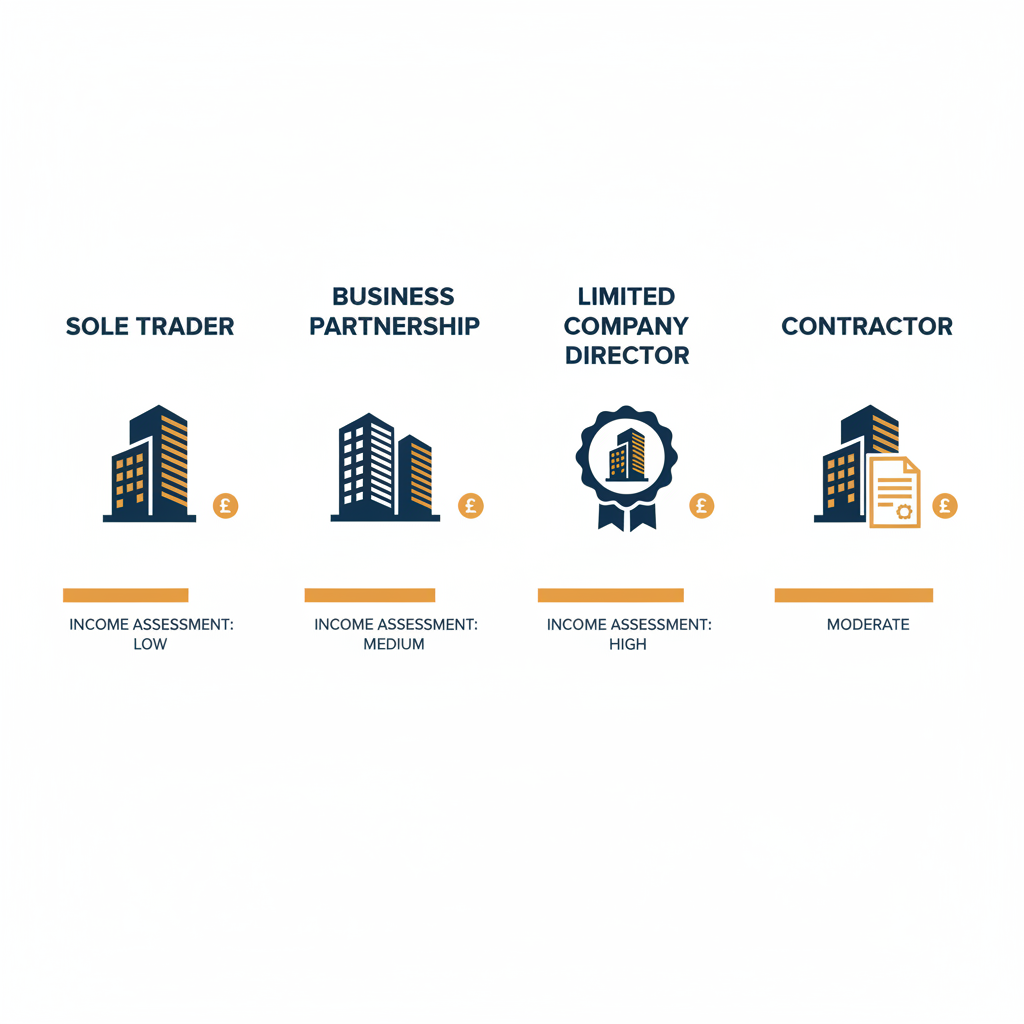
How Your Income Is Assessed: Sole Trader vs Partner vs Director vs Contractor
This is where the self-employed buy-to-let mortgage gets granular. The same £30,000 profit can look very different to a lender depending on how it reaches your tax return.
Sole traders with a Unique Taxpayer Reference filing Self Assessment, partners in a partnership or LLP, and limited company directors holding 20% or more of the company shares are all treated as self-employed. Below 20%, most lenders treat you as a PAYE employee of the company. Contractors working through a personal service company or umbrella are also classed as self-employed, even if the underlying contract is single-client.
Sole traders are assessed on the net trading profit reported on the SA302 — turnover minus expenses minus capital allowances. For self-employed applicants in a partnership or LLP, Accord (part of Yorkshire Building Society) uses the average of the last two years' net profits or the latest year, whichever is lower.
For directors, the split between salary-plus-dividends and salary-plus-retained-profit is critical. Limited company directors are assessed on salary plus dividends, or on salary plus retained profits, at lenders that allow it — including Halifax, Clydesdale, Kensington, Vida and Newcastle BS. If you take a low salary and retain most of your profit in the company for tax efficiency, the salary-plus-dividends figure can dramatically understate your real earnings. Finding a lender that will use your share of net profit before tax can unlock significantly higher qualifying income with no change to your actual finances.
Contractors assessed on a day-rate route need a current contract with at least three months still to run, a confirmed contract day rate in writing, and twelve months of total contracting history (Halifax may go to six months).
Self-employed and not sure how a lender will read your accounts? Send me your last two years' figures and I'll tell you which lenders will use them in your favour.
[Get my income assessed]
One Year's Accounts or Less: What's Possible
Two years of accounts is the market standard. Nationwide requires two years of trading history; Santander requires three years as standard with two years as the minimum. But two years is not the only option.
Kensington accepts one year's trading history and assesses on the latest year's accounts. Saffron Building Society accepts a minimum of 12 months' accounts plus a projection of future earnings. Halifax asks for evidence of the last two years' tax calculations and tax year overviews or finalised accounts, but states that where a customer has been trading for less than two years, a minimum of one year's accounts will be considered.
The cases that work best on one year are those where you did the same work as an employee before going self-employed and where the first year's accounts are clean and filed. Expect the lender to look harder at your projections and your business bank statements.
If you only have one year's trading record, some lenders will consider your application if, in addition to a set of certified accounts or your SA302 for that year, you can provide a suitable financial projection for at least the next twelve months from a qualified accountant.
Proving Income: SA302s, Tax Year Overviews, Accountant's Certificates and Company Accounts
The document stack a lender expects depends on your trading structure. For sole traders and partners, the core requirement is consistent: where a business has traded for at least two years, the application should be supported by accounts or a fully completed accountant's certificate for the last two years, or the two years' tax calculations (SA302s) and the tax year overviews.
Paragon's portfolio lending guide requires SA302 tax calculations (or equivalent), the Tax Year Overview, and the full SA100 tax return, all covering the last two years.
For limited company directors, full company accounts certified by a qualified accountant are the standard. Limited company directors are often classified as self-employed, requiring detailed financial documentation including tax returns and business accounts. Where a lender uses retained profit, they will want to see the company's profit-and-loss account and balance sheet, not just the SA302.
When Your Personal Income Matters Most: Top Slicing, First-Time Landlords and Portfolio Landlords
Top slicing is the mechanism that brings your personal income directly into a BTL affordability calculation. Top slicing applies when the rent from a property is not enough to justify the loan needed, allowing the lender to use personal income to top up the affordability assessment and meet stress tests.
Accord's top-slicing criteria require a minimum income (not from rental properties) of £40,000 for experienced landlords, rising to £75,000 for first-time landlords. The ICR based on rental income alone must be equal to or greater than 100% but less than the minimum required ICR threshold, and maximum LTV is capped at 75%.
If the rent falls a little short of the cover test, some lenders let surplus personal income make up the gap. Self-employed income needs to be well evidenced for this to work.
First-time landlords face stricter personal income scrutiny across the market. If you are a first-time buyer purchasing a BTL, affordability is often assessed more like a residential mortgage, typically capped at 4.5 to 5 times personal income. Portfolio landlords — those with four or more mortgaged buy-to-let properties — also come under additional review. Some lenders expect higher personal income from portfolio landlords to reflect the greater financial commitment.
Buying Through a Limited Company When You're Already a Director
If you already run a trading limited company, the most important structural decision is to keep the property vehicle completely separate. An SPV (Special Purpose Vehicle) is a UK limited company set up specifically to hold buy-to-let property. The SPV's SIC code must sit within the approved property-investment codes (68209 or 68100). Trading SIC codes are usually rejected.
Personal guarantees are required from all directors and shareholders. If the company cannot pay, the debt comes back to you personally — the SPV's limited liability is, for the mortgage, effectively unlimited. This is the least-understood fact about the structure.
Lenders assess the director's personal income as the individual standing behind the SPV, not the trading company's turnover. Lenders need to see directors can stand behind the company. Most want £25,000 or more in personal income (from salary, dividends, employment or pension). A few will lend without personal income if rental cover is strong.
The self-employed buy-to-let mortgage framework does not demand a high salary — it demands a provable one. Clean accounts, correctly structured documentation and the right lender for your trading structure will take you further than chasing the headline rate on a product that was never designed for your income type.