What Gets This Wrong Costs Real Money
Apply for a standard buy-to-let mortgage on a property where you own both the ground-floor retail unit and the flat above, and most residential lenders will decline the application outright. If you own both the flat and the commercial unit below, the property falls into mixed-use territory and most residential lenders will not consider it — you need a semi-commercial or commercial mortgage instead. The restart costs are not trivial. Budget for a lender arrangement fee of 1–2% of the loan amount, a RICS valuation fee of £1,500–£5,000 or more depending on the property, and combined legal fees of £2,000–£6,000 for a straightforward transaction. Pay those twice through a wrong-lender detour, and you have lost money before the mortgage even starts.
Semi-commercial and mixed-use mortgages: flats above shops explained is not just a niche topic — it is the classification question that determines which lender, which rate tier, and which income assessment method applies to an increasingly common portfolio property type.
What Is a Semi-Commercial Mortgage?
A semi-commercial mortgage finances a mixed-use property combining commercial and residential elements on a single title. The classic example is a retail shop on the ground floor with one or more residential flats directly above, all held under one freehold or long-leasehold title. The key word is single title: the moment both uses are registered together, the property steps outside standard residential BTL underwriting.
If you are simply buying the flat portion above an independently operated commercial unit — on a separate leasehold title — a standard residential mortgage is usually available. The distinction matters enormously for your choice of lender and the rate you pay.
Semi-commercial properties where the residential split is more than 50% by value now qualify for lower semi-commercial pricing at InterBay — previously this threshold was set at 55%. That single percentage shift opens access to meaningfully better rates for properties with a dominant residential element.
How It Works in Practice
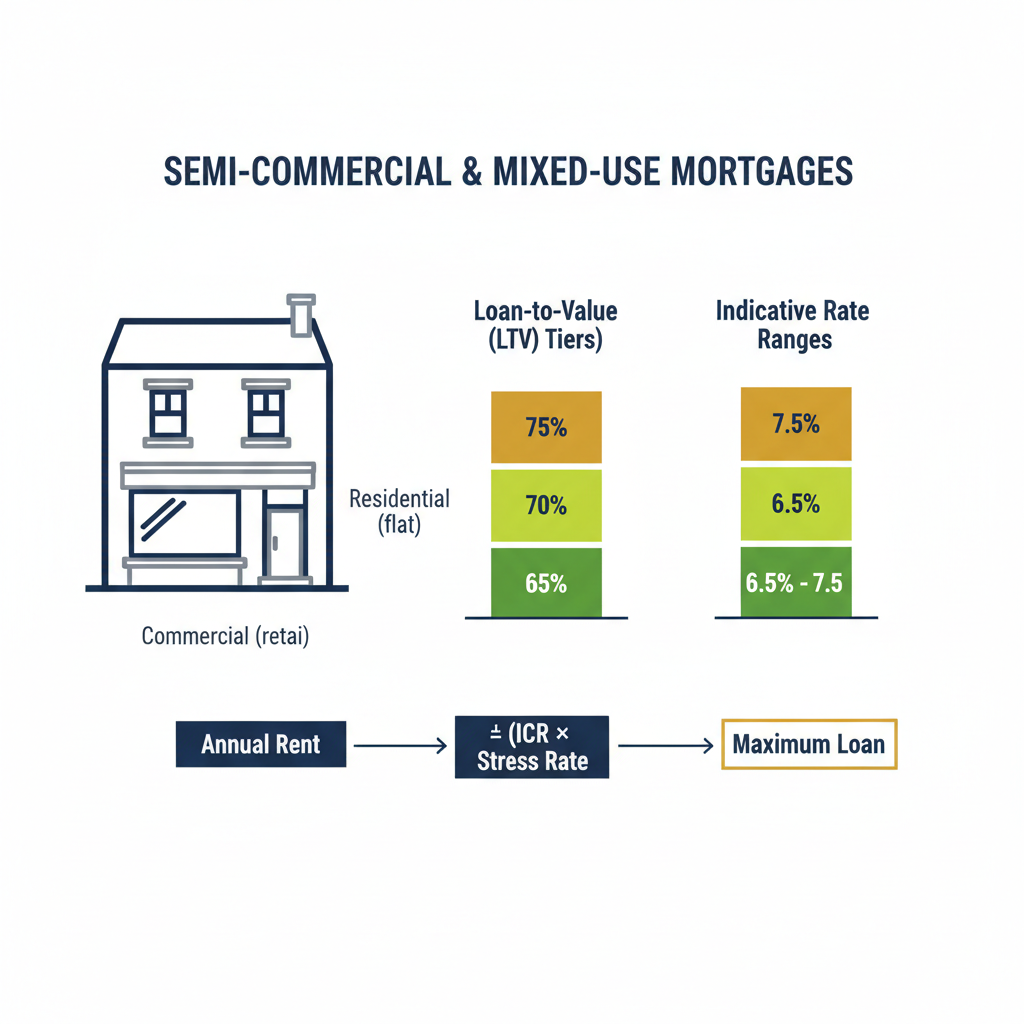
Lenders run two parallel assessments on a semi-commercial and mixed-use mortgages: flats above shops case. First, they look at LTV against the blended property value. Most lenders apply a blended LTV to the total property value rather than splitting the residential and commercial elements separately. Most lenders offer up to 75% LTV on semi-commercial property. Some will go to 75% only where the residential element is dominant and the rental income comfortably covers the mortgage. Properties with a larger commercial element or weaker tenant covenants may be capped at 65% to 70%.
Second, they run an interest coverage ratio (ICR) test across both income streams. For limited company borrowers, most lenders require the annual gross rent to cover the notional interest cost at 125%. For personal borrowers, the cover requirement rises to 140%. The notional rate is typically 8% regardless of the actual rate on offer, or the actual fixed rate if borrowing on a five-year or longer fixed term with some lenders.
A worked example makes this concrete. Take a shop with a flat above in Bristol: residential rent £1,500/month, commercial rent £2,667/month, total £4,167/month or £50,004/year, property value £500,000, LTV cap 75% = £375,000. For a limited company on a variable rate, with an 8% notional rate and 125% ICR, the income-supported loan calculates at £50,004 ÷ (1.25 × 0.08) = £500,040. The LTV cap of £375,000 is the binding constraint, so the maximum loan is £375,000.
On that £375,000 loan at InterBay — one of the most active semi-commercial lenders in the market — a 2-year fixed at 65% LTV is available with a starting rate of 6.49% (with a 3% arrangement fee) or 7.49% (with a 1% arrangement fee), a minimum loan of £125,000 up to £250,000 in the smaller tier, and a reversion rate of BBR + 4.00%. The early repayment charge on a 5-year fixed runs 4%, 3%, 3%, 3%, 3% across the fixed term. On a 2-year fixed, ERCs are 4% and 3% for years one and two respectively.
InterBay now lends up to 75% of market value rather than defaulting to the lower of market value or vacant possession value — provided the loan does not exceed 85% of vacant possession value and the valuer confirms a maximum 12-month letting and sale period.
The commercial element needs its own evidencing. For investor deals at InterBay, the property must be let to a third party with a lease in place with at least 12 months to run and rental payments up to date. Where a property is income-producing at origination and this can be validated, the minimum lease period requirements have been removed, including the previous requirement for a 60-month remaining lease term at loan expiry. That is a material loosening for landlords buying properties where the commercial tenant is mid-lease.
Rates across the market currently sit at 6% to 8.5% per annum for semi-commercial, with owner-occupier rates from around 5.5% per annum as at October 2026. Properties at the lower end of that range — typically 5.5% to 6.5% — have a dominant residential element, strong tenant covenants, established rental income, and an LTV below 65%. At the upper end, 7% to 8%, you find larger commercial elements, short commercial lease terms remaining, first-time commercial investors, or LTVs approaching 75%.
The valuation itself is a specialist exercise. The value of the property is determined through a specialist valuation that assesses both the commercial and residential elements separately. Property value on semi-commercial properties can be complex because different valuation methods apply to each portion. Commercial RICS valuations cost significantly more than residential ones, typically £1,500 to £5,000, and can exceed that on mixed-use or complex properties.
Common Mistakes
Applying to a residential BTL lender first. Two flats can have the same value, floor area and borrower profile yet receive completely different mortgage decisions because one sits above an accountant's office and the other above a late-night takeaway. For lenders, the commercial premises below form part of the security assessment. Apply to the wrong lender type and you burn a valuation fee and weeks of processing time.
Underestimating the impact of commercial use type. Lender criteria for flats above commercial typically focus on the type of commercial use below. A flat above an office, retail shop, or hairdresser is generally viewed favourably. A flat above a takeaway, pub, or nightclub may face stricter assessment due to noise, odour, and fire risk concerns. Flats above low-risk commercial uses may require deposits of 10–15%, while those above hot food takeaways, late-night venues, or bookmakers typically require 20–25% or more.
Missing the separate-access requirement. Most lenders require private access to the flat, not through the shop. They will also check fire separation and building layout compliance. A shared entrance with the retail unit is a frequent cause of restriction or decline.
Ignoring the commercial lease length. A short commercial lease is a risk flag. A lender may restrict the LTV to 70% or require evidence of renewal negotiations. On a £500,000 property, that LTV reduction from 75% to 70% cuts the available loan by £25,000.
Focusing only on the headline rate. Arrangement fees of 1% to 2% are common in the semi-commercial market, so your true cost is rate plus fees, valuation and legal fees, not rate alone. A lender offering 6.25% with a 2% arrangement fee and extensive due diligence requirements may cost more in total than a lender offering 6.5% with a 1% arrangement fee and a streamlined valuation process. Run the all-in comparison before choosing a product.