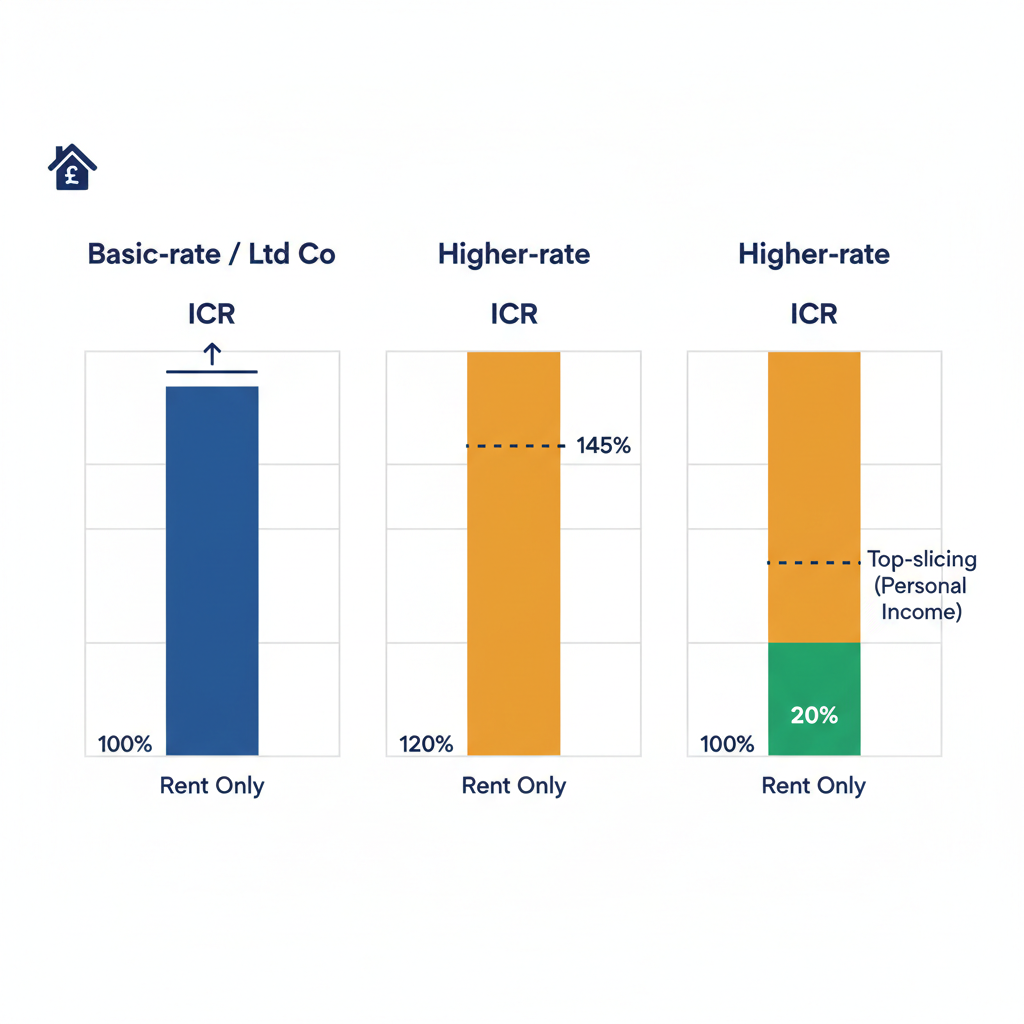
A higher-rate taxpayer buying with a 75% LTV mortgage on a £250,000 property needs £1,246 a month in rent just to pass a standard lender's stress test. If the property lets for £1,100, the application fails on rental cover alone — before the lender has even looked at the borrower's salary, savings or track record. That is the problem Top Slicing Buy-to-Let is designed to solve.
What the Numbers Show
Traditionally, buy-to-let mortgage affordability has been based purely on rental income. Lenders use an Interest Coverage Ratio (ICR) to determine how much you can borrow, ensuring rent comfortably covers the mortgage payments — usually by 125% to 145%.
Higher and additional-rate taxpayers face a higher ICR requirement, often 145%, compared to basic-rate taxpayers who are typically assessed at 125%. The stress rate applied to that calculation — the notional interest rate lenders use in the test rather than the rate you actually pay — is typically 5.5% on two-year fixed products and trackers. The standard stress rate for two-year fixed products and trackers is 5.5%, which has been the PRA-recommended floor since 2017. On five-year fixed products, lenders are permitted to stress at the pay rate of the product instead, which gives meaningfully more borrowing capacity.
The maximum loan formula is: Maximum loan = (annual rent) ÷ (stress rate × ICR).
Working through the illustrative example in this article: a £250,000 purchase at 75% LTV requires a loan of £187,500. For a higher-rate taxpayer on a two-year fix, the formula is £187,500 × 5.5% × 145% ÷ 12, which produces a minimum monthly rent requirement of approximately £1,246. At £1,100 a month, the rent supports a loan of only around £165,500 — a shortfall of roughly £22,000 against the loan needed. These figures are illustrative only; actual outcomes depend on the lender's specific criteria and your circumstances.
That £22,000 gap is what Top Slicing Buy-to-Let addresses. Top slicing allows borrowers to use their surplus disposable earned income to top up a rental shortfall where the income generated by the property is insufficient to meet the minimum rental cover requirements. The lender does not simply add your salary to the rent. Rather than rejecting the application outright, the lender looks at whether your surplus personal income, after your own living costs and existing commitments, is enough to cover the gap.
What Lenders Actually Check
Some lenders apply the ICR strictly and will not consider personal income at all, while others allow top slicing but only after a full affordability assessment of your outgoings, other debts and committed expenditure — not just a quick glance at your payslip.
Minimum income thresholds vary significantly. Personal income tests for top slicing typically require a minimum gross income, commonly £25,000–£50,000, evidence of the affordability of the personal contribution, and an LTI-style assessment of total personal debt service. Some lenders sit at the lower end: Bank of Ireland requires a minimum household income of £40,000. At the other end, BM Solutions requires income of at least £100,000 (first two applicants). Accord offers top slicing with minimum non-rental income of £40,000 for experienced landlords or £75,000 for first-time landlords. Some lenders do not allow top slicing for first-time landlord purchases at all, restricting it to portfolio landlords.
Both employed and self-employed income is considered, but lenders will want to verify it. Employed applicants typically need recent payslips and a P60; self-employed applicants will usually need two to three years of accounts or SA302s. Income must be paid and contracted in sterling and be subject to UK tax and National Insurance contributions — at least at lenders such as Bank of Ireland.
Lenders allow the borrower to use surplus personal income to support the rental coverage gap, effectively topping up the rental income where ICR falls slightly short. Top slicing requires the borrower to evidence that surplus income separately. Existing mortgage commitments, credit card balances, loan repayments and household outgoings all reduce the surplus available. A landlord earning £70,000 with a large residential mortgage and several other buy-to-let properties may have far less surplus than headline salary suggests.
What This Means for Landlords
Top slicing is particularly relevant in London and the South East, where rental yields rarely clear the 145% test for higher-rate taxpayers at common loan-to-values. A gross yield of 4–5% in a prime location simply does not produce the rent-to-interest ratio required at a standard 5.5% stress rate and 145% ICR. A higher-earning landlord who is willing to demonstrate personal disposable income to plug the rental gap can qualify for a BTL in a low-yield location.
The risk is that you are committing personal income to service a property mortgage. Utilising top slicing on variable-rate mortgages introduces intense personal financial exposure, as base rate rises could force the investor to physically subsidise the mortgage from their salary. On a fixed-rate deal that risk is contained for the fix term, but it must be confronted at remortgage. The question to ask yourself is whether you would be comfortable covering the shortfall from salary for two or five years if the property sat empty for a quarter or the rent had to be reduced.
Top slicing also makes less sense if the yield shortfall is not marginal. Where the rent covers 100% of the stressed interest but not the full 125% or 145% ICR, the gap is small and personal income can bridge it without putting excessive strain on your finances. Where the rent covers only 70% or 80% of the stressed interest, the monthly personal contribution would be substantial and lenders are unlikely to accept it in any case.
Before concluding that top slicing is the answer, consider three alternatives. A larger deposit reduces the loan and therefore the minimum rent required; on a 65% LTV the stress test produces a meaningfully smaller rent hurdle than at 75%. A five-year fixed rate allows lenders to stress at the product rate rather than 5.5%, which on current pricing can lift maximum borrowing by 10–15%. Or, higher-rate taxpayers buying personally are typically stressed at 145% of the mortgage payment, while limited company applications are typically stressed at 125% — the same rent supports meaningfully more borrowing in a company structure. Company rates run approximately 0.2–0.5% above personal-name BTL products, but the lower ICR can more than offset that premium.
How a broker approaches this is straightforward in principle but detailed in practice. Lenders that offer top slicing will use surplus personal income to cover a rent shortfall — they check your income, outgoings and other debts first. Many lenders do not offer it, so the choice of lender matters. A broker will run the rental calculation first to establish the size of the shortfall, then identify which lenders both allow top slicing and have an income threshold your earnings meet, and then package the case with full income and expenditure evidence so the underwriter can clearly see the surplus. Brokers must gather detailed income and expenditure data to evidence top slicing eligibility.
Lending criteria change and are entirely dependent on individual circumstances. No article can confirm eligibility or guarantee a borrowing amount — a full assessment of your income, expenditure, existing portfolio and the specific property is required before any conclusion can be drawn.