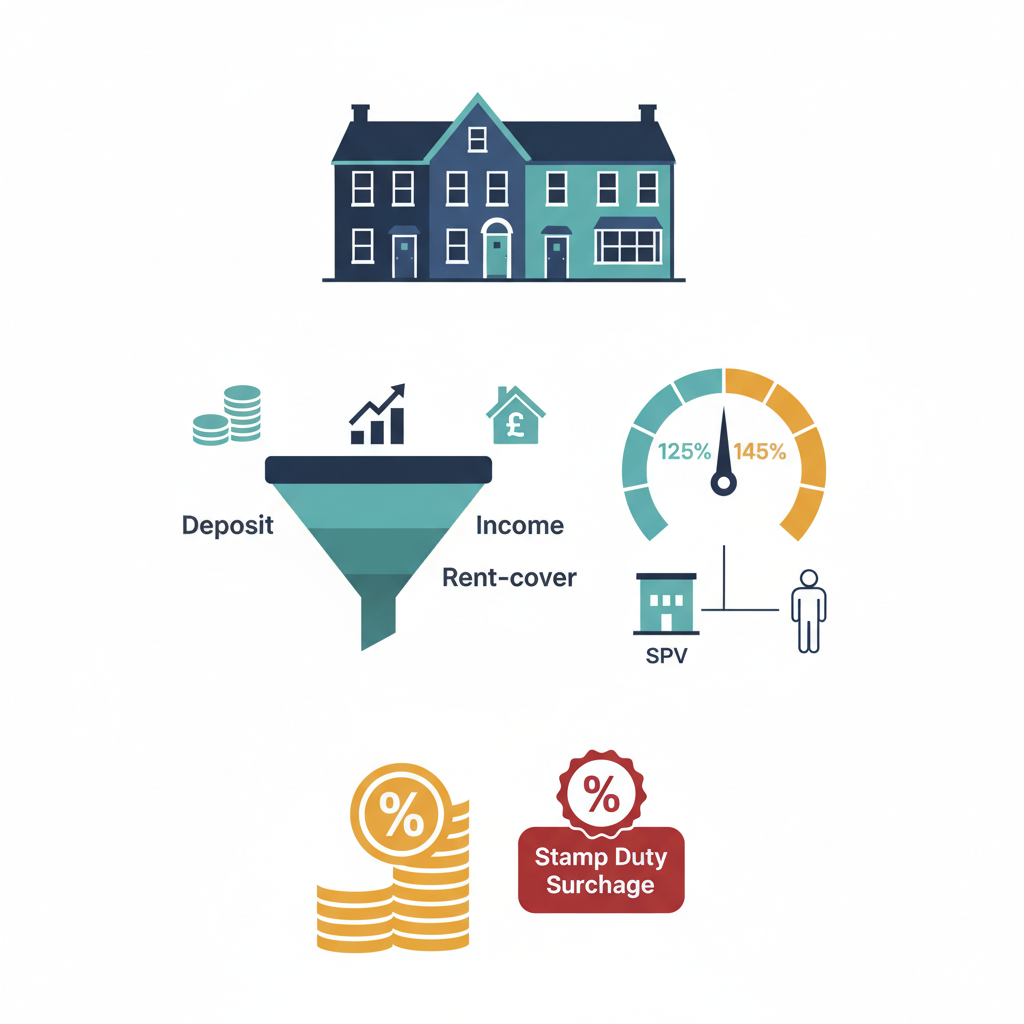
The Short Answer: Yes, But the Rules Are Tighter
You can get a buy-to-let mortgage as a first-time landlord, but expect to be tested on four fronts: a minimum personal income (commonly around £25,000 a year), a 25% deposit — with some lenders accepting 20% at higher rates — the rental cover (ICR) test, and a property whose rent comfortably services the loan on its own. The panel of lenders willing to work with first-time landlords is narrower than the full buy-to-let market, and the terms they offer tend to sit at the more conservative end of each lender's range. That gap closes quickly once you have a year of letting behind you.
What the Numbers Show
The Owner-Occupier Rule
The most common first-time landlord criterion is that you already own your own home. Some lenders only accept applicants who are owner-occupiers — that means you own the property you live in and have been living in it for a minimum of six months. Aldermore's current criteria guide, for instance, requires applicants to have been an owner-occupier for 12 months and caps first-time landlord loans at 75% LTV and £500,000, with a minimum applicant age of 25.
If you rent your own home — sometimes called a "rent-to-let" or "first-time buyer landlord" scenario — the pool tightens further. The Mortgage Works will consider a first-time buyer if they are accompanied by a current homeowner or experienced landlord. A handful of specialist lenders take a broader view, but expect more scrutiny of your income and the deposit size to compensate for the absence of a homeownership track record.
Deposit and Income
Lenders typically look for a 25% deposit, and most first-time landlords should be aiming for exactly that. Some lenders accept 20%, usually at noticeably higher rates; a larger deposit also makes the rental cover test easier to pass, because a smaller loan means a smaller stressed mortgage payment for the same rent.
If you are a first-time landlord, some lenders may want to see a minimum income of around £25,000, although criteria vary significantly between lenders. The Mortgage Works, by contrast, states there is no minimum income requirement — the maximum amount you can borrow is linked to how much the property is let for. First-time landlords usually face stricter income requirements than experienced ones, so having clear, documented income — whether employed or self-employed — removes one of the first objections an underwriter raises.
How Rental Cover (ICR) Is Assessed
Buy-to-let affordability is sized on rent, not salary. The Interest Cover Ratio (ICR) is the test BTL lenders use to decide whether the rent comfortably covers the mortgage. They take the loan, work out the interest-only payment at a stress rate — often 5.5% — then require annual rent to be a multiple of that: typically 125% for basic-rate or limited-company landlords and 145% for higher or additional-rate landlords.
Illustrative example — £180,000 purchase, 25% deposit (figures are illustrative only; actual lender criteria vary)
- Loan: £135,000 (75% LTV)
- Stress rate: 5.5%
- Monthly interest at stress rate: £618.75
- Required monthly rent at 125% ICR (basic-rate taxpayer or limited company): £774
- Required monthly rent at 145% ICR (higher-rate taxpayer, personal name): £897
The 20-percentage-point difference between 125% and 145% translates to a £123/month gap in required rent on this loan — a figure that can determine whether a property is fundable at all. The stress test applies that ratio not to the pay rate but to a higher assumed rate, often around 5.5% or the product rate plus 2%, so the loan still works if rates rise.
Some lenders will consider top-slicing, where you use your own income to top up any shortfall in affordability. If as a higher-rate taxpayer you cannot quite reach the required borrowing based on rental income alone, your personal income could help with the loan required. Not all lenders consider this, but it is worth knowing about.
What This Means for Landlords
Personal Name or Limited Company (SPV)?
Typically 125% ICR applies for a limited-company or SPV borrower and for a basic-rate individual, and 145% for a higher or additional-rate individual. That difference makes the company route attractive for higher-rate taxpayers on affordability grounds alone. Several specialist BTL lenders accept day-one SPV applications, including Aldermore, Paragon, Landbay, Foundation Home Loans and Precise Mortgages. The Mortgage Works offers a full limited company range for first-time, experienced and portfolio landlords.
The tax picture is more involved than the mortgage picture. In a company, mortgage interest is fully deductible against rental profit; individually, the Section 24 restriction limits relief to the basic rate. However, the company route also involves corporation tax on profits, potential dividend tax when you extract income, and usually a small rate premium on the mortgage itself. You should speak to a qualified tax adviser before choosing between personal and company ownership — the right answer depends on your income, plans and timescales.
Purchasing through a limited company does not reduce stamp duty — the 5% additional property surcharge always applies to company purchases of residential property, regardless of whether the company already owns other properties.
Property Types That Cause Problems
Not every property is mortgageable for a first-time landlord. You can get an HMO mortgage as a first-time landlord, but many lenders do require some level of experience — they may want you to have let a property for between one and three years. For HMOs, Aldermore requires at least one applicant to have been an experienced landlord. Holiday lets, flats above commercial premises, ex-local authority flats and high-rise blocks also sit outside standard BTL policy at many lenders. If the property falls into any of these categories, the first-time landlord panel shrinks considerably — in some cases to specialist lenders only. Start with a standard single-let residential property and you will face fewer obstacles on your first purchase.
The Upfront Costs You Cannot Ignore
Buy-to-let properties attract an additional 5% SDLT surcharge on top of standard rates. The surcharge increased from 3% to 5% in line with changes implemented on 31 October 2024. A £300,000 buy-to-let purchase costs £17,500 in stamp duty compared to £2,500 for a main residence. On a £180,000 purchase, the buy-to-let SDLT bill runs to approximately £8,500 — a material sum that must come from cash, not mortgage funds.
You will need a minimum 25% deposit for most buy-to-let mortgages, plus cash for stamp duty, legal fees, survey costs and any initial refurbishment. As a rough guide, budget for an additional 5% to 8% of the purchase price on top of your deposit for these costs. Add annual gas safety certificates, an electrical installation condition report (EICR), and letting agent fees — typically 10% to 15% of monthly rent if you use a fully managed service — and the first year of ownership is expensive even before a void period.
How a Whole-of-Market Broker Helps
The first-time landlord mortgage market is fragmented. Each lender sets its own definition of "first-time landlord", its own income floor, its own LTV cap and its own stance on property types. A whole-of-market broker works across lenders whose products are not available directly — specialist names that do not appear on comparison sites — and can match your specific profile (owner-occupier status, income level, property type, and whether you are buying personally or through an SPV) to the lenders most likely to approve the case. Criteria change regularly, and a broker checking a live sourcing system will spot a lender whose policy shifted last month in your favour.