HMO Maximum Number of Bedrooms For Mortgage: 6, 10 or 20 — Which Lender Tier Fits Your Property?
The single factor that determines every other decision in an HMO mortgage application is bedroom count. It dictates which lenders will consider the case, the maximum LTV available, the valuation basis, the ICR threshold, and the rate. Get the tier wrong before you approach a lender and you will waste time on a decline that was always inevitable.
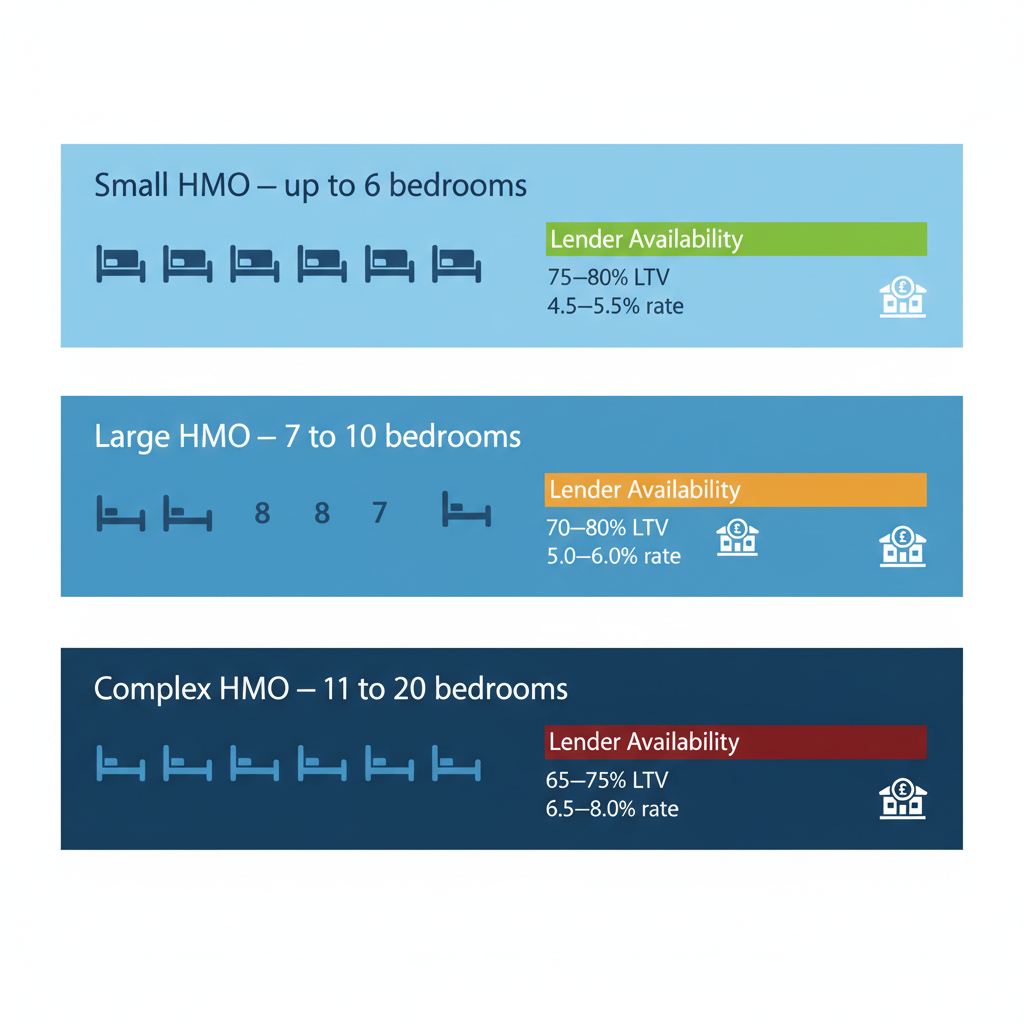
Lenders set a maximum number of rooms or tenants they will accept in an HMO, and exceeding this limit is an automatic decline — no exceptions, regardless of how strong the rest of the application looks. Understanding the HMO maximum number of bedrooms for mortgage purposes means understanding three distinct tiers: the mainstream HMO tier (up to 6 bedrooms), the specialist large-HMO tier (7–10 bedrooms), and the complex/commercial tier (11–20+ bedrooms).
The Decision Framework: Three Tiers, Three Different Markets
Up to 6 rooms is where the widest pool of lenders operates. Most specialist lenders — and the handful of mainstream lenders that touch HMOs at all — will consider properties up to 6 rooms. This aligns with the C4 planning use class.
Seven to 8 rooms represents a meaningful step up in complexity. Fewer lenders operate here, and those that do often require the borrower to have prior HMO management experience. Some also require the property to have sui generis planning permission.
Nine to 12 rooms is firmly specialist territory — perhaps 8 to 10 lenders will consider properties of this size, often with stricter LTV caps and higher rates. Above 12 rooms, very few residential HMO mortgage lenders will operate, and properties of this size may need to be financed through commercial HMO mortgages or specialist institutional lending.
When 6 Bedrooms or Fewer Makes Sense
Small HMOs of up to 6 bedrooms — using C4 planning — attract the widest lender choice, standard valuations in most cases, and 5-year fixed rates typically between 4.5% and 5.5%. This is the tier where lender competition is strongest and where you have genuine rate options.
Lenders active at this level include Aldermore, Fleet Mortgages, Landbay, Foundation Home Loans and Leeds Building Society. Aldermore accepts HMOs up to 6 lettable rooms, offering up to £2 million at 65% LTV and £1.5 million at 75% LTV for HMOs. Fleet Mortgages also caps at 6 rooms, with a maximum LTV of 75% and a minimum loan of £75,000, requiring 12 months of BTL experience. Leeds Building Society caps at 5 bedrooms for its HMO product.
Fleet's 75% LTV HMO and multi-unit block five-year fix is currently priced at 5.39% with a £3,999 fee and £1,000 cashback — a useful benchmark for the 6-bed tier.
ICR testing at this level typically runs at 145% at a 5.5% stress rate for personal-name HMOs, and 125% at 5.5% for limited company HMOs. On a 6-bed property producing £4,200 per month in rent, a limited company borrower at 125% ICR and a 5.5% stress rate can support a maximum loan of approximately £436,000 (£4,200 × 12 ÷ 0.055 ÷ 1.25).
When 7–20 Bedrooms Makes Sense
Kent Reliance and Paragon are the lenders with no maximum bedroom count, both lending up to 80% loan-to-value through limited companies, and both comfortable with manual underwriting where the case needs a human decision rather than a scorecard.
Kent Reliance lends on HMOs up to 20 bedrooms. Properties with 1–6 bedrooms attract up to 80% LTV to £3 million. Properties with 7–10 bedrooms are capped at 80% LTV to £1.5 million and are valued on a commercial basis. For properties over 8 bedrooms, the applicant must already own a HMO property. Kent Reliance requires a minimum ICR of 145% for limited company applications and 175% for personal ownership applications.
Paragon accepts HMOs up to 20 rooms, with a maximum LTV of 75%, a minimum loan of £75,000, and a minimum property value of £100,000 for up to 10 rooms, rising to £150,000 for up to 20 rooms. Paragon requires a minimum of 24 months' landlord experience and an ICR of between 130% and 145%.
Large HMOs of 7 or more bedrooms — classed as sui generis — attract 5-year fixed rates typically between 5.0% and 6.0%, with a maximum LTV of 75% and commercial valuations likely. For HMOs of 7+ bedrooms on Aldermore's commercial mortgage range, rates run from 6.54% for standard products to 7.94% for HMOs on interest-only terms.
Properties with 7 or more bedrooms, or those classified as sui generis, are typically assessed on a semi-commercial or commercial basis. That valuation methodology can work in your favour on an income-rich HMO, since the valuer applies a yield-based approach rather than bricks-and-mortar value — meaning the mortgage can be sized against a higher figure.
The Calculation That Decides It
Before you choose a tier, run the ICR maths on your property. The formula is straightforward: maximum loan = annual rent ÷ stress rate ÷ ICR.
Take a 4-room HMO with rooms at £550 per month each — £26,400 per year. At a 130% ICR and 5.5% stress rate, the maximum loan is approximately £369,200. Tighten the ICR to 145% and the same rent supports only around £331,000.
Scale that to a 10-bedroom property at the same per-room rent: annual income of £66,000. At 125% ICR and 5.5% stress (limited company): maximum loan ≈ £960,000. At 145% ICR (personal name): maximum loan ≈ £828,000. The income advantage of more bedrooms is real — but the ICR threshold often rises with bedroom count, partially offsetting the gain.
Three-bedroom HMOs average 7.1% yields, four-bed HMOs reach 8.5%, and five-to-six-bed HMOs lead with 8.7% average yields across England. Yields at 8%–9% produce strong ICR headroom at the 6-bed level. Push beyond 6 bedrooms and you access even higher income, but LTV ceilings tighten to 70%–75%, rates rise by 50–150 basis points, and arrangement fees on complex cases often reach 2%–3% of the loan.
Bedroom count is the first filter: many lenders cap at 6, some go higher, and large HMOs of 7 or more — or those classed as sui generis — are often handled on different terms or by a smaller set of lenders. That narrowing of lender choice is not just about rate — it is about speed, flexibility, and whether manual underwriting is available when the case has any complexity to it.
The HMO maximum number of bedrooms for mortgage purposes is not a fixed industry number. It is a per-lender criterion that resets every time a lender updates its product guide. Check the current guide, not last year's version.