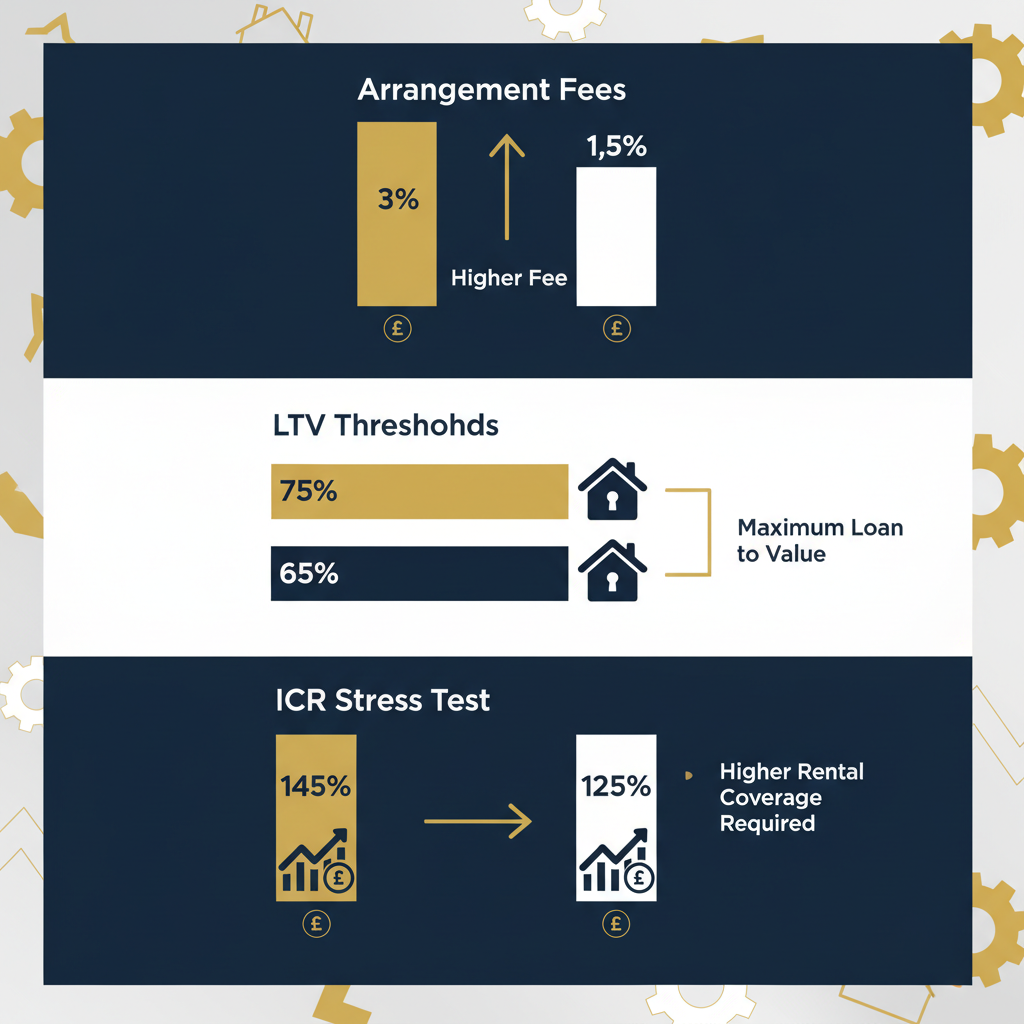
A 3% arrangement fee. That single figure, sitting at the top of Birmingham Midshires' limited company buy-to-let product range, tells you almost everything you need to know about how this lender prices its SPV mortgage offering. Before you assess the headline rate, you need to stress-test what that fee does to your true cost of borrowing — particularly on loans above £300,000 where it becomes a significant upfront liability.
Birmingham Midshires, now operating as a direct-to-intermediary brand under Lloyds Banking Group, does not accept applications via the high street. Every limited company BTL application goes through a registered mortgage broker. The lender has maintained this intermediary-only model since it was repositioned within the Lloyds group structure, and it remains one of the larger institutional players in the SPV mortgage space. That scale matters — it influences both credit appetite and product longevity.
What the Numbers Show
As of the current rate sheet, Birmingham Midshires limited company mortgages are available from approximately 4.79% on a 2-year fixed product, subject to loan-to-value and rental coverage requirements. The 5-year fixed equivalent sits closer to 5.09% at 65% LTV. The maximum LTV for limited company applications is 75%, meaning you need a minimum 25% deposit or equity position to access any product in the range. At 75% LTV, rates step up noticeably — expect to pay around 5.39% on a 2-year fix.
The rental stress test is where Birmingham Midshires gets more conservative than several competitors. For basic-rate taxpayers borrowing through a limited company, the lender applies an ICR of 125% at a stressed rate of 5.5%. For higher-rate taxpayer directors — which covers most portfolio landlords using an SPV — the ICR rises to 145% at that same 5.5% stress rate. On a property generating £1,500 per month in rent, that 145% test limits your maximum borrowing to roughly £200,000 at current stress rates, depending on term and LTV.
The minimum loan size is £25,001 and the maximum sits at £1 million per property. Portfolio landlords — defined by the Prudential Regulation Authority as those with 4 or more mortgaged properties — face additional underwriting scrutiny. Birmingham Midshires will request a business plan, asset and liability statement, and full portfolio details for any application that crosses the 4-property threshold. This is not unusual; it is PRA-compliant practice. But the documentation requirement is more granular here than at some challenger lenders.
On product fees: the 3% arrangement fee is charged on the loan amount, not the property value. On a £250,000 mortgage that is £7,500 added to your cost before you have paid a single month of interest. You can add the fee to the loan, but doing so increases your LTV and your monthly payment. On a 75% LTV deal, adding a £7,500 fee to a £250,000 loan pushes the total advance to £257,500 — which may breach the 75% cap depending on the property's valuation.
There is no higher-fee, lower-rate alternative offered as a product pair. That 3% is the fee, regardless of which fixed term you select. Some lenders offer a 1% fee option alongside a higher rate, giving borrowers a meaningful choice. Birmingham Midshires does not currently structure it that way for limited company products.
What This Means for Landlords
For a landlord with a single SPV holding 2 properties and a sub-£200,000 average loan size, Birmingham Midshires can still make sense — provided the rental income is comfortably above the ICR threshold. The rate at 65% LTV is competitive against many specialist lenders, and the institutional backing of Lloyds provides a level of product stability that smaller challenger lenders cannot always match.
Where it becomes harder to justify is on larger loans. A £600,000 mortgage through Birmingham Midshires carries an arrangement fee of £18,000. At that level, a lender charging 1.5% or a flat £2,995 fee — even at a rate 0.2% higher — will often produce a lower 5-year total cost of borrowing. Run the numbers over a 5-year fixed term before assuming the headline rate is the deciding factor.
The lender's appetite for Houses in Multiple Occupation (HMOs) and Multi-Unit Freehold Blocks (MUFBs) via limited company structures is limited. Birmingham Midshires generally restricts limited company applications to standard single-let residential properties. If your SPV holds or plans to hold an HMO, you will need to look elsewhere — lenders such as Paragon, Fleet Mortgages or Keystone Property Finance have built specific products around this asset class.
Birmingham Midshires limited company mortgages also require the SPV to have been incorporated with a relevant SIC code — 68100 or 68209 are the most commonly accepted codes. A company incorporated for a different trading purpose and later redirected into property will face additional scrutiny or an outright decline. Get the company structure right before submitting.
The maximum age at application for directors is 80 years at the end of the mortgage term. The minimum is 18. Interest-only is available up to 75% LTV, and it remains the most common repayment vehicle for SPV borrowers — the tax efficiency of limited company ownership is most pronounced when cash flow is preserved and profits are managed through salary and dividend structuring.
Valuation fees are charged separately and are not included in the arrangement fee. On a property valued at £400,000, expect a lender valuation cost of between £400 and £600. Some broker packaging fees apply on top of this, depending on the intermediary used.
For portfolio landlords stress-testing multiple refinances in the same tax year, note that Birmingham Midshires counts existing BM mortgages within its own background portfolio assessment. If you already have 3 BM mortgages and are applying for a 4th, the lender will scrutinise all 4 assets simultaneously, not just the new application. That is a meaningful underwriting position — and one that occasionally creates concentration risk issues for landlords who have defaulted to the same lender across their portfolio.
The overall picture is of a lender offering genuine institutional depth with a fee structure that rewards lower LTV, lower loan size, and clean SPV incorporation. The 3% fee is the number to model first — not last.