Choose the wrong ownership structure for an HMO and the cost is immediate and measurable. Section 24 raises a higher-rate landlord's tax bill by £1,800 a year on just £20,000 of rent with £9,000 of mortgage interest — and that is before you account for the tighter stress test applied to personal-name borrowers. Get the structure right from the start and you are simultaneously solving a tax problem and a borrowing capacity problem at the same time.
What an HMO mortgage limited company structure actually does
An HMO (House in Multiple Occupation) is, broadly, any property let room by room to three or more unrelated tenants sharing facilities. As a broad guideline, if you are going to let a property room by room, or it has four or more bedrooms, it is typically an HMO. Buying or holding that property inside a limited company rather than in your personal name changes two things at once: how the mortgage is stress-tested and how much tax you pay on the profit.
On the tax side, the position is clear. Limited companies are exempt from Section 24 and can still deduct mortgage interest as a business expense before paying Corporation Tax. A company deducts mortgage interest in full against rental profit before paying corporation tax at 19% to 25%. Individual landlords cannot — they must pay tax on their full rental income and can only claim back a 20% basic rate tax credit on mortgage interest, regardless of whether they are a basic, higher, or additional rate taxpayer.
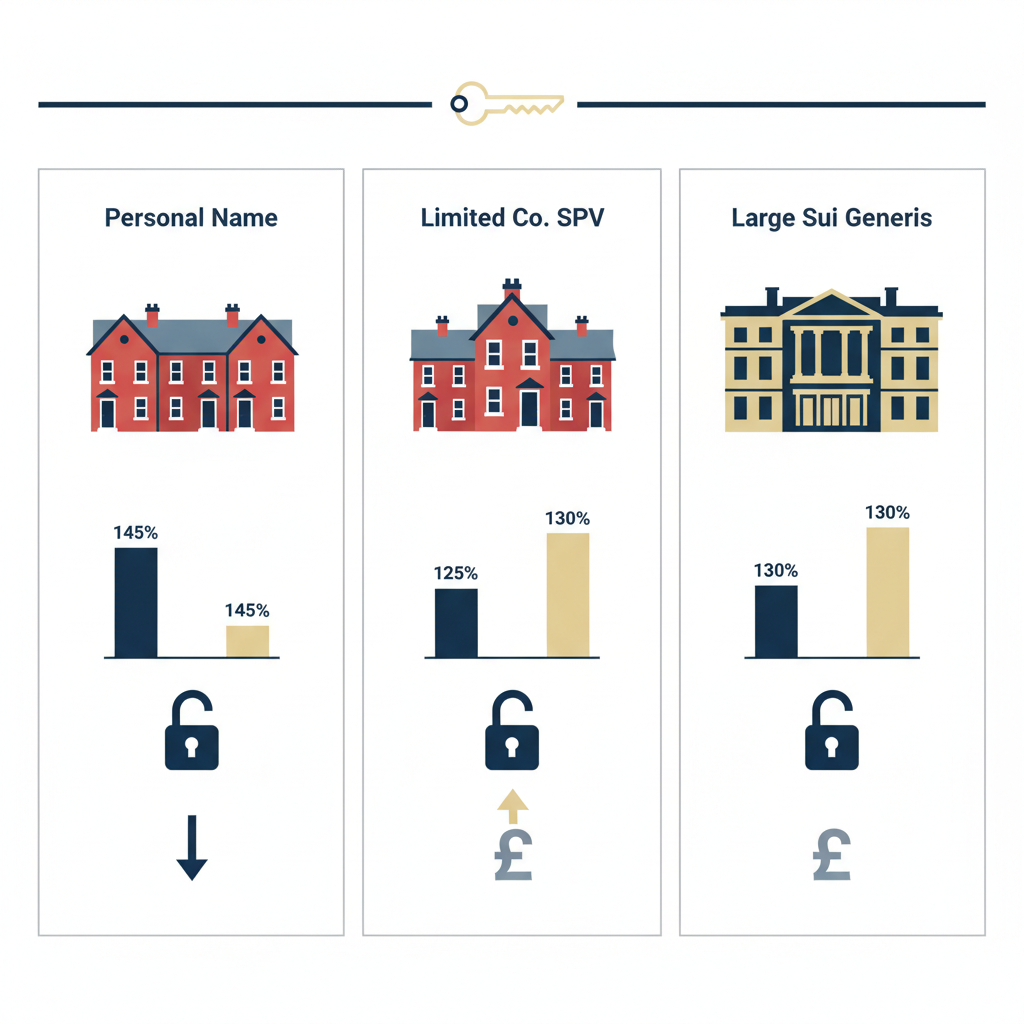
On the mortgage side, the advantage is equally concrete. Typical ICR thresholds are 145% at 5.5% stress on a personal name HMO, and 125% at 5.5% stress on a limited company HMO. That 20-percentage-point difference directly increases how much you can borrow against the same rental income. Company products typically price 0.2% to 0.5% above personal-name equivalents, but are ICR-tested at 125% rather than 145%, so the company can usually borrow more against the same rent.
The limited company must be structured correctly. Lenders require the company to be a Special Purpose Vehicle (SPV) — explicitly for the buying, renting and selling of property — often described by a Standard Industrial Classification (SIC) code, which is the second thing lenders check. A limited company must hold one of the standard SIC codes: 68320 (other letting and operating of own or leased real estate), 68209 (management of real estate on a fee or contract basis), or 68100 (buying and selling of own real estate). Newly incorporated SPVs are accepted by specialist lenders. Day-one companies with no trading history are routinely funded.
How It Works in Practice
The HMO mortgage limited company market is almost entirely served by specialist lenders. Paragon, Kent Reliance, Precise, Shawbrook, Aldermore, Fleet, CHL, Landbay, Foundation Home Loans and Hampshire Trust Bank lead the 2026 HMO market.
Small HMOs up to 6 beds (C4 planning) carry typical five-year fixed rates of 4.5% to 5.5%, up to 80% LTV, with the widest lender choice and standard valuations in most cases. Large HMOs of 7 beds or more (sui generis) run 5.0% to 6.0%, up to 75% LTV, with specialist lenders only and commercial valuations likely. HMOs held in a limited company price at 4.5% to 5.75% on a five-year fix, with maximum LTV up to 80% at specialist lenders.
At Yorkshire Building Society, small HMOs up to 6 bedrooms are available up to 75% LTV, and large HMOs from 7 to 20 bedrooms up to 70% LTV. For limited company borrowers, YBS applies a net rental ICR of 130% at pay rate.
At Paragon, which publishes one of the most transparent product guides in the specialist market, the ICR for a limited company on single self-contained units is 125%, rising to 130% for HMOs, multi-units and similar property types. SSC products carry no application fee, while HMO and MUB loans have a £150 application fee. ICRs are calculated at the initial rate plus two percentage points.
The Mortgage Works (TMW) offers a dedicated limited company HMO range. Products include a two-year fixed rate at 5.34% up to 75% LTV with a £1,495 fee, and a five-year fixed rate at 5.39% up to 75% LTV with the same £1,495 fee — both available for purchase, remortgage and further advance.
Arrangement fees on HMO products run from 2% to 5% on the sharpest headline rates; the true cost comparison is rate plus fee modelled over the fixed period. A 3% fee on a £300,000 loan is £9,000 upfront — enough to swing the effective rate by more than 0.5% on a two-year fix. Always model the effective rate, not just the headline.
Personal guarantees are non-negotiable. Because almost all HMO limited company lenders require a full personal guarantee from the directors, your personal credit profile sits front and centre of the underwriting. Aldermore defines an experienced landlord as one who has let a property for a minimum of 12 months for HMOs, and requires at least one applicant to have met that 12-month threshold.
Common Mistakes
Buying in personal name and incorporating later. Transferring a property already held personally into a limited company triggers Stamp Duty Land Tax on the market value and potentially Capital Gains Tax on the gain. The cost can easily exceed £15,000 on a £300,000 HMO. Structuring through the SPV from day one costs nothing extra and keeps both problems permanently off the table.
Using the wrong SIC code. No SIC codes other than the approved property letting codes are accepted, and the SPV must be non-trading. A company with a mixed SIC code — say, a consultancy that also holds property — will be declined by most specialist lenders and will need to incorporate a separate SPV before any application can proceed.
Ignoring the 25-deposit threshold on HMO cases. For HMO SPV cases, the deposit typically rises to 30% (70% LTV). Some landlords budget for 25% based on standard BTL experience and are caught short at the point of purchase. Check the specific LTV cap for your lender and property type before committing to a purchase price.
Choosing a two-year fix to save on rate. Two-year pricing is currently higher than five-year, reflecting the present shape of the swap rate curve. The effective rate range for a small HMO two-year fixed (limited company) runs from 5.86% to 6.84%, versus 5.59% to 6.51% on a five-year fix. The short fix costs more right now and resets sooner.
Failing to evidence the licence before application. Lenders want landlord experience, the licence, fire compliance and a full room schedule. Applications without proof of mandatory licensing, or where the local authority application has not yet been made, will not proceed to offer at most lenders. Get licensing paperwork in order before the mortgage application, not after.