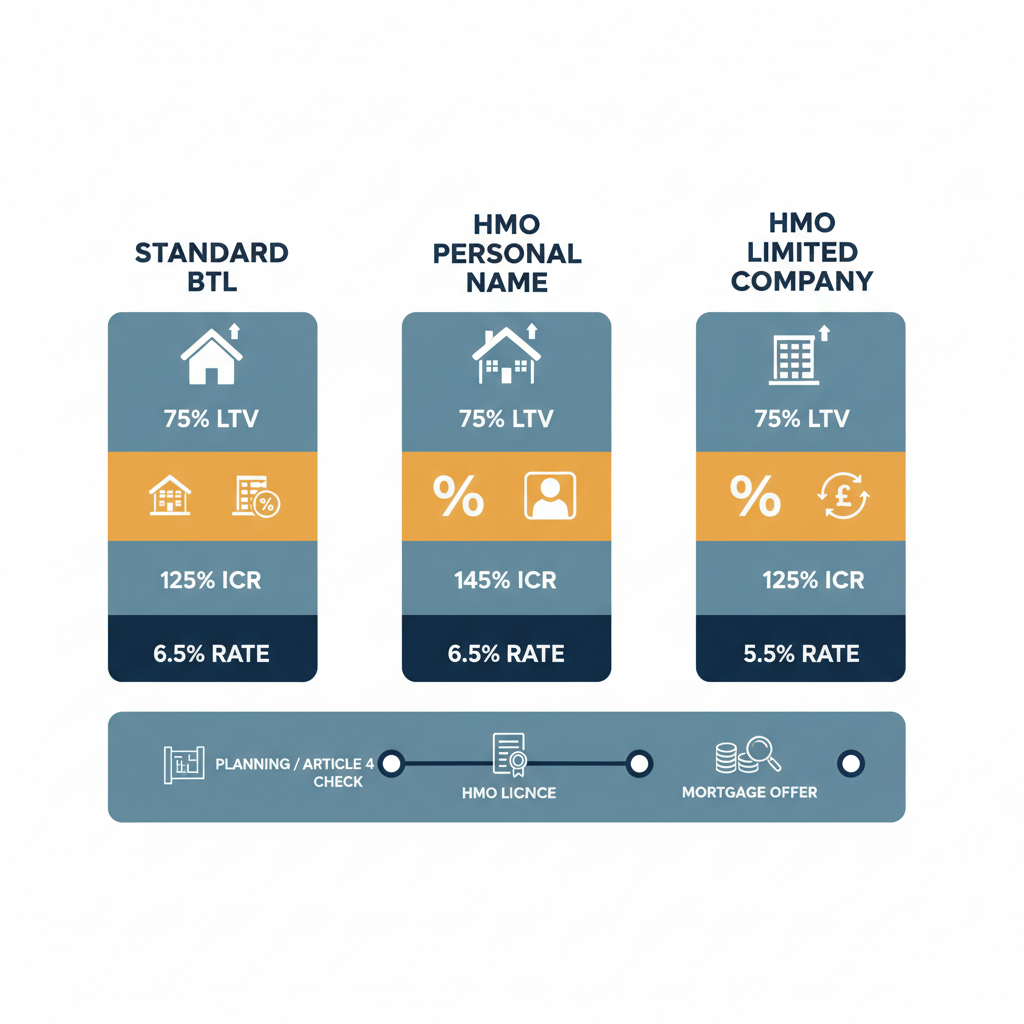
Paragon Bank's HMO and multi-unit block rates currently start from 5.10% — that is the opening figure on their August 2026 product guide, and it is the rate against which every other decision in this process needs to be measured. If you are sitting on a standard buy-to-let mortgage and your property already has three or more unrelated tenants sharing facilities, you are almost certainly in breach of your existing mortgage terms. Getting this remortgage right matters more than chasing the best headline rate.
What the Numbers Show
A standard buy-to-let mortgage almost never permits HMO use. Letting to three or more unrelated tenants without your lender's consent is a breach of your mortgage terms and can trigger recall of the loan. That is not a theoretical risk — it is the first number that should focus your attention before rates, fees or ICRs enter the conversation.
Paragon's five-year fixed ICR calculation rate for HMOs and multi-unit blocks is whichever is greater: the product charging rate or 5.00%. For single self-contained properties, the equivalent figure is 4.50%. That 50 basis-point uplift on the stress rate matters enormously to how much you can borrow. Paragon's maximum loan at 65% LTV extends to £2 million for three or fewer properties, or up to £4 million for portfolios of four or more, limited companies or HMOs. At 75% LTV, the cap is £1.2 million across all applicant types.
When you remortgage buy to let to HMO, the income calculation shifts from a single assured shorthold tenancy to a room-by-room assessment. HMO lenders assess income on a room-by-room basis rather than as a single tenancy figure. That is the structural advantage of HMO financing: four rooms at £550 per month produces £26,400 annually, which supports a meaningfully larger loan than a single-tenant AST on the same property. The surveyor's view of achievable room rents — not what you are currently charging — sets the ceiling.
Typical ICR thresholds for HMO lending are 145% at 5.5% for personal-name HMOs and 125% at 5.5% for limited company HMOs. The difference between those two figures can shift the maximum loan by tens of thousands of pounds on a mid-sized property. A higher-rate taxpayer borrowing in personal name faces the tougher test: 145% at a 5.5% stress rate. Run the ICR arithmetic before you select an ownership structure — not after.
To verify the arithmetic: on a £400,000 HMO loan, the minimum monthly rent at 145% ICR and a 5.5% stress rate = (£400,000 × 5.5% × 145%) ÷ 12 = £2,679 per month. At 125% ICR (limited company), the same loan requires £2,292 per month. That is a £387-per-month difference in the rent hurdle on a single property. Across a portfolio, it accumulates quickly.
Paragon's application fee for HMO and MUB products is around £299, though this may be waived for multi-property applications. Product fees run from 0% to 5%, and can be added to the loan or paid upfront. Many products include a free valuation. On Paragon's two-year fixed products, ERCs of 3% apply in year one and 3% in year two. Check your current deal's ERC schedule before triggering a remortgage — paying a 3% exit charge on a £350,000 balance costs £10,500.
What This Means for Landlords
The decision to remortgage buy to let to HMO is not just a financing event. It has a planning and licensing dimension that catches landlords who move too fast. Converting a single home (use class C3) to a small HMO of three to six people (use class C4) is permitted development across most of England, so no planning application is needed — unless the council has removed that right with an Article 4 direction, in which case a full application is required. A large HMO of seven or more people is always sui generis and always needs planning permission.
In England, mandatory HMO licensing applies to HMOs occupied by five or more people. Over 70 councils also run additional licensing schemes, which pull smaller HMOs into the licensed category. For a remortgage, Metro Bank requires the HMO licence to have been dated within the last five years; for a purchase or let-to-buy, confirmation that a licence application has been made is sufficient. Most lenders take a similar position: a valid licence is a condition of the mortgage offer, not an afterthought.
Indicative HMO mortgage rates in 2026 run from around 4.79% on a five- to six-bed personal-name HMO at 75% LTV, with limited company products typically 0.2% to 0.5% higher and sui generis large HMOs (seven or more beds) from around 5.5%. The jump from a standard HMO to sui generis triggers a meaningful rate step and a tighter LTV ceiling: for a sui generis large HMO of seven or more beds, the maximum LTV is 65%–70% and rates start from around 5.5%, with an ICR test of 125%–130% depending on the lender.
A lender using a 5.5% stress rate versus one using 7% on the same property can produce a borrowing difference of £40,000 to £60,000. That spread explains why lender selection for an HMO remortgage is not interchangeable with lender selection for a standard BTL remortgage. Many high-street lenders will not lend on HMOs at all. A specialist broker typically has access to 30–50 lenders that consider HMO properties.
Before applying, you will typically need: proof of the current HMO licence (or confirmation that one is not required); an up-to-date tenancy schedule showing the rent per room; assured shorthold tenancy agreements for each room; gas safety and electrical (EICR) certificates; and proof of landlord experience — often a minimum of one property owned for at least six to twelve months.
UK HMOs consistently deliver gross yields of 8–12% in strong Northern cities, well above the 5–7% from standard buy-to-let apartments. That yield differential is the strategic case for the switch. The financing discipline — correct ICR, verified licence, right lender for the room count — is what determines whether the numbers actually work once you have signed the offer.